Shark Tank India's Real Prize: Marketing Power Over Funding
When startups enter Shark Tank India, the investment cheque often becomes the smallest part of their reward. Founders consistently report that national television exposure delivers their greatest advantage. This visibility compresses years of brand-building into a single broadcast episode. The show's fifth season on SonyLIV now positions itself more as a marketing accelerator than a pure capital-raising platform.
Immediate Impact on Consumer Brands
Several startup founders describe how Shark Tank India dramatically reduces customer acquisition friction. The show shortens distribution timelines significantly. Smylo, a direct-to-consumer cat food startup, provides a clear example. After raising ₹75 lakh on the latest season, the brand experienced immediate effects.
Kartikeya Gupta, Smylo's co-founder, reported a five- to six-fold jump in organic followers following their episode. Customer acquisition costs declined as national television exposure built instant trust with first-time buyers. Gupta noted that achieving current sales volumes now requires nearly 30% less spending on Meta platforms compared to pre-telecast levels.

The impact proved most visible in improved discovery and demand from Tier II and III markets. While the visibility boost reduced marketing intensity short-term, Gupta emphasized that sustaining growth requires continued optimization of category and product mix. Relying solely on television exposure's one-time spike cannot guarantee long-term success.
Transforming Brand Trajectories
Multiple Shark Tank India pitches have translated into outsized outcomes, particularly within consumer brands. Let's Try snack brand demonstrates remarkable returns. Aman Gupta's ₹12 lakh investment reportedly values at about ₹40 crore today, representing one of the show's highest-return investments.
In FMCG, Skippi Ice Pops emerged as an early breakout success. Monthly sales grew to ₹2-2.8 crore after their television appearance. Nasher Miles crossed ₹80 crore in revenue following a multi-shark deal. Ravelcare achieved a rarer public-market outcome, listing and delivering roughly 55% IPO gains for early investors.
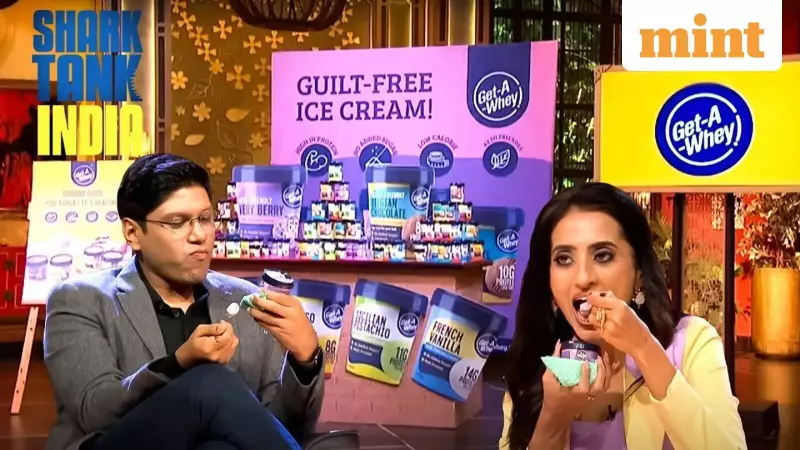
Get-A-Whey, now known as Get-A-Way Ice Cream, offers a larger-scale example. This Mumbai-based healthy ice cream brand won Shark Tank India's first season in December 2021. Revenue scaled from ₹7.9 crore in FY23 to ₹14.8 crore in FY24 according to Tracxn data.
Pashmi Shah Agarwal, Get-A-Way's co-founder and chief marketing officer, described their pre-show operation. "We were running it completely by ourselves, and it was a bootstrapped brand," she said. Marketing spends represented about "1% of overall revenue, which is very, very minuscule for a startup."
Post-episode airing triggered dramatic changes. "Within five minutes of the episode airing, we had a line of almost 40 riders from Zomato and Swiggy who had come to collect orders," Shah recalled. Website traffic jumped nearly tenfold, though limited geographic presence initially challenged demand fulfillment.
The visibility also triggered investor and franchise interest. Shah reported receiving franchise queries "upwards of ₹1 crore." The exposure helped save planned advertising expenditures. "We saved on a lot of ATL and BTL that we had planned for the summer because people were already aware of what Get-A-Way is," she explained.
Distribution Access as Key Advantage
Experts identify distribution access as the show's most durable advantage rather than sustained consumer demand. Himanshu Trivedi, associate vice president at Avalon Consulting, explained this dynamic. "The biggest tangible benefit is on distribution," he said. "Modern trade and quick-commerce platforms are far more willing to onboard Shark Tank brands because the show does discovery upfront, shortening onboarding cycles by months."

Zoff Foods experienced this effect directly. This condiments and spices brand appeared on the show's second season in January 2023. Akash Agrawalla, Zoff Foods CEO, described their experience. "It is very difficult to list on quick commerce as they charge a lot for listing products, but since we already had visibility, they approached us," he said. The brand also broke into larger grocery chains like DMart and Reliance.
The company estimates that their 15-minute appearance saved ₹10-15 crore in marketing spends. Zoff Foods secured investment from boAt co-founder Aman Gupta, closing a ₹1 crore deal for 1.25% equity at about ₹80 crore valuation. They later raised around ₹40 crore from JM Financial Private Equity to expand product portfolio and strengthen distribution.
Beyond Initial Visibility Spikes
Snitch menswear brand demonstrates sustained growth potential. After appearing on Shark Tank India season 2 in January 2023, the company scaled to over ₹500 crore revenue by FY25 from about ₹11 crore in FY21. They built more than ₹30 crore in Ebitda and raised roughly ₹300 crore in Series B funding at around ₹2,500 crore valuation according to Tracxn.
Avalon Consulting noted that Snitch invested early in offline expansion, faster supply chains and operational depth rather than relying on discount-led or ad-heavy growth. Beyond Snacks similarly used Shark Tank visibility to accelerate offline expansion according to Trivedi.
This Kerala-based banana chips brand appeared on Shark Tank India season 1, where founder Manas Madhu pitched ₹50 lakh for 2.5% equity. He secured a deal with Ashneer Grover and Aman Gupta at about ₹20 crore valuation. Rather than remaining D2C-focused, the brand pushed aggressively into modern and general trade, building repeat purchases and stabilizing revenues beyond the initial TV-driven spike.
Revenue rose from ₹0.6 crore in FY21 to ₹3.5 crore in FY22, before jumping to ₹17.7 crore in FY23. Growth continued in subsequent years, reaching ₹34.1 crore in FY24 and ₹52.9 crore in FY25 according to Tracxn.
Structural Challenges and Risks
The early surge can mask deeper structural challenges. Trivedi highlighted this concern. "Many Shark Tank brands outperform peers on early top-line growth but underperform on profitability and long-term scale," he observed.
TagZ Foods, which appeared in season 1, scaled to ₹15-20 crore revenue range before facing margin pressure. Reliance Industries Ltd later acquired them at a modest ₹28 crore valuation. Wakao Foods remains operational but has largely stagnated after TV-driven demand faded.
"This is especially visible in ₹30-50 crore revenue brands, where fundamentals like margins, operational efficiency and governance start dominating outcomes," Trivedi explained.
Evolving Show Dynamics
The show's reach now benefits brands beyond those competing for investment. Punjabi beverage company Lahori Zeera paid to sponsor the fifth season, using Shark Tank as a national branding platform. Co-founder Nikhil Doda described their decision. "It's a big cheque, we've never written that big a cheque in our entire life," he said without disclosing figures due to confidentiality agreements.
"The overall intent was just branding. We don't expect it to culminate into sales," Doda added. The association helps fuel aspiration for the brand and positions it alongside much larger national players. Shark Tank sponsorship accounts for roughly 20% of the company's annual marketing budget, despite historically spending less than 2% of revenue on advertising.
The queue of brands seeking association has made Shark Tank India one of Sony Pictures Networks India's standout recent properties. The show skews toward 18-plus audiences with urban and male-dominated viewership, mirroring where startup culture and capital access concentrate according to industry executives.
This audience profile shapes advertiser mix, drawing more new-age, digital-first brands than traditional mass-market advertisers. While Shark Tank India doesn't match Kaun Banega Crorepati's television reach, it commands significant online viewership across SonyLIV and YouTube. Clips routinely garner up to 13 million views on YouTube where the channel has over 4 million subscribers.
Over time, the show has evolved into a powerful marketing engine. Sharks have become mainstream public figures while founders leverage the "As seen on Shark Tank" tag as a branding signal well beyond episode airtime. Bimal Unnikrishnan, who previously worked on Sony's flagship KBC, serves as showrunner for Shark Tank India.
"For SonyLiv, both shows are aspirational and celebrate knowledge, but similarities largely end there," explained a person with direct knowledge. Shark Tank India was never designed to match KBC's scale or viewership, with sharply different economics. Production costs remain significantly lower partly because Sharks aren't paid for participation, aligning with the global format.