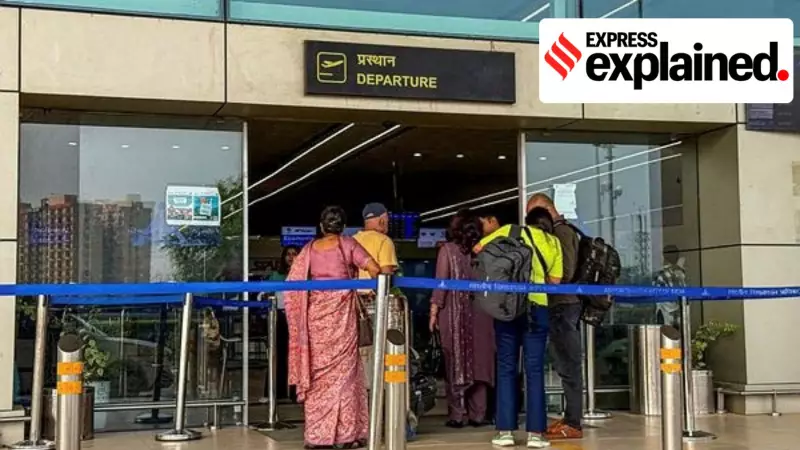
A recent judicial order has ignited major concerns over a potential sharp rise in user charges and airfares at India's two busiest airports in Delhi and Mumbai. The dispute, which involves billions of rupees in pending airport charges, is now headed to the Supreme Court for a crucial hearing.
The Core of the Rs 50,000 Crore Dispute
At the heart of the matter is an order passed by the Telecom Disputes Settlement and Appellate Tribunal (TDSAT) on July 1, 2025. The tribunal set aside the method used by the Airports Economic Regulatory Authority of India (AERA) to determine tariffs for the Delhi and Mumbai airports for their first control period from April 1, 2009, to March 31, 2014.
Industry insiders warn that if the formula approved by TDSAT is implemented, the airport operators—Delhi International Airport Ltd (DIAL) and Mumbai International Airport Ltd (MIAL)—could be owed a staggering sum of over Rs 50,000 crore in past airport charges. This colossal amount would ultimately need to be recovered from passengers, potentially causing user charges at these hubs to skyrocket, with some estimates suggesting an increase of over 20 times in certain cases.

Following the TDSAT order, both AERA and several airlines approached the Supreme Court, challenging the tribunal's decision and seeking a stay on its implementation. The apex court is scheduled to hear the matter. Sources indicate the Ministry of Civil Aviation (MoCA) is likely to support AERA's appeal, fearing the severe impact of exorbitant airfares at these critical national hubs.
Regulatory Asset Base: The Technical Tussle
The legal battle revolves around a highly technical aspect of airport economics: the calculation of the Hypothetical Regulatory Asset Base (HRAB). This is a notional value representing the worth of airport assets at the beginning of a regulatory control period, used to determine future tariffs.
When AERA began its tariff-setting role in 2009, it had to compute the HRAB for 2008-09, the year just before its oversight began. A key point of contention was whether this calculation should include only aeronautical revenue (from landing fees, passenger service charges) or also incorporate non-aeronautical revenue (from retail, parking, advertising)—a method known as the single-till mechanism.
The airport operators, DIAL and MIAL, had argued back in 2011-12 that AERA should use the single-till approach and calculate the HRAB by back-solving the target revenue formula mentioned in the State Support Agreement (SSA) signed during privatization in 2006. AERA did not fully agree with this methodology, leading to a tariff order that was challenged by the operators before TDSAT in 2013. Their appeals were initially dismissed, and they also did not get relief from the Supreme Court at the time.
MoCA's 2011 Letter Becomes Decisive
The turning point came when the Supreme Court, in December 2023, remanded the matter back to TDSAT for a fresh look. The court asked the tribunal to interpret a specific part of the SSA and evaluate the role of the Ministry of Civil Aviation in the tariff determination for the initial five-year period.
In its July 2025 order, TDSAT ruled in favor of the airport operators. A crucial piece of evidence was a letter dated May 24, 2011, sent from MoCA to AERA. The tribunal interpreted this letter as a direction to the regulator, guiding it to compute the HRAB by back-solving the target revenue formula. TDSAT stated that AERA disregarded this directive.
The tribunal also ruled that AERA should have employed the single-till methodology for HRAB computation, noting that the Airports Authority of India (AAI) and MoCA had used this method in 2008-09 when they controlled the airports. The SSA's reference to "prevailing tariff and revenues" should have been interpreted as the single-till regime in force at that time, the order stated.
Implications and the Road Ahead
While the TDSAT order specifically addresses the 2009-2014 period, its implications are far-reaching. It is expected to have a cascading effect on tariff determinations for subsequent control periods, potentially locking in a new calculation methodology for the future.

This creates a paradoxical situation. The very ministry whose 2011 letter formed the basis for the operators' victory at TDSAT is now poised to argue against the order in the Supreme Court. MoCA's primary concern is the massive financial burden on passengers and the negative impact on air travel affordability and growth if the Rs 50,000 crore liability is passed through.
The Supreme Court's upcoming hearing is therefore critical. Its decision will not only settle a long-running regulatory dispute but also determine the financial trajectory of India's premier aviation gateways and the cost of air travel for millions of passengers for years to come.