

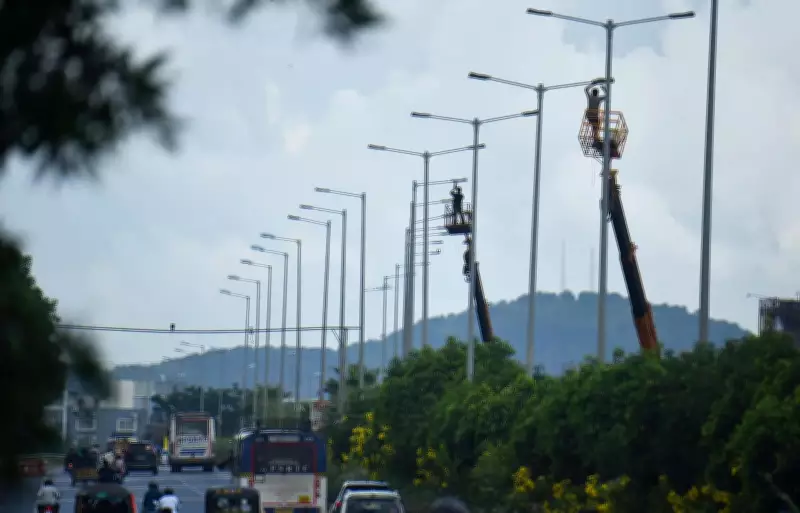
The Andhra Pradesh government, in collaboration with Energy Efficiency Services Limited (EESL), will implement an integrated lighting management system (ILMS)-based smart street lighting project across all urban local bodies in the state. This initiative falls under the Union government’s Street Lighting National Programme.
Project Scope and Phases
The project aims to upgrade approximately 10.5 lakh streetlights across Andhra Pradesh in two phases. Phase one will cover 7.5 lakh lights, while phase two will address the remaining 3 lakh lights. Conventional fixtures will be replaced with advanced LED luminaires offering an efficiency of 150 lumens per watt. The initiative is expected to deliver at least 30 percent energy savings through actual performance-based measurements, reducing both electricity consumption and maintenance costs for urban local bodies (ULBs).
Technology and Management
The project will incorporate a centralized integrated lighting management system with individual pole-level control. This system enables real-time monitoring and instant fault detection, allowing accurate verification of energy savings and efficient management of the entire street-lighting network. By improving illumination and road safety, the smart lighting system will also enhance service reliability and support data-driven governance through comprehensive operational data.

Environmental and Economic Benefits
Ultimately, the project will lead to low carbon emissions and contribute to India’s climate and sustainability goals. The state government has set a target to complete the project within six months from the date of signing the agreement.
Review Meeting and Timelines
To review progress, Principal Secretary (Municipal Administration and Urban Development) S. Suresh Kumar, along with Commissioner and Director of Municipal Administration P. Sampath Kumar, held a virtual meeting with EESL CEO Akhilesh Kumar Dixit and APSEEDCO Managing Director P. Pulla Reddy. Suresh Kumar stressed the need to adhere to the timeline set by Chief Minister N. Chandrababu Naidu to ensure early delivery of benefits to citizens.
Historical Context and Commitment
The principal secretary also released an EESL report on the impact of energy-efficiency initiatives nationwide. He recalled Andhra Pradesh’s pioneering adoption of LED street-lighting technology during the post-Hudhud cyclone reconstruction phase in Visakhapatnam nearly a decade ago. He reiterated the chief minister’s commitment to making the ILMS-based smart street lighting programme a success, positioning Andhra Pradesh as a model for other states.
Energy Savings and Bidding
CDMA P. Sampath Kumar said that MA&UD Minister P. Narayana directed officials to ensure a minimum energy saving of 30 percent based on actual measured performance, rather than a deemed-savings methodology. EESL CEO Akhilesh Kumar Dixit highlighted that the Street Lighting National Programme has helped reduce 6.2 million tonnes of CO₂ emissions, generated 9,031 million kWh of energy savings, and delivered annual economic benefits of Rs 5,400 crore to urban local bodies across several states. He added that the commercial bid opening for the Andhra Pradesh project is scheduled for June 15.
Dixit said EESL would implement the project roadmap in a time-bound manner. He added that this next-generation smart street-lighting programme would further strengthen Andhra Pradesh’s position as a leader in energy efficiency and renewable energy adoption, setting a benchmark for urban local bodies across India.






