

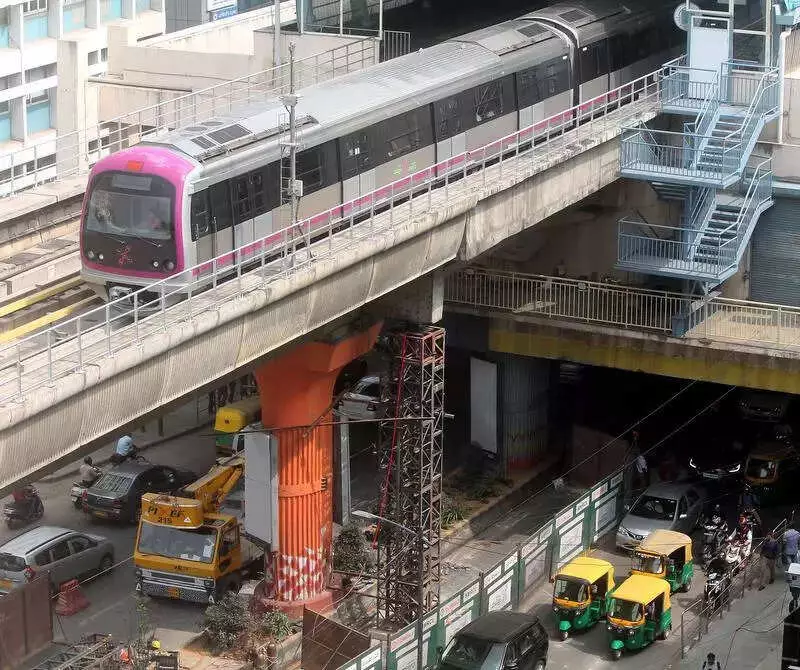
A new working paper from the Economic Advisory Council to the Prime Minister offers fresh insights into Bengaluru's urban transformation. While traffic woes dominate headlines, the study highlights how Metro connectivity is quietly reshaping household economics.
Metro Access Transforms Financial Behavior
The report titled 'Golden Decade of Infrastructure Development in India with Special Reference to Metro Rail Network' examines granular home-loan data. It reveals compelling patterns among residents living near Metro corridors.
Researchers found that private vehicle registrations slowed in neighborhoods with better public transport access. This reduction in car dependency directly eased household transport expenses. Families saved money on fuel, maintenance, insurance, and parking costs.

Improved Loan Repayment Patterns
The study focused specifically on Bengaluru's Namma Metro Purple Line stretching from Whitefield to Challaghatta. Analysis of 94,356 account-month observations showed significant changes in mortgage behavior.
Borrowers in Metro-served areas became nearly 2.5 percentage points less likely to miss scheduled payments. Simultaneously, their probability of prepaying loans increased by 3.5 percentage points compared to borrowers in non-Metro areas.
The prepayment surge tells an important story. The value of prepayments by Metro-connected borrowers jumped by 26% to 27% after the Purple Line Phase-2 expansion. This statistically significant increase suggests improved household liquidity rather than distress-driven repayment.
Understanding the Delinquency Shift
While the reduction in delinquent amounts wasn't statistically strong for Bengaluru, the frequency pattern proved revealing. Fewer households slipped into delinquency at all, even when overdue amounts changed modestly.
Researchers interpret this as evidence that Metro access helps families stay current on EMIs. It prevents payment problems from developing rather than merely helping clean up arrears later.
Bengaluru Outperforms Other Cities
The Bengaluru effects proved stronger than those observed in Hyderabad. There, Metro access reduced delinquency rates by about 1.8 percentage points and increased prepayment rates by a similar margin.
Bengaluru's results compare favorably even with Delhi's mature Metro system. The Purple Line's impact demonstrates how strategic infrastructure can rapidly transform urban financial landscapes.
How Metro Reshapes Urban Mobility
The Purple Line extension has fundamentally altered Bengaluru's urban profile. Connecting Whitefield's IT corridor with the Mysuru Road–Kengeri–Challaghatta belt, it addresses historical travel bottlenecks.
This grade-separated transport system offers reliable alternatives to congested corridors like Outer Ring Road and Old Madras Road. Workers can now access employment opportunities without being constrained by distance or traffic congestion.
The Metro provides a genuinely viable alternative in a city where private vehicles were once considered unavoidable. It steers Bengaluru toward a more sustainable and mobility-efficient urban future while simultaneously strengthening household finances.
The Broader Infrastructure Context
India's Metro network has expanded dramatically from 248 kilometers in 2014 to over 1,025 kilometers by October 2025. Bengaluru contributes 96.1 operational kilometers with another 79.4 kilometers under construction.
This infrastructure growth creates ripple effects beyond transportation. As the Bengaluru study demonstrates, efficient public transport systems can improve financial stability, reduce pollution, and enhance overall quality of life.
The research confirms what urban planners have long suspected: well-designed Metro systems do more than move people. They transform economic behavior, strengthen household budgets, and create more resilient urban communities.






