

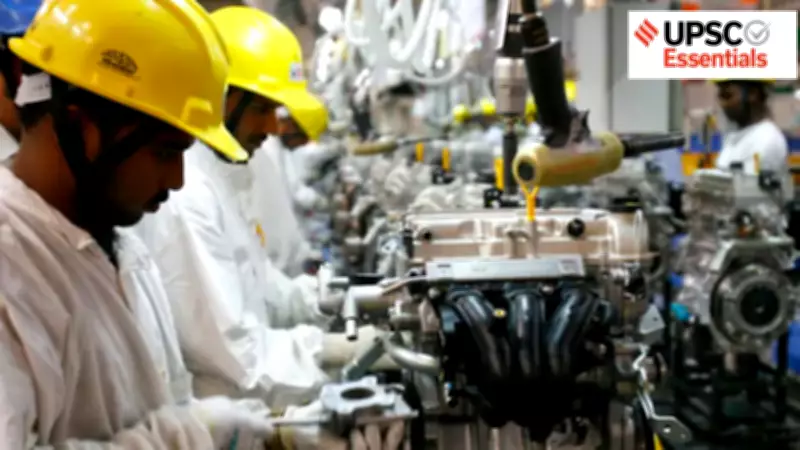
Budget 2026's Manufacturing Strategy: Continuity Over Change
The Union Budget 2026-27 has placed a renewed emphasis on boosting manufacturing in India, with measures such as cuts in basic customs duties to address inverted duty structures and spur domestic production. However, analysts note that the budget largely signals policy continuity rather than a significant shift in manufacturing strategy. As a result, the long-standing gap between industrial growth and employment generation persists, raising questions about the effectiveness of current policy efforts.
The Persistent Gap Between Growth and Employment
It has been more than three decades since the 1991 liberalization, yet manufacturing remains India's unfinished task. Its share in Gross Domestic Product (GDP) has stagnated between 14 to 17 percent for years, failing to reach the 25-30 percent threshold seen in successfully industrialized economies. This stagnation is not a short-term issue but has persisted through different governments, business cycles, and repeated industrial pushes.
Manufacturing was expected to play two major roles: raising productivity and absorbing surplus labor. However, it has achieved neither at scale. While output has grown in phases, employment generation has not kept pace. The organized manufacturing sector employs less than two crore workers, with most manufacturing jobs remaining small, informal, and insecure. This pattern highlights a critical problem: manufacturing has grown, but the economy has not structurally shifted, leaving a gap between growth and employment at the heart of India's industrial challenges.

Employment Structure and Absorption Limits
In 2023-24, organized manufacturing employed about 1.96 crore workers, adding around 57 lakh jobs over the past decade—a steady but modest increase. In contrast, unorganized manufacturing employs a larger workforce of 3.48 crore workers, bringing total manufacturing employment to approximately 5.44 crore. The issue lies in the structure: only about one-third of manufacturing workers are in organized factories, with the rest in low-productivity, informal units.
This explains why manufacturing growth has not translated into broad-based employment. Even in organized manufacturing, output has grown faster than employment, as firms expand production through capital deepening and automation rather than large-scale hiring. Consequently, manufacturing has fallen short of absorbing surplus labor from agriculture and informal services, limiting its role in driving inclusive growth.
Why Manufacturing Has Lagged Behind
Manufacturing in India has lagged because growth has not led to structural changes. For over three decades, its share in GDP has remained broadly unchanged, reflecting a failure of industrialization despite policy efforts. One key reason is the structural cost of the economy: rising wages in the public sector and organized services have increased wage expectations without a parallel rise in manufacturing productivity. This has constrained firms' ability to expand and create jobs, reinforcing stagnation.
In other industrializing economies, rising wages incentivized firms to invest in technology and skill upgrades. In India, the response has been limited, with firms relying on old structures without adequate upgradation. This has resulted in a low-skill and low-wage equilibrium, where private sector growth shifts towards services and platform-based work that utilize labor without significantly raising productivity. The outcome is a divided manufacturing sector: organized factories are productive but create few jobs, while unorganized units absorb workers but remain trapped in low productivity.
Comparison with East Asian Economies
A comparison with East Asian economies like South Korea illustrates a different path. As manufacturing expanded there, firms trained workers on the shop floor, building skills tied to production processes and upgraded with technology. The state supported this by sharing training costs and setting standards, but training remained firm-driven. Rising wages pushed firms to invest in skills and technology, with automation working alongside labor, not against it. This led to productivity rising alongside wages, and manufacturing continued to create jobs even as output grew.

India's experience has been different. Firms have relied on abundant labor and invested little in training, with skill development fragmented in public programs weakly linked to industry needs. This has resulted in growth without deep industrialization, marked by skills mismatches and weak employment quality.
Skills and Employability Constraints
India's growth has been lopsided, with rising inequality and weak employment quality rooted in structural constraints. The most important is the skills mismatch: firms struggle to find job-ready workers despite an abundance of labor, as noted in the Economic Survey 2025-26. Formal skill training remains limited, with weak firm-level training and apprenticeships, especially among micro, small, and medium enterprises (MSMEs). Most workers enter factories without the skills needed for sustained employment and upward mobility.
Labor-intensive segments suffer from low technological depth, as firms rely on cheap labor rather than investing in technology and skills together. This keeps productivity and wages low, particularly in the MSME sector, which employs a large share of the workforce but lacks strong linkages with training systems and supply chains, preventing scaling up and stable job creation.
Budget 2026 and the Manufacturing Push
The Union Budget 2026 largely continues the existing manufacturing strategy, with Production Linked Incentive (PLI) schemes remaining the central instrument. Across 14 sectors, PLIs have attracted around 2 lakh crore in actual investment and generated incremental production of over 18 lakh crore. Outcomes include electronics production more than doubling between FY2021 and FY2025, and India emerging as a major mobile phone manufacturing base, with improved domestic value addition in pharmaceuticals and auto components.
However, the employment impact remains limited. Total direct and indirect jobs created under PLI schemes are estimated at about 12.6 lakh, small relative to investment and labor force size. This is due to design: PLIs prioritize scale, efficiency, and capital intensity, leading output to rise faster than employment. Budget 2026 reinforces this approach, with allocations concentrated in large, technology-intensive sectors important for competitiveness but not labor-intensive.
Support for MSMEs is extended primarily through finance, with expanded credit guarantees, raised lending limits, and new funds to address equity gaps. While this improves liquidity, it does not address core constraints like technology adoption, skill formation, and integrated supply chains. As a result, MSMEs remain small and low-productivity, with weak employment outcomes.
Infrastructure, Finance, and Fiscal Stance
Infrastructure remains a key enabler of manufacturing growth, with Budget 2026 sustaining public investment through PM Gati Shakti and related programs. Effective capital expenditure for 2026-27 is budgeted at 15.4 lakh crore, up from 13.2 lakh crore in the previous year, improving logistics and reducing costs. However, infrastructure support is a necessary condition, not a sufficient driver, of manufacturing-led employment generation, as better roads and ports do not automatically create factories or jobs.
On the fiscal side, the deficit target for 2026-27 is set at about 4.3 percent of GDP, with gross market borrowing high at over 15.6 lakh crore. This supports macro stability and investor confidence but limits space for large, employment-focused interventions.
What the Budget Leaves Unaddressed
Budget 2026 signals policy continuity rather than a shift in manufacturing strategy. Core instruments like PLI schemes continue to prioritize scale and output, while credit support to MSMEs focuses on liquidity over capability building. Infrastructure investment remains an enabler, not a direct lever for employment. These choices support stability, improve logistics, and sustain output growth but do not address core constraints limiting manufacturing's role as a large-scale employer.
Employment absorption remains weak, skills mismatches persist, and firm-level training and technology diffusion receive limited attention. The budget assumes growth will eventually deliver jobs, but India's experience suggests otherwise. Without stronger links between incentives, skills, and employment, manufacturing will continue to grow without absorbing surplus labor at scale, reflecting continuity rather than course correction in India's manufacturing strategy.





