

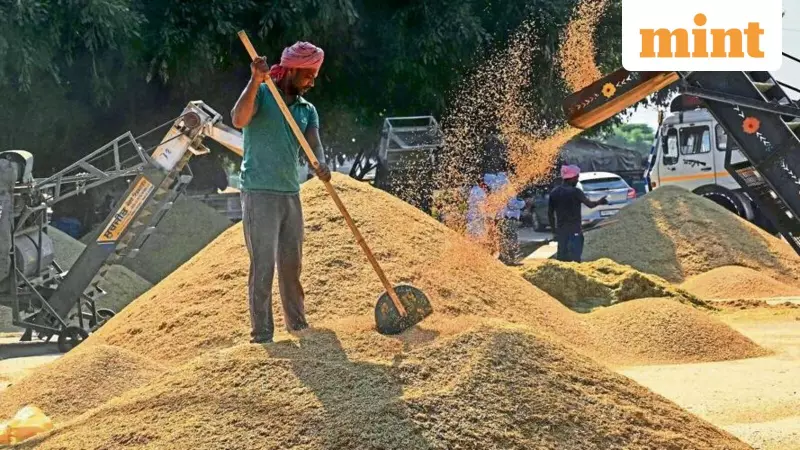
Budget 2026: A Ritual, Not a Remedy for India's Farmers
Ajay Vir Jakhar, chairperson of Bharat Krishak Samaj, presents a stark view. He says the Union Budget has become a mere ritual for Indian farmers. It offers little real remedy for their pressing issues.
The Bigger Economic Picture in 2026
2026 stands as a pivotal year for India's economy. The Union Budget matters, but other milestones loom larger. The Eighth Pay Commission and the Sixteenth Finance Commission will have major consequences.
Two expert panels led by Rajiv Gauba also demand attention. One focuses on Viksit Bharat goals. The other tackles non-financial sector regulatory reforms.

Trade negotiations with the US and EU pose another strategic challenge. These talks could quietly lock India into external standards. These standards may cover food safety, data regulation, and compliance. Such moves might not serve India's best interests.
Why the Budget Fails Farmers
For farmers, the budget process seems broken. Either the finance ministry ignores the agriculture ministry. Or the agriculture ministry fails to build a strong case. Budget announcements often remain as statements of intent.
A clear example exists. Last year's promise to raise the Kisan Credit Card limit from ₹3 lakh to ₹5 lakh still awaits official notification. This delay highlights a gap between promise and action.
This is not about a lack of bold ideas. New programs have been tried. Some underperform. Circumstances change over time. The real problem is political. Exigency forces the continuation of failing programs.
This narrows the room for genuine reform. The system enters a vicious cycle. Weak outcomes fuel electoral anxiety. This anxiety, in turn, promotes populism. Populism and fiscal problems then feed each other. Governance becomes much harder.
The Populism Trap and Fiscal Strain
Populist politics thrives where inequality is high. Recent Bihar elections validated this trend. Political parties may differ in ideology. Yet their populist tendencies look strikingly similar.
Governments often try to solve debt problems with more debt. A shocking fact emerges. Many private businesses enjoy lower borrowing costs than several Indian states. This is true even though state debts carry sovereign guarantees.
Take the fertilizer subsidy. Food security once justified it. That rationale has weakened. Agriculture grows at about 3% annually. Population growth sits near 0.5%. The arithmetic has shifted.
A 25% increase in urea prices is politically feasible. The savings could be repurposed. They could directly benefit farmers instead.
Consumption, Welfare, and Crop Insurance
India has made great strides in reducing extreme poverty. Estimates put the number between 7.5 crore and 15 crore people. Yet, about 80 crore Indians receive free cereals. Logically, this situation cannot continue indefinitely.
Crop insurance presents another concern. The Pradhan Mantri Fasal Bima Yojana (PMFBY) sees the Centre and states pay 90% of the premium. Despite this, widespread dissatisfaction persists.
Farmers and states alike complain about claim settlement and transparency. It is time for a change. A straightforward crop compensation fund could replace PMFBY. Such a move would help rebuild farmers' trust.
Urban Policy and a Better Approach
Urban policy offers a clear misstep. The 'Smart Cities' idea was flawed from the start a decade ago. It pulls people from villages into already strained cities.
This approach ignores India's natural settlement patterns. A better correction is obvious. The focus should shift to revitalizing over 5,000 census towns. This would promote more inclusive growth.
The Need for Evaluation and a Farmers' Commission
None of these solutions are easy. The backlog of grievances is long. Problems have compounded for decades. Evaluation must come before expansion.
Governments, however, are poor judges of their own performance. A statutory farmers' commission should be formed. Its mandate would be clear.

- Audit existing government interventions.
- Recommend improvements to current programs.
- Propose new initiatives and a comprehensive farmers' policy.
Hidden Policies and the Inflation-Control Tool
Some policies work remarkably well, but not for openly stated reasons. The artificial suppression of farm-gate prices remains India's most effective tool for controlling inflation.
Whatever the Reserve Bank of India argues about repo rates, this suppression comes first. The data reveals its impact. Crops like ahrar, cotton, gram, and groundnut trade below Minimum Support Price (MSP).
Maize, masur, moong, ragi, soybean, and urad show the same trend. Even common vegetables tell a story. Onion, potato, tomato, and carrot prices fell by about a third. This happened despite a 4% increase in fruit and vegetable output.
This is not a paradox. It highlights the difference between production and productivity. The message is clear. Government welfare and populist measures prevent depression from turning into open dissent.
Trade Policy and the R&D Shortfall
Trade policy adds to the squeeze on farmers. Import tariffs on palm, soybean, and sunflower oils were cut by 40% last year. India now imports 57% of its edible oil needs.
Imports stay high because a crop yield gap persists. Agricultural research and development (R&D) has been starved for decades. Anything less than doubling the R&D allocation betrays the ambition of Viksit Bharat.
An Unintended Relief and the Path Forward
Ironically, farmers received one piece of relief unintentionally. Currency depreciation provided it. The rupee weakened from about ₹60 per dollar in 2014 to near ₹90.
This acts as a natural barrier against cheap farm produce imports. It also boosts export competitiveness. In the absence of tariff protection, depreciation did the job that policy would not.
India has risen to become the world's fourth-largest economy by GDP. Yet, among roughly 200 countries, it ranks about 142nd in GDP per capita. Farmers will see higher farm-gate prices only when purchasing power rises.
Consumption must expand. The economy needs to grow more evenly. Governance is the key to all this.
A Crucial Governance Reform
To improve governance quality and the commons—air, water, soil—one reform stands out. Civil service recruitment through the UPSC should change.
The upper age limit should reduce to 26. Attempts should be capped at two, irrespective of caste. This change must begin at the top to lift the bottom.
Jakhar expresses faith in the Prime Minister's intent and capacity. His confidence wavers, however, on whether the government will truly listen to farmers. The call for action is urgent. The budget must transform from a ritual into a real remedy.





