

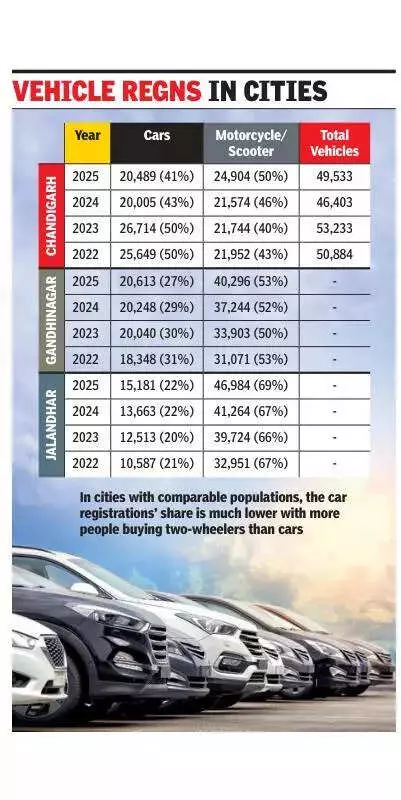
Chandigarh, long known for its high car ownership, is witnessing a notable shift in its vehicle registration patterns. Recent data reveals that two-wheelers have now edged past cars in new registrations, marking a change in the city's automotive landscape. However, the share of cars in the total vehicle mix remains significantly higher than in other comparable Indian cities, reflecting the city's unique socio-economic profile.
A Reversal in Registration Trends
For years, Chandigarh stood out nationally for the disproportionate number of cars on its roads. Central government data, aggregated from Regional Transport Offices (RTOs), shows that in 2022 and 2023, cars accounted for a staggering 50% of all vehicle registrations in the city. In contrast, motorcycles and scooters made up 43% and 40% of registrations in those years respectively.
The trend began to change in 2024. That year, registrations of non-transport two-wheelers climbed to 46% of the total, while car registrations fell to 43%. This decline continued into 2025, with car registrations dropping to a 41% share. Two-wheeler registrations, meanwhile, comprised nearly half of all new vehicles registered in the city.

How Chandigarh Compares to Other Cities
Despite the recent dip, Chandigarh's car ownership levels remain exceptionally high compared to other urban centers with similar populations. A Union Territory official highlighted this disparity, noting that car registrations still account for "way more in percentage share" than in other parts of the country.
The contrast is sharp when compared to planned cities like Gandhinagar. In 2025, cars comprised only around 27% of total registrations in Gandhinagar, with two-wheelers at 53%. The previous year showed a similar pattern with cars at 29% and two-wheelers at 52%.
Jalandhar, which had a population similar to Chandigarh's as per the 2011 census, presents an even starker difference. In 2025, merely 22% of new vehicles registered were cars, while a massive 69% were two-wheelers. The figures for 2024 were almost identical.
The Economic Drivers Behind High Car Ownership
Officials attribute Chandigarh's distinctive vehicle mix to its robust economic standing. "The city has very high per capita income, and it is mostly a town of government salaried class, pensioners, and a service sector dominated by financial sectors," explained a UT official. This affluence translates into multiple car ownership per family being common.
The official further noted, "It is not uncommon for families to have a car for each adult member." An additional factor encouraging new car purchases is the relatively higher resale value of city-registered cars compared to other cities, making it easier for residents to upgrade.
While Chandigarh's per capita income has seen a slight relative decline nationally—slipping from the third highest in the country in 2013-14 to the fourth position in 2023-24—it continues to outperform neighboring states like Punjab, Haryana, and Himachal Pradesh by a considerable margin.
The data underscores a nuanced story: while two-wheelers are gaining ground in Chandigarh, the city's love affair with the car is far from over, deeply rooted in its economic prosperity and lifestyle.






