

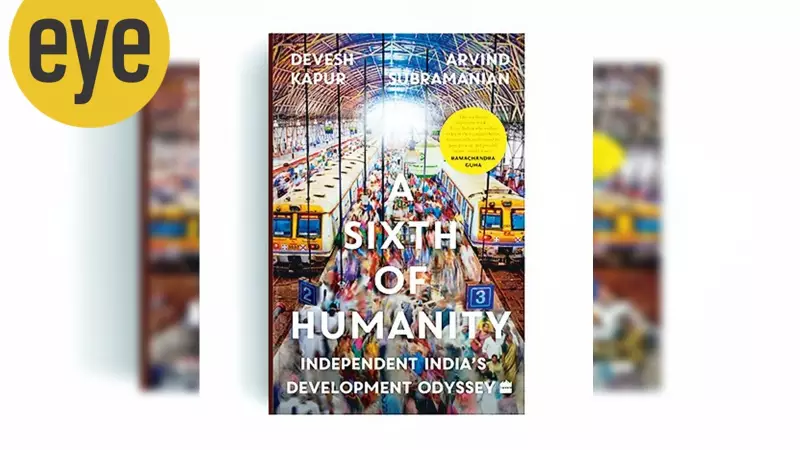
In a recent critical review, economist Pulapre Balakrishnan has taken aim at the grand narrative presented in the book 'A Sixth of Humanity: Independent India's Development Odyssey' by renowned scholars Devesh Kapur and Arvind Subramanian. While acknowledging the work's massive scale and rich data, Balakrishnan argues that its core narrative is fundamentally flawed, oversimplifying complex economic history and overlooking crucial policy outcomes.
Questioning the Growth Narrative and Periodization
Balakrishnan focuses his critique on the section where Kapur and Subramanian address two central puzzles: why growth was tepid in the 1950-80 'socialist' era, and why rapid post-1991 growth failed to create enough formal jobs. He finds the authors' characterization of the 1950-80 period as "comprehensively poor" and a regime of "scarcity" that throttled the private sector to be a misleading caricature.
Contrary to this unified view, Balakrishnan points to a distinct growth cycle. He highlights that growth accelerated significantly in the first decade and a half after Independence, particularly during the Nehru era (1950-64). Citing data from economist Angus Maddison, which the book itself uses, he notes that India's per capita income grew 19 times faster than in the last years of British rule and even outpaced China's growth during that period.

Furthermore, he challenges the notion of a throttled private sector, revealing that private corporate investment actually grew faster than public sector investment between 1950 and 1964. He suggests that state investment may have aided the private sector by expanding the market for its goods.
Overlooked Transformations and the Real Reform Challenge
Balakrishnan asserts that the book fails to credit the 1950-80 period with two significant, lasting transformations. First, the share of industry in the economy rose as planned. Second, and perhaps more importantly, the poverty rate began a sustained secular decline starting in the late 1960s, even during a phase of lower overall growth.
This analysis leads him to answer the authors' second puzzle. The lack of formal job creation post-1991, he argues, stems from the fact that industrial share did not rise significantly after the liberalizing reforms. Generating formal jobs would have required a much faster expansion of manufacturing, driven by either booming domestic demand or sharp export competitiveness—outcomes that the broad macroeconomic reforms of 1991 alone could not guarantee.
The real policy failure of the early decades, according to Balakrishnan, was not industrial licensing but the absence of a massive nationwide program to spread schooling and health infrastructure. This foundational gap, he contends, ensured that India's growth would be lower and poverty more persistent compared to East Asian nations.
Avoiding the Modi Era and Theoretical Shortcomings
One of the most striking criticisms is the book's apparent evasion of a serious evaluation of economic performance under Prime Minister Narendra Modi. Balakrishnan notes that by creating a combined "growth phase" from 2010 to 2020, spanning both the UPA and NDA tenures, the authors sidestep a direct assessment of policies since 2014.
He argues that a straightforward examination of data shows a slowing economy from 2017 onwards. This trend, he states, implies two critical points: first, that the economic policies adopted since 2014 have not raised India's growth rate, and second, that the 2016 demonetisation may have contributed to this reduction. The authors' avoidance of this possibility is a major lacuna in a book claiming to chart India's development journey.
Ultimately, Balakrishnan finds the book lacking a coherent theoretical vision of growth, rendering its framework of 'State, society, nation and markets' inadequate. He concludes with a philosophical note, comparing the book's valuable but disjointed data points to raisins, suggesting that while raisins are the best part of a cake, a bag of raisins is not better than a complete, well-baked cake.






