

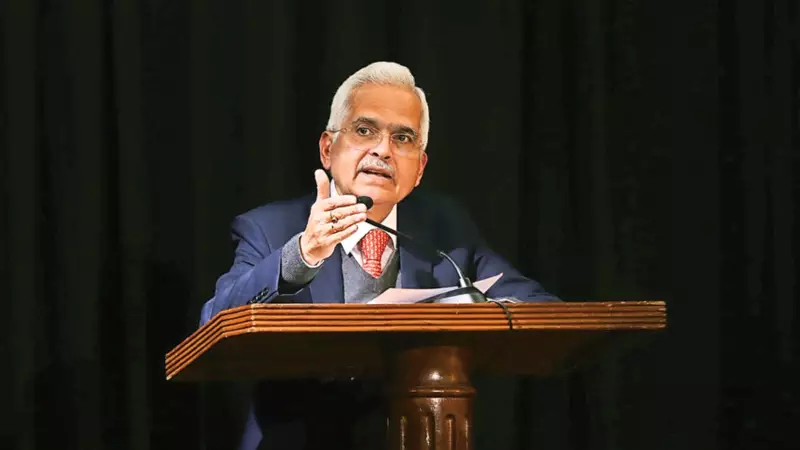
In a significant address outlining India's economic philosophy and foreign policy stance, Principal Secretary to the Prime Minister, Shaktikanta Das, stated that India is proactively forging partnerships and devising strategies to secure its national interests in a world where power is increasingly diffused. Delivering the inaugural Bibek Debroy Memorial Lecture on Friday, January 9, 2026, Das emphasized that the Indian economy remains resilient and is projected to be the fastest-growing major economy globally, despite facing multiple and overlapping global shocks.
A Vision of Cooperative Global Engagement
Das articulated India's clear stance in an evolving world order, affirming the country's commitment to a "co-operative and rules-based global system." He acknowledged that traditional multilateralism is under severe strain, with key international institutions struggling to fulfill their mandates. Geopolitical rivalries, protectionism, and fragmentation are sidelining multilateralism, he noted, with critical sectors like semiconductors, rare earths, energy, and pharmaceuticals being leveraged as tools of influence, exposing vulnerabilities in dependent economies.
"At the same time, India is proactively forging partnerships and strategies to secure national interest in a world where power is more diffused," Das asserted. He pointed out that the share of trade in global GDP has stagnated, signaling a shift from hyper-globalisation to regionalisation, trends that create vulnerabilities for emerging nations and the Global South by amplifying economic volatility and narrowing convergence opportunities.

The Pillars of Economic Resilience and Atmanirbharta
In this fluid landscape, Das explained, India has embraced Atmanirbharta (self-reliance) as the overarching policy principle. He clarified that this is not an isolationist strategy but one aimed at building core competence and resilience. "Economic Atmanirbharta means developing the capacity to produce critical goods and technologies at home and reducing over-reliance on foreign sources," he said.
This vision, he elaborated, rests on a tripod of stability, reforms, and schemes designed to address structural gaps. On stability, Das highlighted India's success in maintaining macroeconomic and financial sector stability, controlling inflation, and committing to fiscal consolidation. He revealed that the general government’s gross debt-to-GDP ratio declined to 81.6% in 2024-25 from a peak of 88.4% in 2020-21, with the IMF projecting a further decline to 76.9% by 2030-31.
On reforms, he listed landmark changes including the Goods and Services Tax (GST), the Insolvency and Bankruptcy Code (IBC), the Real Estate (Regulation and Development) Act (RERA), the flexible inflation targeting framework, and the recent notification of the four labour codes. These reforms, he said, aim to reduce regulatory complexity, encourage workforce formalisation, attract investment, and generate higher employment.
Regarding schemes, Das mentioned initiatives like the Production-Linked Incentive (PLI) schemes, the National Critical Minerals Mission, and the Electronic Component Manufacturing Scheme, stating these are part of a coherent strategy to build domestic capacities in critical areas.
Speeding Ahead on Multiple Cylinders
Das expressed strong confidence in India's economic trajectory, stating the country is at the cusp of a historic journey "from being an incredible India to a credible India." He acknowledged headwinds but said the economy is speeding ahead on "multiple cylinders."
He cited robust post-pandemic growth, with the economy rebounding at an average rate of 8.2% from 2021–22 to 2024-25, driven by resilient private consumption and investment. For 2025–26, real GDP is expected to grow at 7.4%, as per National Statistics Office projections. Further, India is projected to contribute around 18% to global GDP growth in 2025-26.

India's strengths, Das noted, are converging in a historic way: a youthful demographic, digital public infrastructure (DPI), deepening financial inclusion, and significant potential in technology and artificial intelligence (AI). "Building on our strong base of STEM talent, as India produces the highest number of engineers and science graduates in the world, we are positioning ourselves at the forefront of the new tech revolution," he said.
Concluding on an optimistic note, Das stated, "…with the policies that the country has adopted, the wind is in our sails. We are indeed on our path to Viksit Bharat." The lecture, themed 'Indian economy, a story of rising credibility,' honored the late Bibek Debroy, former Chairman of the Economic Advisory Council to the Prime Minister and a contributing editor for The Indian Express.





