

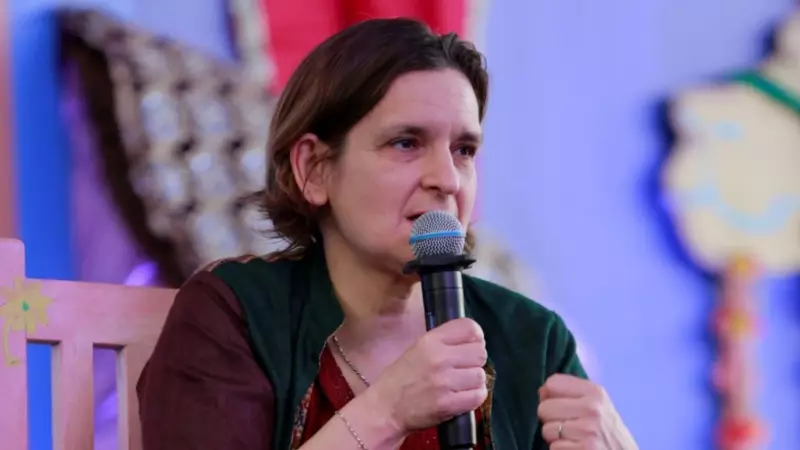
Nobel Economist Esther Duflo Sounds Alarm on Climate and AI at Jaipur Literature Festival
Esther Duflo, the Nobel Prize-winning economist, delivered urgent warnings about climate change and artificial intelligence during her appearance at the Jaipur Literature Festival. Speaking against the vibrant backdrop of the literary event, Duflo shared insights from her updated book 'Poor Economics' and addressed pressing global issues.
Climate Change Disproportionately Harms Poor Women
Duflo emphasized that climate change hits the poorest communities hardest. She described visiting the Sundarbans region, where women face extreme dangers during heat waves. These women often work alone after their husbands migrate for jobs.
"They have no access to air conditioning," Duflo stated clearly. "They cannot go to the one hotel that has it because they're not allowed. They literally die of heat exposure."

The economist argued that social systems need complete redesign to protect vulnerable populations. She posed a critical question: "What do we do to allow people not to work when it's very hot?" This challenge requires innovative solutions for social protection.
Professional Move from MIT to Zurich
Duflo revealed her upcoming relocation from the Massachusetts Institute of Technology to Zurich. She explained this move reflects both professional and geopolitical shifts. "With the disengagement of the US from international development and climate, it is time for other actors to take over," she noted.
She envisions a more multipolar leadership emerging from various sources:
- Indian philanthropy
- European institutions
- Voices across the Global South
Zurich, she hopes, will help shift the center of gravity in development economics. This realignment takes concrete form in July 2026 when Duflo and her husband, fellow Nobel laureate Abhijit Banerjee, join the University of Zurich.
Using funds from the Lemann Foundation, they will establish a new center for development economics, education and public policy. This represents a tangible step toward changing the field's focus.
Artificial Intelligence Threatens India's Growth Engine
Duflo expressed serious concern about artificial intelligence undermining India's economic progress. "India's middle class rose through IT and back-office jobs—exactly the roles AI could replace," she warned.
She stressed the need for proactive measures: "We need to get ahead of this trend." This warning comes as India's technology sector faces potential disruption from advancing AI capabilities.
Persistent Barriers in Economics
Within economics academia, Duflo sees ongoing challenges for women and scholars outside the US and Europe. She described the culture as "a little aggressive" with seminars that feel like "boxing matches instead of places of exchange."
She shared a telling anecdote about submitting a paper on Indonesia. An editor told her, "Indonesia tells me nothing about Indiana." Duflo responded quickly: "Indiana tells me nothing about Indonesia. There are many more people in Indonesia than Indiana."
Cautious Approach to Poverty Data
Regarding recent World Bank estimates showing sharp declines in Indian poverty, Duflo urged caution. "The data is difficult to parse," she said. "I would take it with healthy skepticism and look to ground surveys."
On rising global inequality, she was unequivocal: "It does produce political fallout. This is exactly what's happening."
As the Jaipur Literature Festival continued around her, Duflo prepared for her next session. Her work, much like the complex world she studies, continues evolving in response to heat, power dynamics, and relentless change.






