

Economic Survey 2025-26 Advocates for Formal Recognition of Village Commons
The Union government's Economic Survey 2025–26, released ahead of the Union Budget, has issued a compelling call for a renewed focus on the revival and protection of village commons. Describing these shared resources as a critical yet underutilized foundation for sustainable rural development, resilient livelihoods, and ecological stability, the Survey underscores their vital role in India's economic and environmental framework.
Formal Recognition as a Distinct Land-Use Category
The Survey argues that village commons—also known as Common Property Resources (CPRs)—must be formally recognized as a distinct land-use category. This step is essential to enable accurate mapping, monitoring, and targeted policy interventions. According to the document, "Reviving and protecting village commons requires a collaborative approach that involves both the government and local communities actively participating." It further emphasizes that official incorporation of commons with clear sub-categories is crucial for informed governance.
Significance and Current Status of Village Commons
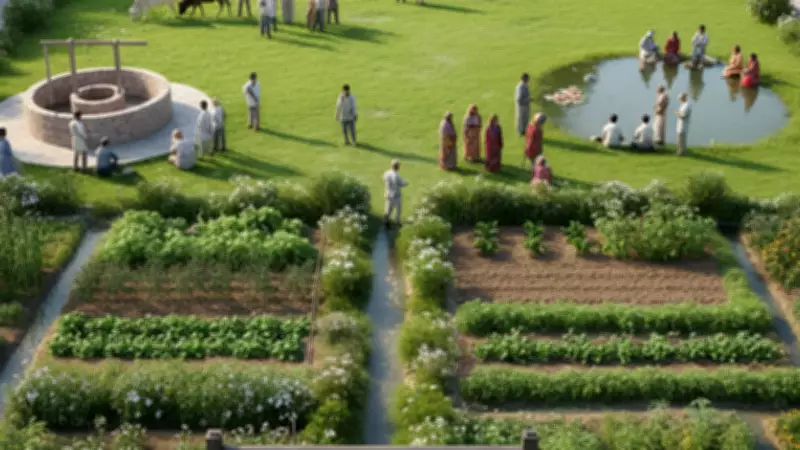
In a chapter titled Rural Development and Social Progress: From Participation to Partnership, the Survey describes commons such as grazing lands, ponds, water bodies, and shared spaces as sites where community institutions, technology, and livelihood generation intersect. Approximately 15% of India's geographical area comprises village commons, with the 2011 Census estimating common land at 6.6 crore hectares. These resources support the livelihoods of nearly 35 crore rural people, highlighting their immense socio-economic importance.

Sisir K Pradhan from the University of Waterloo noted, "These ecosystems are not marginal spaces. For the first time, the Economic Survey has emphasized village commons as an economic resource essential for rural communities to thrive, while also underlining their role in addressing the climate crisis that affects social, ecological, and economic foundations every day."
Ecosystem Services and Economic Value
The Survey highlights that commons provide at least 34 ecosystem services, including food, fodder, fuelwood, water, and income. Additionally, they contribute to water purification, soil protection, carbon sequestration, and flood control. Despite their critical functions, the Survey estimates their annual economic dividend at USD 9.05 crore, warning that their value is "often underestimated" and their condition is steadily eroded by encroachment, misuse, and environmental stress.
Citing ISRO data, the Survey points to the expansion of degraded land by about 2.2 lakh hectares annually, leading to declining agricultural productivity, falling water tables, and rising cultivation costs—impacts felt most acutely in rural India.
Expert Insights and Recommendations
Pravas Mishra, an economist and natural resource management expert, stated, "The renewed focus on village commons is a timely acknowledgment that India's rural economy depends as much on shared natural resources as on private land and infrastructure." He added that the forthcoming Budget should prioritize "panchayat-wise inventories of commons" to enable sustainable use and local self-sufficiency.
Drawing on Nobel laureate Elinor Ostrom's principles for managing common-pool resources, the Survey stresses the importance of:
- Clearly defined boundaries
- Participatory rule-making
- Local monitoring
- Strong community institutions
These should be supported by GIS-based registries and capacity building. Initiatives such as Mission Amrit Sarovar, SVAMITVA Yojana, Jal Shakti Abhiyan: Catch The Rain, and restoration works under PM Krishi Sinchai Yojana are cited as steps in this direction.

Cautions and Implementation Challenges
However, experts caution against reducing commons to purely economic assets. Kanchi Kohli, a researcher and educator, emphasized that formal recognition must not dilute their social and cultural essence. "Projects that increase productivity should not lose sight of diversity, collective custodianship, and the very idea that commons represent," she said, warning against unchecked land-use change driven by market pressures.
Former IAS officer Aurobindo Behera flagged gaps between intent and implementation. "Diversion of commons for other purposes must be made difficult, and laws need strengthening," he said, calling for mandatory public reporting by state and district administrations on the health of commons and stronger incentives for gram panchayats to protect them.
Extension to Urban Commons
The Survey also extends the idea of commons to urban spaces, arguing that shared infrastructure—from public transport to civic spaces—functions best when cooperation is made "rational, visible, and dignified" through trust, institutional design, and fair enforcement.
Conclusion: Central to a Sustainable Economy
Taken together, the Economic Survey positions the revival of commons—both rural and urban—not as a peripheral concern but as central to building a productive, inclusive, and sustainable economy. By advocating for formal recognition and collaborative management, the Survey sets a forward-looking agenda for harnessing these shared resources to address contemporary challenges and foster long-term resilience.





