

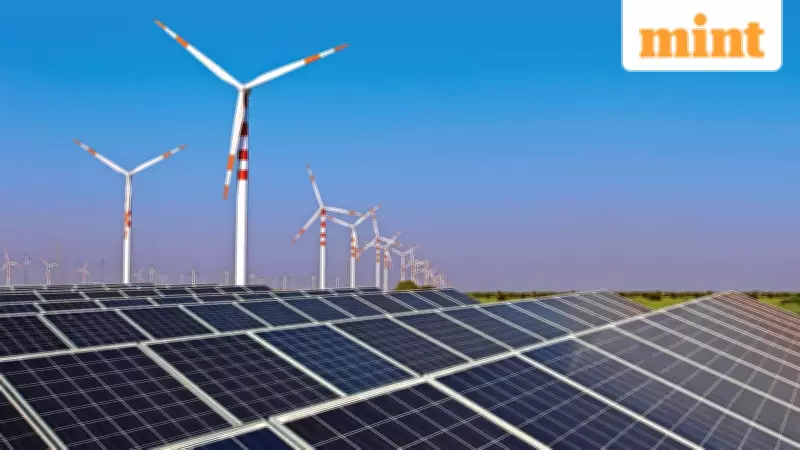
New Delhi: The government's Economic Survey for 2025-26 has raised significant concerns about a deepening mismatch between global climate ambitions and the financial resources available to achieve them. The report warns that the financing shortfall, now estimated at a staggering $4 trillion, has expanded considerably, especially for developing economies, while international public finance continues to remain constrained.
Structural Biases and Funding Imbalances
The annual survey, released on Thursday, pointed to persistent structural biases within the international financial architecture that systematically favor developed nations. For India specifically, the analysis reveals that climate finance remains disproportionately concentrated in mature sectors such as solar and wind energy, along with energy efficiency initiatives.
Meanwhile, critical areas including climate adaptation, support for MSMEs, urban infrastructure development, and hard-to-abate industries like steel, cement, chemicals, aviation, and shipping continue to suffer from chronic underfunding. These sectors face particular challenges in reducing carbon emissions due to their inherently high energy requirements.

Domestic Dominance in Climate Funding
Currently, approximately 83% of India's mitigation finance and a striking 98% of adaptation finance originate from domestic resources. This overwhelming reliance on internal funding underscores the severely limited role played by international capital in supporting India's climate transition efforts.
The call for bridging this substantial financial gap emerges at a critical juncture for India's energy transition landscape. Despite rapid growth in capacity installation and local manufacturing, the sector confronts multiple obstacles including approximately 43 GW of unsigned power purchase agreements and curtailment of green power in solar-rich states like Rajasthan and Gujarat.
Innovative Financing Models and Bond Market Potential
The Ministry of New and Renewable Energy is actively exploring alternative financing and contract models to address these challenges. Among the approaches under consideration are Contracts for Difference (CFD) for power purchase agreements, which could replace conventional long-term pacts spanning up to 25 years. Under CFD arrangements, either party compensates for the difference between contracted and actual market prices.
The ministry is also examining innovative financial instruments such as mezzanine finance, which blends elements of debt and equity to create more flexible funding solutions for renewable energy projects.
The Crucial Role of Bond Markets
The Economic Survey emphasizes that bond markets are becoming increasingly vital for financing climate infrastructure projects that demand substantial upfront capital and extended repayment timelines. According to government assessments, well-developed bond markets can provide stable, long-term financing at predictable costs while attracting institutional investors with substantial long-term capital.
These markets are already enabling urban local bodies to raise local-currency funds for climate-aligned services including water supply systems, waste management infrastructure, and renewable energy installations.
In India, pioneering cities including Indore, Ahmedabad, Ghaziabad, and Vadodara have issued municipal green bonds aligned with SEBI's established green bond framework. These innovative issuances could potentially unlock between $2.5 and $6.9 billion for locally driven climate action initiatives over the next five to ten years.
At the national level, the government has issued sovereign green bonds worth ₹15,000 crore in FY26, bringing the cumulative issuance since FY23 to an impressive ₹72,697 crore. The government is reportedly developing a comprehensive blueprint to grant municipal administrators greater financial autonomy and encourage urban local bodies to utilize market-based instruments like municipal and green bonds for funding long-term urban investments.

India's Dual Strategy and Global Disparities
India has adopted a two-pronged strategy that focuses simultaneously on strengthening domestic financial systems while seeking enhanced international support. Specialized institutions including IREDA, NABARD, SIDBI, Power Finance Corporation, and Rural Electrification Corporation are actively supporting low-carbon and renewable energy projects by improving project preparation and enhancing bankability.
Regulatory initiatives such as SEBI's Business Responsibility and Sustainability Reporting framework, green bond guidelines, and IFSCA's sustainability-linked lending norms have significantly improved disclosure standards and bolstered investor confidence in climate-focused investments.
Persistent Global Financing Gaps
On the international front, the report highlights continuing disparities between climate finance commitments and actual fund flows under the Paris Agreement framework. The survey cites high capital costs and structural weaknesses within the global financial system as primary contributors to these persistent gaps.
The document calls for coordinated reforms in multilateral development banks, cautious implementation of blended finance mechanisms, and robust governance frameworks to ensure climate finance effectively supports sustainable growth and resilience without compromising fiscal stability or broader development priorities.
Despite global financial assets under management reaching $147 trillion in 2025, climate finance flows remain heavily skewed. In 2023, global climate finance totaled $1.9 trillion, with private capital accounting for nearly $1.3 trillion of this amount. More than half of this private finance flowed to advanced economies, while China attracted approximately 30%, leaving developing countries (excluding China) with only about 15% of total private climate finance.
Developed Nations' Inadequate Climate Action
The Economic Survey delivers pointed criticism toward developed economies regarding their insufficient climate action and inadequate support for developing and least developed nations. The report notes that even the new Nationally Determined Contributions (NDCs) for 2035 from major developed economies demonstrate only limited enhancement in their climate mitigation goals.
This represents a concerning backpedaling on commitments made under the Paris Agreement, despite these countries having reached their peak emissions decades ago, in stark contrast to developing nations like India that continue to balance development needs with climate responsibilities.
The survey concludes with a sobering assessment: "The clear signals from the global north, which are dithering on their own climate action, warrant that India must place adaptation centre stage in India's climate action story to ensure that development gains are not lost." This emphasis on climate adaptation—anticipating adverse climate effects and taking preventive action—becomes increasingly crucial as mitigation efforts (reducing greenhouse gas emissions) face substantial financing challenges.





