

Economic Survey 2025-26 Highlights Fiscal Strain in States Amid Inflation Relief for Households
While numerous families across Punjab, Haryana, and Himachal Pradesh are starting to experience some respite from the persistent cost-of-living pressures, state governments continue to wrestle with constrained financial conditions, as detailed in the latest Economic Survey 2025–26. The comprehensive report underscores a complex economic landscape where household relief contrasts with emerging budgetary challenges at the state level.
State Fiscal Deficits Show Gradual Increase Post-Pandemic
The Survey indicates that the combined fiscal deficit of all state governments, measured as a proportion of Gross Domestic Product (GDP), remained relatively stable at approximately 2.8% during the post-pandemic period. This figure is broadly consistent with pre-pandemic levels, suggesting an initial recovery phase. However, following a significant correction from the pandemic-induced peak of around 3.9%, state deficits have gradually crept upward over the past three years, reaching about 3.2%. This upward trend signals emerging pressures on state finances that warrant attention.
The Survey attributes this renewed fiscal stress primarily to revenue growth lagging behind nominal GDP growth. This shortfall is further compounded by increased expenditure on discretionary unconditional cash transfers, which have strained state budgets. The fiscal health of states is often assessed using a revenue ratio, where a value above 1 indicates a surplus, and a ratio below 1 reflects a deficit.

- Punjab's revenue ratio stands at 0.7, placing it clearly in the deficit zone, a position shared with Andhra Pradesh.
- Haryana follows closely with a ratio of 0.8, indicating ongoing fiscal challenges.
- Himachal Pradesh is near balance at just under 0.9, though it remains below the surplus threshold.
Inflation Eases Significantly, Offering Comfort to Households
On the inflation front, the picture is notably comforting for households across these northern states. Headline inflation, which measures the overall rise in prices across the economy including volatile items such as food and fuel, has shown a marked decline. This reduction directly impacts the cost of living and purchasing power, providing much-needed relief to consumers.
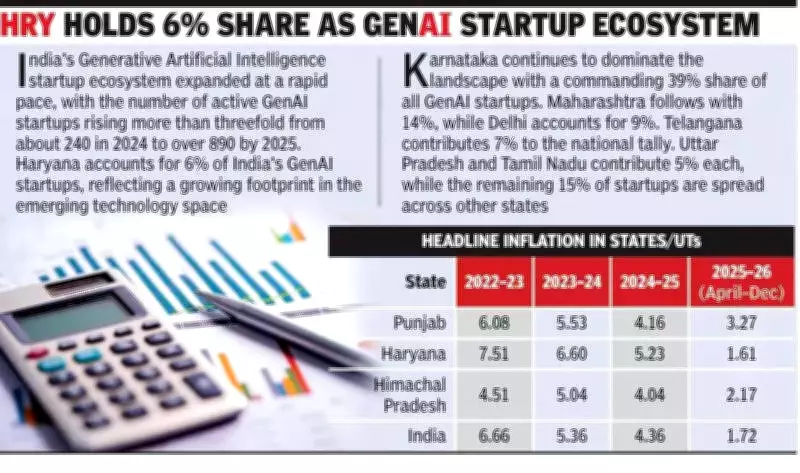
- In Punjab, headline inflation eased from 6.08% in 2022–23 to 3.27% in 2025–26 (April to December).
- Haryana experienced a sharper moderation, with inflation dropping from 7.51% to 1.61% over the same period.
- Himachal Pradesh saw its inflation decline from 4.51% to 2.17%.
At the national level, inflation softened considerably from 6.66% in 2022–23 to 1.72% in 2025–26 (April to December), indicating a broader trend of price stability.
State-Level Inflation Trends and Synchronisation
The Survey notes that state-level inflation in 2025–26 (April to December) broadly followed the national trend, with an across-the-board reduction observed in most regions. Exceptions include Kerala and Lakshadweep, where retail inflation breached the upper tolerance band of 6%. In the majority of states, average inflation remained within or below the Reserve Bank of India's 2–6% tolerance band, reflecting effective monetary and policy measures.
It also observes that inflation outcomes across states are increasingly synchronised, with remaining differences largely driven by local relative-price movements rather than broad-based inflationary persistence. Importantly, inflation differentials were not purely transitory, as all states exhibited positive persistence. This means deviations from the national average often extended beyond a single month, indicating underlying economic dynamics.
Regional patterns emerged in the data: southern and north-eastern states tended to record inflation above the national average with relatively higher persistence, while states such as Delhi and Himachal Pradesh were typically below the national average with comparable persistence. Several states clustered close to the national average, though with varying degrees of persistence, highlighting the diverse economic conditions across India.

The Economic Survey 2025–26 thus paints a dual picture of economic conditions in northern India and beyond. While households benefit from easing inflation, state governments face ongoing fiscal challenges that require strategic management to ensure sustainable growth and public welfare.





