

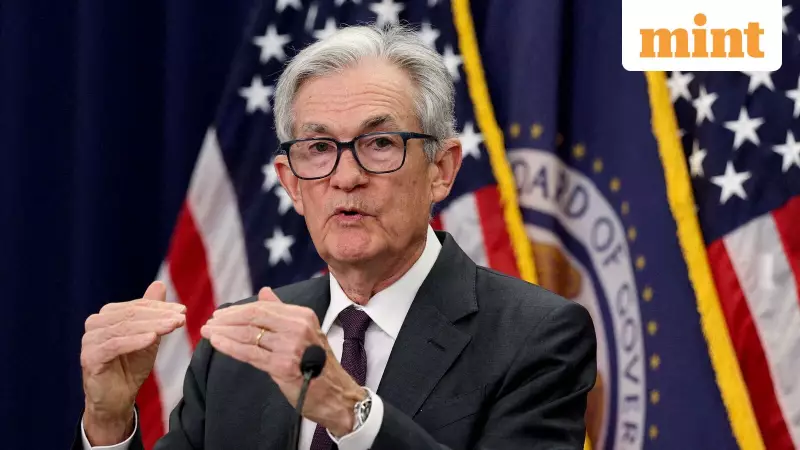
Federal Reserve Chair Jerome Powell has finally acknowledged the existence of a K-shaped economic reality in the United States, where affluent consumers continue spending freely while lower-income households pull back significantly. However, during his recent press conference, Powell stopped short of admitting how the Federal Reserve's own aggressive interest rate hikes have actively contributed to widening this economic divide.
The Bifurcated Consumer Landscape
During last week's press conference, Powell pointed to evidence from major consumer-facing companies indicating a sharply divided economic experience. "If you listen to the earnings calls or the reports of big, public, consumer-facing companies, many of them are saying that there's a bifurcated economy there and that consumers at the lower end are struggling and buying less and shifting to lower cost products," Powell stated. "But that at the top, people are spending at the higher income and wealth."
Research from the Boston Federal Reserve provides concrete data supporting this observation. Analysis of credit card usage patterns reveals that since 2022—when the Fed began its sharp interest rate increases—inflation-adjusted spending by low-income consumers has nearly flatlined. Meanwhile, higher-income consumers have been the primary drivers of aggregate growth in real credit card spending.

How Rate Hikes Hit Different Income Groups
The mechanism behind this spending divergence lies in how different consumer groups interact with credit. Credit card interest rates, being short-term instruments, move closely with the federal funds rate, making them a clear indicator of monetary policy effects.
Another research team examining contract details within the same credit data isolated the direct impact of federal funds rate increases on credit card spending. Their findings were striking: a one percentage point increase in a credit card's annual percentage rate reduced aggregate card spending by nearly 9% in the following month.
However, this pullback was far from uniform across consumer segments. The reduction in spending was approximately twice as large among account holders who carry balances on their cards and those with low credit scores. Meanwhile, spending among consumers who pay off their balances monthly and those with high credit scores remained largely unaffected by the higher rates.
The Business Investment Divide
The divergent effects of monetary policy extend beyond consumer spending to business investment patterns. Powell noted last week that capital expenditures in artificial intelligence, which have been significant drivers of GDP growth, show little sensitivity to interest rate changes due to their long-term expectations.
This observation holds validity, particularly since large, profitable corporations like Amazon, Meta, and Google are leading these AI investments with limited reliance on debt financing. However, research consistently demonstrates that investments by financially constrained businesses—including young companies, small firms, and those dependent on debt financing—respond much more strongly to interest rate changes resulting from monetary policy.
According to the NFIB survey of small businesses, capital expenditure plans over the next six months remain depressed compared to pre-pandemic levels, consistent with reports of elevated financing costs and increased difficulty obtaining loan approvals.
Policy Implications and Economic Reality
The K-shaped economy represents both a feature and a limitation of restrictive monetary policy. Interest rates function as a blunt instrument, far less targeted than the tax-and-transfer toolkit available to fiscal policymakers. Even if the Federal Reserve desired to do so, shielding low-income households or restraining specific AI investments would prove challenging within its current framework.
The Fed's policy approach effectively slows the economy from the bottom up rather than the top down, concentrating demand reduction among households already facing financial constraints. While this contributes to economic bifurcation, it doesn't necessarily justify immediate rate cuts, given that inflation remains above the Fed's target and unemployment stays relatively low.

However, the slower growth at the economy's lower tiers does indicate that the federal funds rate remains restrictive, suggesting room for future rate reductions. This dynamic also provides reason for optimism about broader participation in consumer spending and business investment as the Federal Reserve eventually begins lowering interest rates.
The author, Claudia Sahm, serves as chief economist at New Century Advisors and previously worked as a Federal Reserve economist, bringing insider perspective to this analysis of monetary policy's distributional effects.





