

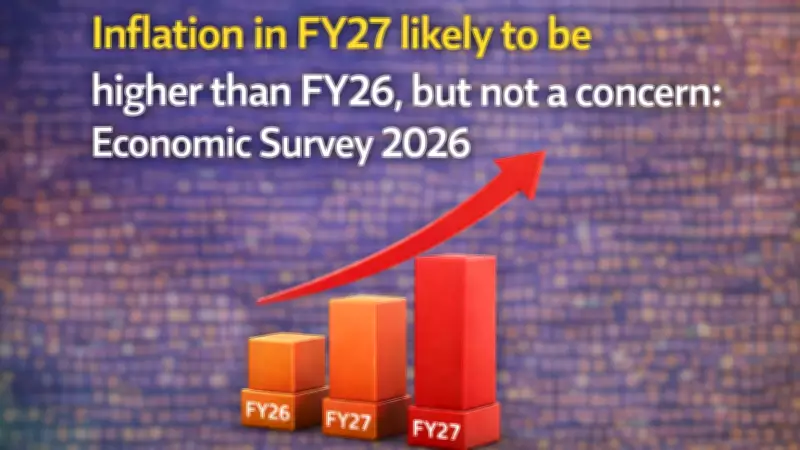
Economic Survey 2026 Projects Higher Inflation in FY27 Than FY26
The Economic Survey 2025-26, presented in Parliament, indicates that domestic inflation is expected to be higher in the financial year 2027 compared to FY26. However, the government document emphasizes that this anticipated rise is unlikely to become a significant concern for the Indian economy.
Inflation Trends and RBI Projections
In its December 2025 monetary policy review, the Reserve Bank of India revised its inflation estimate for FY26 downward from 2.6 percent to 2 percent. This adjustment was attributed to a successful kharif harvest and robust rabi sowing patterns. Looking ahead, the central bank has projected headline inflation for the first quarter of FY27 at 3.9 percent and for the second quarter at 4 percent.
The International Monetary Fund has aligned with these projections, forecasting an inflation rate of 2.8 percent for FY26 and 4 percent for FY27. The Survey specifically states: "India's inflation rate – headline and core excluding precious metals – will likely be higher in FY27 than in FY26. However, we believe it is unlikely to be a concern."

Recent Inflation Performance and Core Inflation Dynamics
Over the past four years, average retail inflation measured by the Consumer Price Index has demonstrated a consistent downward trajectory:
- Declining from 6.7 percent in FY 2022–23
- Falling to 1.7 percent in 2025–26 (up to December)
The pace of disinflation has been particularly noticeable in the current year, especially considering that inflation stood at 4.6 percent in 2024–25. The period from April to December 2025 recorded the lowest average inflation rate in the current CPI series, enabling the RBI to implement a 125 basis points reduction in the repo rate during 2025, bringing it down to 5.25 percent.
Inflation reached a notable low of 0.3 percent in October 2025 – the lowest reading in the current CPI series. This significant disinflation was primarily driven by food items, reflecting favorable weather conditions and increased production that enhanced supply.
In contrast, core inflation – which excludes volatile components such as food and fuel – has remained relatively stable while showing a modest upward trend. Core inflation increased from 3.8 percent in October 2024 to 4.62 percent in December 2025. The Survey notes that "the apparent divergence between headline and core inflation creates an impression of sticky core inflation, suggesting that underlying price pressures are firming even as headline inflation softens."
Future Outlook and Risk Factors
The average reading of core inflation shows an increase from 3.5 percent in FY25 to approximately 4.3 percent in FY26, indicating persistence in non-food, non-fuel inflation. Despite this, the Survey maintains an optimistic outlook, projecting that inflation will remain within target ranges due to several supportive factors:
- Strong agricultural output
- Stable global commodity prices
- Continued policy vigilance
However, the report identifies several risk factors that require ongoing monitoring and adaptive policy responses:
- Currency fluctuations
- Surges in base metal prices
- Global economic uncertainties
The government has mandated the RBI to maintain inflation targeting at 4 percent within a medium-term band of 2-6 percent, providing a clear framework for monetary policy decisions.






