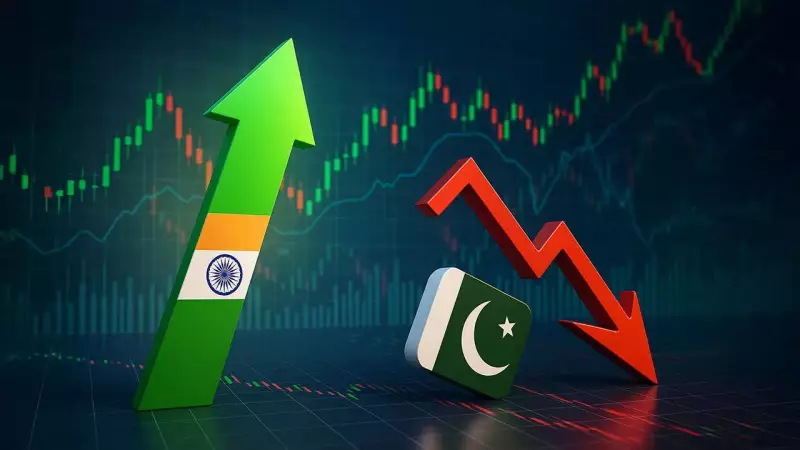
A provocative social media post by economist Noah Smith has ignited discussions across the subcontinent, drawing a vivid parallel between the economic futures of India and Pakistan and the famous "Korea-at-night" satellite image. Smith suggested that in another decade, a similar photo could emerge for South Asia, with one side of the border glowing brightly and the other lagging visibly behind.
The Stark Numbers: A Widening Economic Chasm
Beneath the dramatic imagery lies a hard economic reality defined by compounding growth rates. The data reveals two neighbours on sharply divergent paths. In 2024, India's nominal GDP stood at approximately $3.9 trillion, dwarfing Pakistan's estimated economy of $370-410 billion. This creates a staggering size gap of around ten to one.
The growth momentum further accentuates this divide. India's economy expanded by a robust 8.2% in the July-September quarter of 2024, surpassing forecasts and building on previous strength. The nation is on track to achieve about 7% growth for the full fiscal year, maintaining its status as the fastest-growing major economy.

In contrast, Pakistan's economy managed a growth of roughly 2.38% in 2024, following a contraction the previous year. While these percentage differences may seem modest annually, their compounded effect over time leads to a dramatic widening of the absolute economic gap.
Quality of Growth: Broad-Based Strength vs. Structural Challenges
The nature of economic expansion in both countries tells a deeper story. India has cultivated a diversified economic base, powered by a strong services sector—including IT, finance, and telecom—coupled with manufacturing and a vast domestic consumer market. Reforms and consistent policy have provided resilience against global headwinds.
Pakistan's economic journey, however, has been more turbulent. The country has faced repeated balance-of-payments crises, relying on International Monetary Fund (IMF) programmes for stability. Analyses cited by the IMF point to structural issues like "elite capture" and systemic corruption acting as a heavy tax on the nation's growth potential.
The Per Capita Picture and Regional Comparisons
The divergence extends to individual prosperity. India's GDP per capita is around $2,700, while Pakistan's is in the range of $1,500-$1,700. The cumulative impact of sustained growth differentials is already evident on the ground. Several Indian states now have economic outputs that rival or exceed Pakistan's entire national GDP.
2035: A Subcontinent Illuminated by Data
If current trends persist, with India growing at 6-7% and Pakistan at 2-3%, Noah Smith's mental image could become a statistical reality long before a satellite photo captures it. By 2035, the economic map of the subcontinent would show an India significantly more prosperous and industrially developed, with its highways and industrial corridors forming continuous belts of light. Pakistan, while growing, would not keep pace with the scale of its neighbour's advancement.
The original Korea-at-night photo was a powerful visual shorthand for decades of policy outcomes. The discussion around India and Pakistan underscores how sustained GDP growth rates, quality of economic management, and structural reforms are quietly drawing a new map of South Asia—one that future satellites may one day reveal to the world.