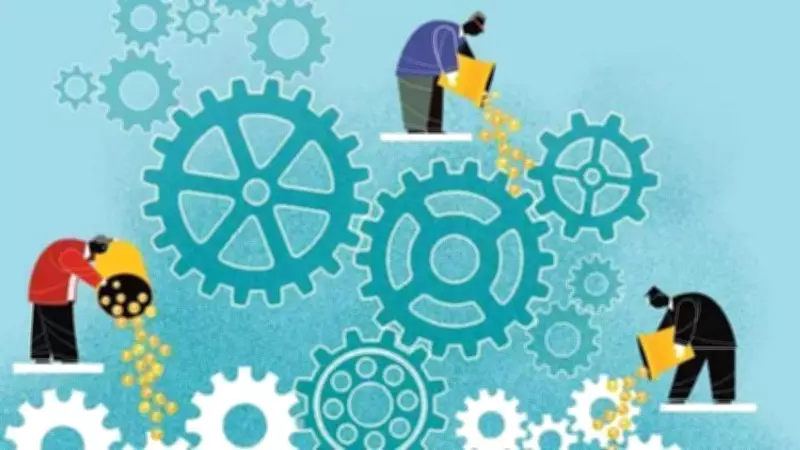
India's Economic Evolution: The Critical Shift from Service Execution to Product Ownership
On the eve of the Union Budget, India stands at a crucial economic crossroads. The nation's remarkable transformation into a global service powerhouse represents one of its most significant economic achievements in recent history. For three decades, software exports, IT-enabled services, and global capability centers have delivered substantial employment opportunities, foreign exchange reserves, and international credibility on an impressive scale. This service-led model has not only fueled consistent growth but has also deeply integrated India into the complex fabric of the global economy.
The Service Economy's Limitations in a Changing World
However, the fundamental question facing India today is not whether the service model has been successful, but whether it remains sufficient for the nation's future aspirations. A service-driven economy primarily scales through human resources, while a product-oriented economy scales through intellectual property and innovative ideas. Services expand by deploying skilled labor across various sectors, whereas products embed knowledge into platforms, manufacturing systems, and processes that can grow independently of workforce numbers.
As automation technologies and artificial intelligence tools increasingly compress traditional service margins, the inherent limitations of labor-based growth models are becoming more apparent. Perhaps more significantly, service economies typically occupy downstream positions within global value chains, responding to demand generated elsewhere rather than creating it. Nations that own products shape markets, establish international standards, and capture long-term economic value that extends far beyond immediate transactions.

Biomanufacturing: A Case Study in India's Structural Gap
The biomanufacturing sector provides a revealing window into this structural economic challenge. India has earned global respect for its pharmaceutical manufacturing capabilities and affordable generic medicines. Yet in emerging domains such as advanced biologics, engineered enzymes, sustainable chemicals, microbial manufacturing platforms, and cell-based therapies, product ownership and platform control frequently reside outside the country.
This situation does not stem from scientific weakness. India has demonstrated its capacity to develop frontier technologies comprehensively, as evidenced by NexCAR19, the nation's first indigenously developed CAR-T cell therapy. This achievement proved that advanced biomedical innovation, clinical translation, and regulatory clearance can occur entirely within domestic systems. What made this case particularly notable was the rare alignment of research capability, manufacturing intent, regulatory engagement, and problem-driven demand.
The Persistent Innovation Gap Across Sectors
Unfortunately, such examples remain exceptions rather than the rule. In most instances, laboratory breakthroughs struggle to advance beyond proof-of-concept stages, unable to access the scale-up infrastructure, risk capital, and institutional support necessary to transform into scalable, domestically owned products. This pattern extends beyond biotechnology into other critical sectors.
In climate and energy initiatives, India is rapidly deploying solutions ranging from biofuels to green hydrogen and low-carbon manufacturing. Yet many enabling technologies, including electrolyzers, catalysts, advanced materials, and bioprocessing systems, continue to be imported or licensed from external sources. Similarly, in healthcare, while India manufactures at impressive scale, the nation maintains substantial dependence on external innovation pipelines for advanced diagnostics and platform therapies.

Global Economic Shifts and India's Strategic Position
This context coincides with significant shifts in global economic conversations. Recent discussions at the World Economic Forum in Davos have moved beyond traditional themes of cost optimization and frictionless outsourcing toward greater emphasis on resilience, re-industrialization, supply-chain security, and strategic technologies. In a world increasingly shaped by geopolitical uncertainty, climate transition imperatives, and health security challenges, economic strength is being redefined as the ability to build, adapt, and manufacture critical products domestically rather than merely adopting them efficiently.
Addressing India's Innovation Ecosystem Imbalance
India's innovation ecosystem currently demonstrates a significant imbalance, with substantial attention directed toward either discovery or deployment while neglecting the critical middle ground. Universities often prioritize academic publications over practical prototypes, while public funding frequently concludes at proof-of-concept stages. Scale-up infrastructure, including pilot plants, testbeds, and demonstration facilities, remains sparse and fragmented across the nation.
Regulatory pathways continue to favor imported technologies over first-of-kind domestic innovations, and public procurement systems persistently prioritize lowest-cost solutions rather than long-term capability building. This combination creates a persistent missing middle where promising technologies repeatedly fail to survive the challenging transition from laboratory success to industrial relevance.
The Path Forward: Building a Product Nation
This critical intermediate space represents precisely where product-focused nations invest most deliberately. Such investment rarely generates immediate glamour but involves essential components including shared infrastructure development, regulatory learning processes, patient capital allocation, and public demand that tolerates early imperfections in exchange for future capability development.
Transitioning from a service nation to a product nation does not require abandoning services entirely. Rather, it involves ensuring that services become a foundation for deeper, more sustainable value creation. India's service economy has delivered unprecedented scale, remarkable speed, and substantial international credibility. However, in a world where economic power increasingly flows from product ownership rather than execution alone, India's next growth phase will depend fundamentally on whether its service strengths can be leveraged to design, build, and own technologies that truly matter on the global stage.
Services have brought India significant credibility, but products will ultimately determine its lasting economic power and influence.