

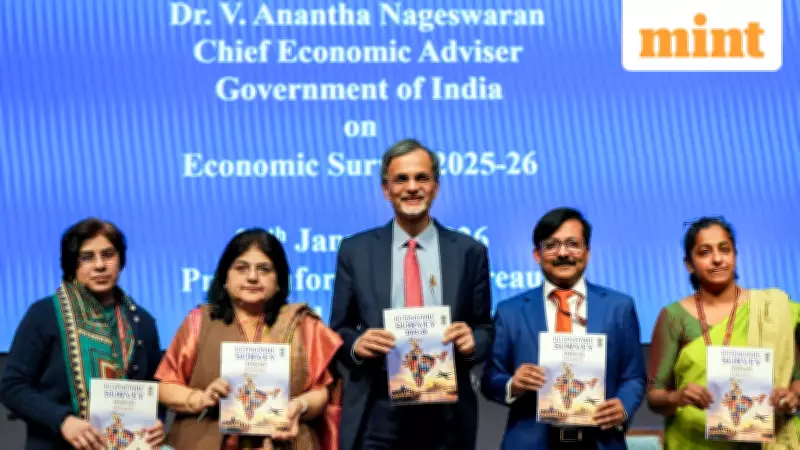
India's Economic Survey 2025-26: Navigating Global Turbulence with Strategic Resilience
The Economic Survey 2025-26 has been unveiled against a backdrop of significant geo-economic upheaval, presenting both an optimistic outlook for India's domestic economy and a sobering assessment of international risks. While projecting a robust GDP growth range of 6.8%-7.2% for 2026-27—slightly below the current fiscal year's estimated 7.4%—the survey acknowledges the challenging global environment that necessitates strategic adaptation.
The Global Risk Landscape: Three Scenarios for 2026
The survey provides a striking analysis of potential global developments in 2026, outlining three distinct scenarios with varying probabilities:
- Best-Case Scenario (40-45% probability): Characterized as "business as in 2025" but with greater fragility and thinner safety margins. While financial stress, trade friction, and geopolitical conflicts wouldn't lead to systemic collapse, increased volatility might require enhanced state intervention.
- Disorderly Multipolar Breakdown (40-45% probability): This scenario envisions intensified strategic rivalries, ongoing armed conflicts, and disintegrating security frameworks. The world would be divided by coercive commerce, forcing nations into difficult trade-offs between autonomy, growth, and stability.
- Amplified Crises (10-20% probability): The least likely but most severe scenario where financial, technological (including potential AI bubble bursts), and geopolitical crises reinforce each other, potentially creating fallout worse than the Great Recession.
India's Vulnerability: The Capital Flow Paradox
Despite India's macroeconomic stability, the survey identifies a concerning trend: foreign capital is no longer being attracted as strongly—a phenomenon termed the "paradox of 2025." For an economy running persistent trade deficits, this represents a significant vulnerability. The document notes India's geopolitical challenges, citing the country's weak score on the Lowy Institute's Power Gap Index as a call to action.

Even with India's relatively strong performance, global turmoil could impact the economy with delayed effects, making resilience-building imperative.
The Resilience Strategy: Structural Shifts for Sustainable Growth
The survey presents a coherent argument for enhancing India's economic resilience through fundamental structural changes:
- Addressing Capital Cost Challenges: Despite fiscal discipline, bond yields have hardened, making sovereign debt issuance more expensive. The survey advocates for reducing the risk premium paid to global investors as essential for lasting relief from high capital costs across the economy.
- Transforming External Balances: India must shift from its history of persistent external deficits to sustained surpluses. This transformation requires enhanced export competitiveness, with particular emphasis on manufacturing, as services sector success alone will be insufficient.
- Balancing Self-Reliance with Competitiveness: While acknowledging the increased importance of self-reliance amid rising supply-shock risks, the survey emphasizes that import policies must not keep input costs prohibitively high for exporters. Businesses should rely on cheaper credit resulting from improved external balances rather than protectionist barriers.
The State's Role: Entrepreneurial Governance and Institutional Challenges
The survey offers nuanced perspectives on economic governance:

- It advocates for an "entrepreneurial state" while acknowledging that proponents of market-led growth might find this approach contentious.
- While covering emerging challenges like AI risks and digital addiction—areas where an active state role seems favored—the document also emphasizes light regulation focused on process reforms rather than policy overhauls.
- The survey highlights the importance of institutions for national power but warns against the "Catch-22" of rules becoming irrational when institutions "mistake procedure for purpose."
This balanced approach recognizes both the necessity of state involvement in certain areas and the inherent challenges of bureaucratic overreach.
Path Forward: Building Enduring Economic Strength
The Economic Survey 2025-26 presents a comprehensive framework for India's economic strategy in uncertain times. While crediting the Centre's capital expenditure outlays and recent reforms for raising the economy's potential growth rate to 7% annually (from 6.5%) while maintaining benign inflation, it clearly identifies areas requiring urgent attention.
The document makes a compelling case that India's future economic resilience depends on addressing structural vulnerabilities, particularly in capital flows and export competitiveness, while navigating the complex balance between necessary state intervention and market efficiency. As global uncertainties persist, the survey provides a roadmap for transforming India's economic narrative from one of vulnerability to sustained strength in an increasingly turbulent world.





