India Braces for Economic Impact as Middle East Conflict Intensifies
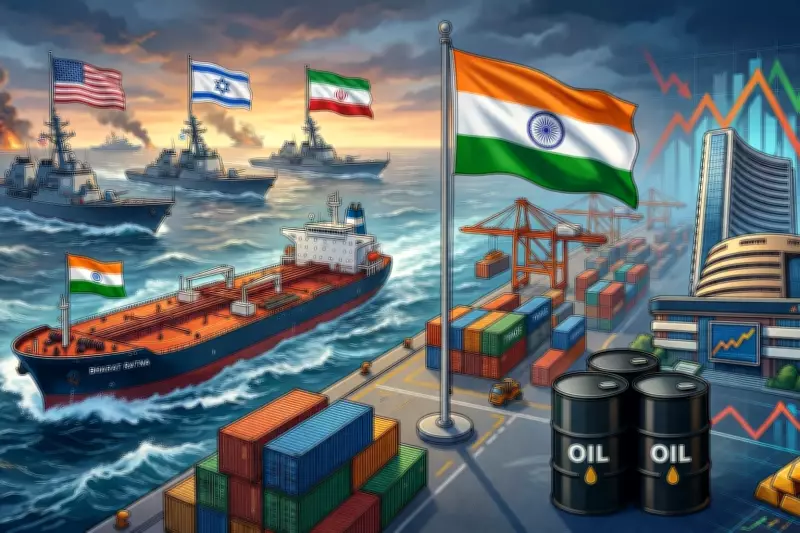
The escalating tensions between the United States, Israel, and Iran are creating significant geopolitical and economic ripples across the globe, with India positioned to face substantial consequences if hostilities persist. Indian policymakers are vigilantly monitoring crude oil prices and cargo movements following renewed Middle Eastern confrontations, though they emphasize it remains premature to assess the full economic fallout.
Immediate Market Reactions and Energy Concerns
The immediate economic effects are most visible in energy markets, given India's heavy reliance on imported oil and gas, much of which transits through the volatile Middle East region. Any sustained increase in crude prices would directly impact both consumers and businesses nationwide.
Dalal Street reacted negatively to the conflict news, with the Nifty falling below 24,700 and the Sensex shedding over 1,600 points during trading. Benchmark indices remained in negative territory throughout the day, with the NSE Nifty50 closing at 24,865, down 1.24%, and the BSE Sensex trimming 1,048 points or 1.29% to end at 80,238.85. The currency market mirrored this decline, with the Rupee plunging past the 91 per US dollar mark to reach 91.32 in early trading sessions.

Strategic Vulnerabilities in Energy Supply Chains
Ajay Srivastava, founder of the Global Trade Research Initiative, highlighted that consequences for India would be both economic and strategic. "Disruption in the Strait of Hormuz threatens a major share of India's crude oil and LNG imports, raising freight costs, insurance premiums, and fuel prices," he explained. "A surge in global oil prices could widen the current account deficit and fuel inflation significantly."
Between 2.5 and 2.7 million barrels per day of India's crude imports move through the Strait of Hormuz, primarily sourced from Iraq, Saudi Arabia, the United Arab Emirates, and Kuwait. In recent months, India's reliance on Middle Eastern oil has increased as refiners reduced some Russian crude purchases, amplifying sensitivity to any disruption in this critical corridor.
Trade and Shipping Disruptions Mount
Exporters have voiced serious apprehensions about vessel movement through two strategic sea lanes vital to global commerce: the Strait of Hormuz and the Bab el-Mandeb Strait. These maritime corridors serve as key arteries linking India to the Gulf region and onward to major markets in North America and Europe.
The Strait of Hormuz, a narrow 33-kilometer channel connecting the Persian Gulf to the Arabian Sea, is widely recognized for its role in global oil trade but also facilitates significant broader commercial traffic. Federation of Indian Export Organisations president SC Ralhan confirmed that hostilities are already straining established logistics networks, with airlines adjusting routes and maritime trade facing mounting uncertainty across the Red Sea and key Gulf passages.
If rerouting becomes prolonged, cargo destined for Europe and the United States may need to sail around the Cape of Good Hope, extending transit times by 15 to 20 days and driving up freight and insurance costs substantially.
Sector-Specific Impacts and Industry Responses
Agriculture and Food Security:Higher grocery bills for Indian households may be imminent, with staples such as pulses likely to become costlier as trade disruptions drive up global prices. India relies on imports of around 5–6 million tonnes of pulses each year, including tur, urad, and lentils, sourced largely from Myanmar, Canada, and African nations.
Consumer Goods and Manufacturing:Crude oil and its derivatives form crucial components in everyday consumer products such as detergents, biscuits, toothpaste, paints, packaging materials, soaps, shampoos, creams, hair oils, bottles, and tubes. These derivatives contribute more than a quarter of input costs for FMCG companies and roughly 40% for paint manufacturers.

Escalating tensions could affect India's $4.5 billion electronics and technology exports to the Gulf region. Commerce ministry data shows the UAE is a key market for Indian electronics, with shipments totalling $4.1 billion during the first nine months of FY26, making it the second-largest buyer of such products from India.
Transportation and Logistics Challenges
Across the Middle East, thousands of Indian nationals—including tourists, expatriates, pilgrims, public representatives, and families—have found themselves stranded due to widespread airspace closures and the shutdown of Dubai, the world's busiest transit hub. Air connectivity across the region continues to face major disruption, with several thousand flights operated by regional carriers cancelled globally.
Indian airlines including IndiGo, Air India, and Akasa have cancelled numerous flights, with normal operations dependent on when it is considered safe to resume flights in conflict-affected airspace. Air India has announced that its services to North America and Europe would operate via alternate flight paths through available Middle Eastern air corridors, increasing travel time significantly.
Insurance and Risk Management Implications
Insurance companies are preparing for possible activation of "notice of cancellation" provisions in war-risk policies and sharp spikes in war-risk premiums. In response to fears of potential closure of the Strait of Hormuz, Iranian vessel seizures, and retaliatory military action, several marine war-risk underwriters have already issued cancellation notices for ships navigating the corridor.
"In case of ships and airlines, insurers can issue a notice of cancellation of war cover for specified zones after due notice," said Kunal Khanna, MD–Reinsurance and global head of natural resources at Edme Insurance Brokers. "If the conflict continues for long, it will impact reinsurance contracts, which are typically struck from the beginning of April in India."
Long-Term Economic Considerations
Industry executives stress that the magnitude of impact would hinge on how long hostilities continue. B Thiagarajan, managing director of Blue Star, noted that southern markets, which are heavily supported by remittance inflows, could face a sharp slowdown if the conflict persists. Any sustained increase in oil prices would weigh on consumer confidence more broadly across the nation.
Global markets are preparing for inflationary pressure and potential supply disruptions in one of the world's most critical oil-producing regions. While India may manage higher crude prices and short-term supply constraints through strategic petroleum reserves and alternative sourcing, the structural reality remains: India is materially exposed to Middle Eastern tensions through multiple economic channels that extend well beyond energy markets alone.