India's event industry has undergone a remarkable transformation over the past decade, with larger weddings, immersive brand experiences, corporate events, concerts, exhibitions, and destination celebrations pushing the boundaries of creativity and scale. Yet as the industry continues to grow, a new conversation is gaining momentum: how can this growth be made more sustainable?
Traditional Linear Consumption Model
Traditionally, event execution has often been associated with a linear consumption model. Equipment is purchased, utilised for a limited number of events, and eventually stored away or replaced. While this approach has helped businesses keep pace with evolving client expectations, it has also resulted in a significant accumulation of underutilised resources across the industry.
From stage structures and lighting systems to decor elements, furniture, trussing, props, and production equipment, thousands of assets remain idle in warehouses despite being fully functional. This not only ties up capital but also contributes to unnecessary consumption and waste.

Shift to Smart Reuse
Today, however, the industry is witnessing a gradual but important shift—from one-time use to smart reuse. This change is being driven by businesses that recognise sustainability is no longer just a corporate responsibility initiative; it is becoming a business imperative. Clients are increasingly conscious of environmental impact, organisations are setting sustainability goals, and event professionals are looking for more efficient ways to manage resources.
Role of Event Kabaadi
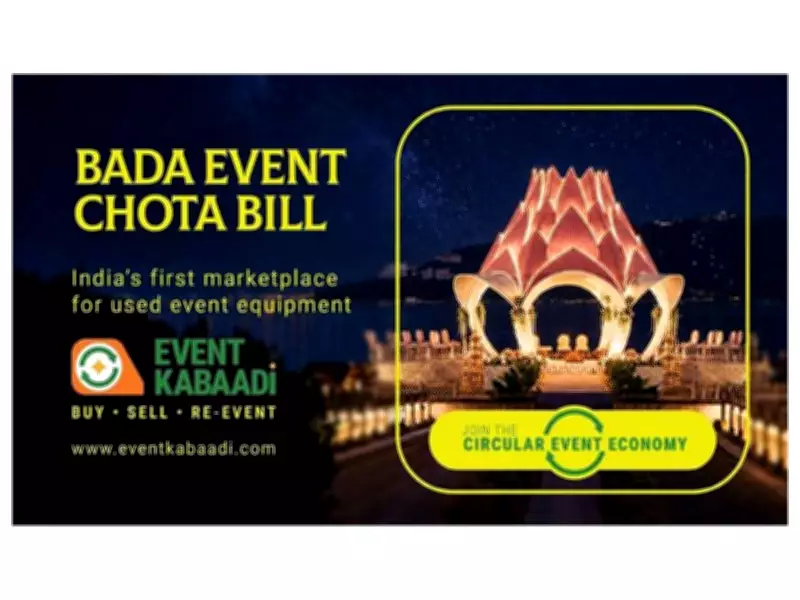
Event Kabaadi is helping facilitate this transition. As India's dedicated marketplace for used event equipment, Event Kabaadi is creating a structured ecosystem where event professionals can buy and sell pre-owned assets with confidence. By connecting businesses that have surplus inventory with those actively seeking quality equipment, the platform ensures that valuable resources continue serving the industry rather than remaining unused.
According to the company, every piece of equipment that is reused extends its lifecycle and reduces the need for additional production. This helps minimise resource consumption while encouraging a more circular approach to business operations.
Economic and Environmental Impact
The impact goes beyond environmental considerations. Smart reuse creates economic value as well. Sellers can recover capital from assets that are no longer part of their active inventory, while buyers gain access to quality equipment without making substantial new investments. The result is a more efficient and accessible ecosystem that benefits businesses of all sizes.
Moreover, smart reuse challenges a long-standing misconception that 'new' is always necessary. In reality, many event assets are designed for durability and can continue performing effectively across multiple projects. By enabling these assets to remain in circulation, Event Kabaadi is helping reshape how the industry thinks about ownership, value, and sustainability.
Aligning with Circular Economy
The platform's vision aligns closely with the principles of a circular economy, where products and materials are kept in use for as long as possible. Rather than following a cycle of purchase, storage, and disposal, event businesses can now participate in a system that prioritises utilisation, recovery, and reuse.
As India moves towards a more sustainability-conscious future, the events industry has a unique opportunity to lead by example. The transition from one-time use to smart reuse is not simply an operational improvement—it represents a fundamental shift in mindset. Through its focus on sustainability, resource optimisation, and industry-wide collaboration, Event Kabaadi is helping make that shift possible. By giving event equipment a longer and more productive life, the company is proving that successful events do not always require new resources—sometimes they simply require smarter ways of using the ones that already exist.
(This is a press release from VMPL. The Tribune assumes no responsibility for its content.)