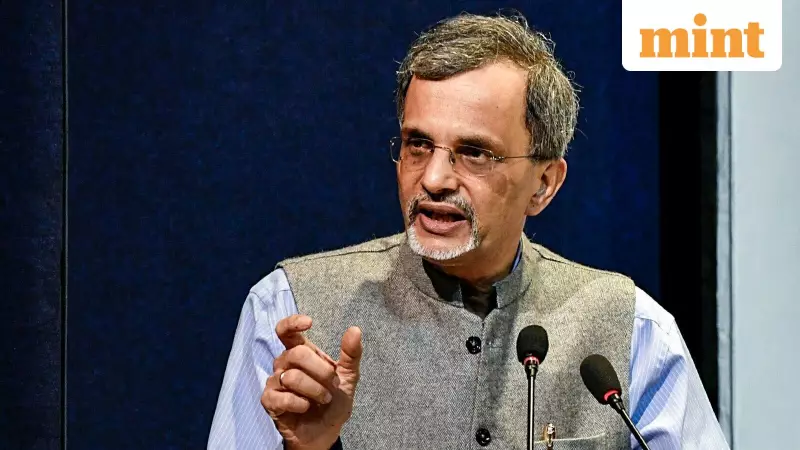
India's chief economic adviser V. Anantha Nageswaran has expressed heightened optimism about the country's economic prospects, stating he now feels more comfortable projecting GDP growth above 6.8% for fiscal year 2026. This upward revision signals renewed confidence in India's economic momentum driven by stronger private investment and improving foreign capital inflows.
From Caution to Confidence: Evolving Growth Projections
Speaking at the CNBC-TV18 Global Leadership Summit 2025, Nageswaran revealed that his initial projections had been more conservative, ranging between 6.3-6.8%. He recalled the economic concerns that prevailed just months earlier, noting "Back in August, we were all concerned about whether we would even go towards the lower end of the 6%-7% range."
The chief economic adviser emphasized that while he awaits second-quarter numbers before finalizing projections, he acknowledges "an upward bias" to current estimates. He further suggested that a resolution on trade disputes could transform this upward bias into mainstream forecast territory.

India's economy has demonstrated remarkable resilience, expanding faster than anticipated with GDP growth reaching 7.8% in the April-June quarter - the fastest pace recorded in five quarters. This robust performance comes despite challenges posed by rising US tariffs on Indian imports that have clouded the trade outlook.
Manufacturing Strategy and Investment Momentum
Nageswaran emphasized that India's push for domestic manufacturing must be complemented by deeper integration into global value chains. "There has to be a complementary goal of plugging ourselves into the global value chain," he stated, adding that success wouldn't come from "onshoring everything" but through smarter integration into the global production system.
Drawing lessons from the electronics sector's success, he highlighted key reforms including removing inverted duty structures and exempting raw materials from customs duties as crucial measures for reducing production costs. The production-linked incentive (PLI) scheme, he noted, should propel India from domestic indigenization to strategic resilience and eventually to becoming strategically indispensable.
Addressing concerns about private capital expenditure, Nageswaran firmly dismissed notions of weakness. "Honestly, I think the one-year data for 2023-24 has influenced us all to think that private capital has been somewhat disappointing. It's not," he asserted.
He provided context to the investment trajectory, explaining that 2024-25 has been "a very good year for private capex" according to data from both listed and unlisted private sector companies. Official estimates from the Ministry of Statistics and Programme Implementation's Forward-Looking Survey support this assessment, projecting private investments at ₹6.56 trillion in FY25, compared to public capital expenditure of ₹11.11 trillion during the same period.
Foreign Investment Revival and Fiscal Measures
The chief economic adviser highlighted a significant revival in foreign direct investment, noting that despite global uncertainties, net FDI numbers appear strong for 2025-26. "With five months of RBI data, we are seeing net FDI meaningfully higher than what it was in the last two years," he revealed.
This optimism is backed by concrete numbers - FDI inflows rose to $81.04 billion in FY25, up substantially from $71.28 billion recorded a year earlier.
On fiscal measures implemented by the central government, Nageswaran clarified that recent tax reforms were designed to strengthen both demand and supply sides of the economy. "What was done in direct taxes in February and indirect taxes in September, they are not about a demand boost. They are also very much about supply boost," he explained, emphasizing that demand visibility remains the most critical economic indicator rather than interest rates.

Looking ahead to the Union Budget, Nageswaran described it as "premature" to comment on the government's policy thrust, noting that many initiatives originate from other ministries while the finance ministry acts as a compiler. Ongoing work includes income tax simplification bills, customs reforms, and public sector banking initiatives.