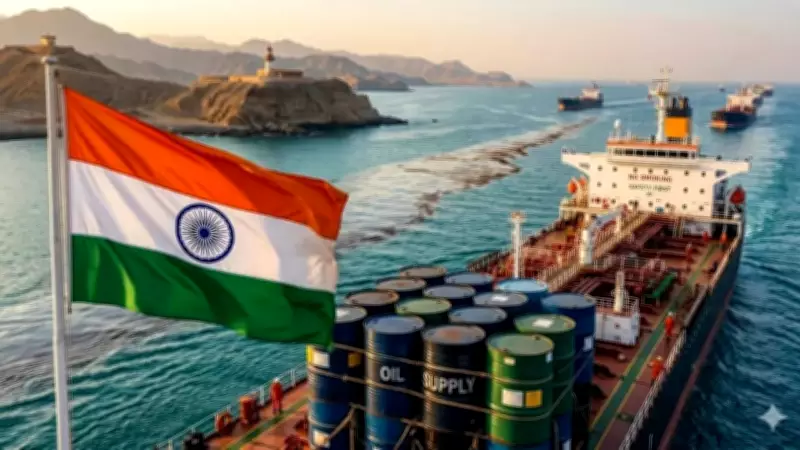
India Activates Contingency Plans as Hormuz Strait Tensions Threaten Oil Supplies
In response to recent military strikes in West Asia, Indian officials have swiftly activated contingency plans to protect the nation's energy supplies, with a sharp focus on the Strait of Hormuz—a vital global shipping route. The unfolding geopolitical situation has prompted immediate action to safeguard crude oil and liquefied natural gas (LNG) imports, which are crucial for India's economy.
Critical Role of the Strait of Hormuz
The Strait of Hormuz, situated between Oman and Iran, serves as a key conduit linking the Persian Gulf with the Gulf of Oman and the Arabian Sea. This narrow passage handles nearly 20% of the world's seaborne oil trade, making it indispensable for global energy markets. For India, which imports approximately 90% of its crude oil requirements—around 5.5 million barrels per day—over 40% of these imports transit through this route. Officials note that this share increased to about 50% in the first two months of this year, highlighting its growing importance. Additionally, about half of India's LNG supplies also pass through the Strait, underscoring its strategic significance.
Impact on Global Oil Prices and India's Economy
The recent attacks have already influenced global oil markets, with Brent crude closing at a seven-month high of $72.87 per barrel on Friday. Analysts predict that prices could spike further, potentially reaching $80 per barrel if geopolitical tensions persist. This surge poses a significant economic threat to India, as every $10 per barrel increase in crude prices could add $13-14 billion annually to the country's import bill. Moreover, any disruption in supplies via the Strait of Hormuz would not only trigger higher crude prices but also increase freight and insurance costs due to the need for import diversification.

India's Preparedness and Alternative Strategies
Indian officials have emphasized that pre-emptive measures are already in place to mitigate potential disruptions. These include strengthening strategic petroleum reserves, which can last up to 74 days to meet demand during a global crisis, and diversifying imports from 41 countries. Specific contingency options being explored involve utilizing alternative pipelines, such as the 360-km Habshan-Fujairah oil pipeline operated by ADNOC, with a capacity of 1.5 million barrels per day, and the 1,200-km East-West crude oil pipeline controlled by Saudi Aramco, which provides access to the Red Sea with a capacity of 5 million barrels per day.
Furthermore, India is considering increasing sourcing from regions like the United States, West Africa, Russia, and Latin America through eastern routes if West Asian supplies are disrupted. An executive at a state-owned refiner confirmed that internal discussions on alternative routes have been ongoing for weeks, reflecting proactive planning despite no immediate supply disruptions.
Global Context and OPEC+ Response
Amid the escalating tensions, OPEC+ is scheduled to meet on Sunday, with Saudi Arabia and the United Arab Emirates having already raised exports in anticipation of the strikes. The group had planned a modest increase in supply to stabilize markets. However, with limited alternatives to bypass the Strait of Hormuz, any prolonged disruption could have major consequences for global oil markets, affecting not only India but also other Asian countries reliant on this route.
As the situation continues to evolve, Indian authorities remain vigilant, closely monitoring developments to ensure energy security and minimize economic impact. The activation of contingency plans underscores India's commitment to navigating these challenges through strategic foresight and diversified import strategies.