

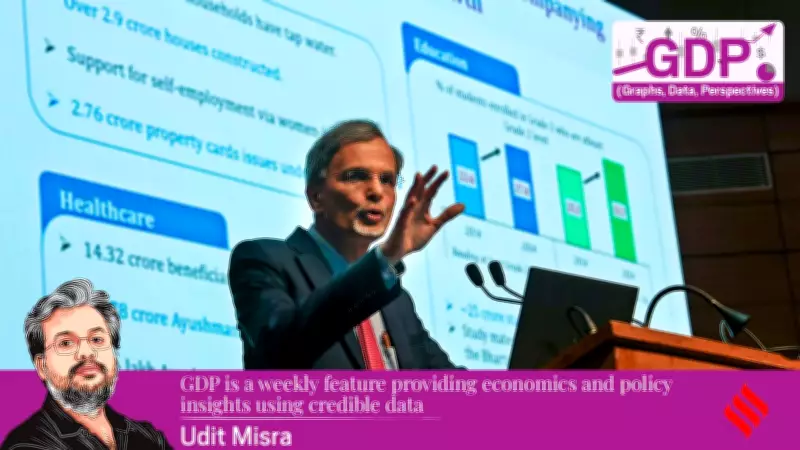
Economic Survey 2025-26 Revises India's Potential GDP Growth Upward to 7%
In a significant development, the latest Economic Survey for 2025-26, led by Chief Economic Advisor V Anantha Nageswaran, has reassessed and increased India's potential economic growth rate from 6.5% to 7%. This announcement comes amid intense debates over India's current economic growth metrics, often measured through Gross Domestic Product (GDP). The survey highlights that the cumulative impact of policy reforms implemented in recent years appears to have elevated the economy's medium-term growth potential closer to this revised figure.
Understanding Potential GDP Growth Versus Annual Growth
A country's potential economic growth rate differs fundamentally from the more commonly cited annual GDP growth rate. While the annual GDP growth rate indicates the actual expansion of an economy within a specific year, the potential GDP growth rate represents the maximum sustainable pace at which an economy can grow without triggering undesirable levels of inflation. Essentially, if demand for goods and services surges too rapidly—a core aspect of GDP growth—it can outstrip supply, leading to accelerated price increases. Thus, the potential growth rate serves as a benchmark for optimal economic performance under normal conditions.
Exceeding this potential rate carries risks of higher inflation, while falling short suggests that a nation is not fully utilizing its available resources. To sustainably boost a country's GDP growth, governments must focus on enhancing this potential growth rate, which hinges on several critical factors.

Key Drivers of Potential GDP Growth: A Mixed Record
The potential GDP growth rate is primarily influenced by three main components, as outlined in the Economic Survey. First, the capital stock in the economy encompasses all physical assets such as roads, bridges, and machinery that facilitate growth. Second, labor input refers not only to the size of the workforce but also to its capabilities and skills. Third, total factor productivity (TFP) measures the efficiency with which labor and capital are employed within the economy.
Historical data reveals a concerning trend: India's potential growth rate has been declining over the years. During the high-growth phase from 2003 to 2008, the potential rate stood at an impressive 8%. However, it dropped to 7% between 2009 and 2015. By 2023, even the Chief Economic Advisor acknowledged that around the time of the Covid-19 pandemic, the potential growth rate had fallen to 6.5%. This downward trajectory underscores challenges in maintaining robust growth drivers.
Policy Reforms and Their Impact on Growth Potential
Despite these historical declines, the Economic Survey points to recent policy initiatives as key factors in reversing the trend. Manufacturing-oriented reforms, including the Production-Linked Incentive (PLI) schemes, foreign direct investment (FDI) liberalization, and logistics improvements, have bolstered India's production capacity and supply capabilities. On the labor front, consolidation of labor laws, reduced regulatory compliance burdens, and state-level regulatory reforms have begun to alleviate frictions in the labor market.
Additionally, sustained investments in education, skilling programs, and the apprenticeship ecosystem are enhancing workforce quality and employability. The survey emphasizes that international experience indicates such increases in potential growth are most credible when reforms are persistent rather than sporadic, and when macroeconomic stability is maintained. Domestically, India meets both these conditions, according to the survey.
Caveats and Future Outlook
While the survey expresses optimism about India's growth potential, it concludes with a cautionary note. Geopolitical conflicts and their adverse effects possess the capacity to hinder India from achieving its full economic potential. This highlights the interconnected nature of global events and domestic economic performance.

In summary, the Economic Survey 2025-26 presents a nuanced view of India's economic landscape, balancing upward revisions in growth potential with an honest assessment of historical weaknesses in key drivers. As policymakers continue to implement reforms, monitoring these factors will be crucial for sustaining long-term economic health and resilience.





