

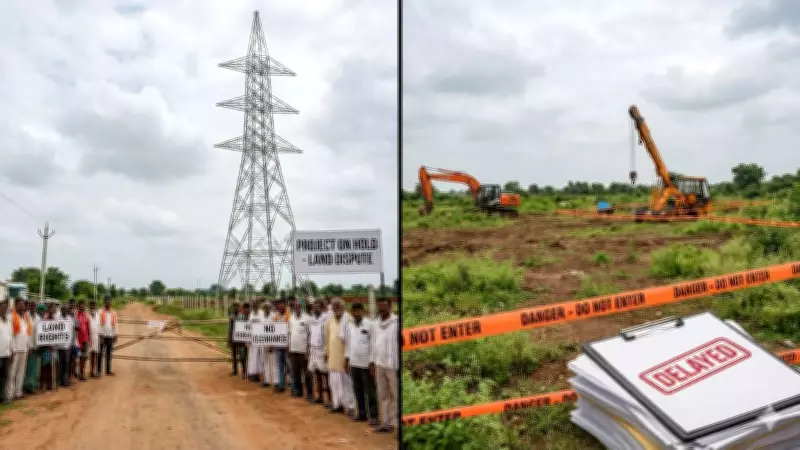
Land Acquisition and Clearance Hurdles Delay 25 Transmission Projects in India
New Delhi, February 10, 2026 – A significant bottleneck in India's energy infrastructure expansion has emerged, with 25 out of at least 164 under-construction transmission line projects under the Inter State Transmission System (ISTS) facing delays due to land acquisition and clearance-related challenges. Alarmingly, 24 of these delayed projects are specifically tied to the evacuation of renewable energy, posing a direct threat to the nation's ambitious climate targets.
Right of Way: A Critical Barrier to Green Energy Growth
The Ministry of Power has informed Parliament that delays stemming from Right of Way (RoW) issues have adversely affected project timelines. RoW refers to the essential strip of land beneath and adjacent to transmission lines that utilities require to construct, maintain, and safeguard this critical infrastructure. This transmission corridor serves as a minimum safety zone, ensuring compliance with safety clearances and electromagnetic field exposure limits, while allowing utilities to keep power lines free from obstructions like tall trees or buildings.
However, RoW has become a major impediment in expanding the transmission networks necessary to evacuate power from generating stations. The challenge is particularly acute for renewable energy, as capacity addition accelerates in alignment with India's goal of achieving net-zero emissions by 2070.

Renewable Energy Capacity Surge Amid Infrastructure Delays
India's renewable energy sector is experiencing rapid growth, with capacity additions reaching 44.51 GW during this financial year until November—nearly double the 24.72 GW recorded in the same period last year. By November, the total installed renewable capacity stood at 253.96 GW, marking a 23% increase from 205.52 GW in November 2024.
Despite this impressive growth, the mismatch between project commissioning and transmission infrastructure development is causing significant bottlenecks. Santosh Kumar Sarangi, Secretary at the Ministry of New and Renewable Energy (MNRE), highlighted that renewable energy curtailment is largely driven by this disparity in timelines.
Government Initiatives and Persistent Challenges
In December, the Parliamentary Standing Committee on Energy flagged RoW issues as a key hurdle in laying transmission lines under the government's Green Energy Corridor (GEC) programme. The MNRE has previously noted that delays in the GEC were due to a range of factors, including:
- State-specific technical and statutory constraints
- Right of Way challenges
- Restrictions in Great Indian Bustard (GIB) zones
- Nil bidder participation and weak bid response
- Repeated retendering processes
- Forest and environmental clearances
- Disruptions during monsoon seasons
The ministry reported that state governments have been addressing these challenges with support from local administration, but hurdles persist, especially in renewable-rich states such as Gujarat, Rajasthan, Karnataka, and Tamil Nadu. Building ISTS networks from these regions continues to face significant delays due to land acquisition and RoW issues, hampering the timely creation of essential transmission infrastructure.
As India strides toward its net-zero emissions target, resolving these land acquisition and clearance delays will be crucial to ensuring that the nation's renewable energy potential is fully harnessed and efficiently integrated into the national grid.






