

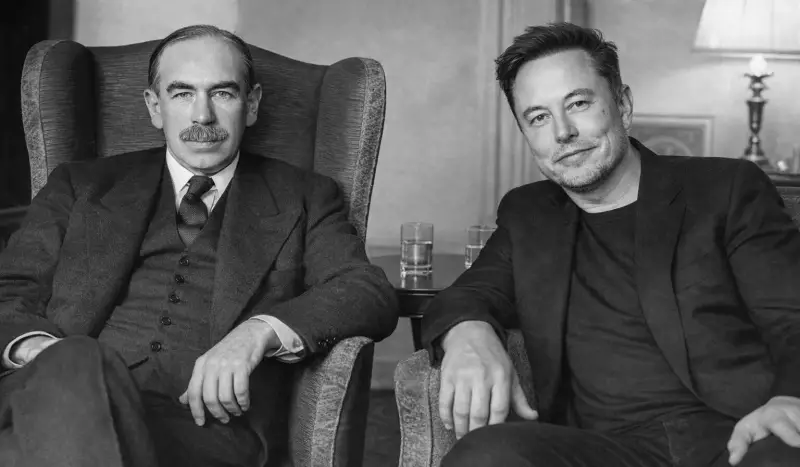
Just three hours ago, Tesla and SpaceX CEO Elon Musk ignited a fresh debate on economic philosophy with a blunt, five-word post on social media. Responding to former Coinbase CTO Balaji Srinivasan, Musk declared: "Keynes was a demon." This sharp critique was aimed at the foundational ideas of British economist John Maynard Keynes, whose theories have dominated Western economic policy for decades.
The Spark: A Tweet That Reveals a Growing Chasm
Musk was directly engaging with Balaji Srinivasan's provocative statement that the end of Western Keynesianism would be a more significant event than the collapse of Soviet communism. While not a market-moving event in itself, this exchange offers a revealing glimpse into the mindset of influential technology leaders. For them, this is not merely an academic discussion about a long-dead economist. It is a fundamental battle over who controls and shapes the modern global financial system.
Keynesianism: The Engine That Powered the Post-War West
John Maynard Keynes rose to prominence in the aftermath of the Great Depression of the 1930s. He championed a revolutionary idea that overturned classical economic thought. His core argument was that when capitalist economies seize up—when consumers stop spending and businesses halt hiring—governments should not remain passive. Instead, they must actively intervene, borrow money, and inject spending into the economy to restart the growth engine.

Before Keynes, economic recessions were often viewed as painful but necessary corrections. After Keynes, they became problems to be actively managed and solved. His framework became the silent operating system for Western nations after World War II. From massive public works like highways and the creation of welfare states to modern stimulus packages and bank bailouts, the logic remained consistent: when private sector demand fails, public money must fill the void.
Why Silicon Valley's Titans Are Pushing Back
The consensus around Keynesian solutions began to show severe cracks after the 2008 global financial crisis and was stretched further during the COVID-19 pandemic. Governments and central banks unleashed trillions of dollars in created money to prevent total economic collapse. Interest rates were kept at historic lows for years, public debt ballooned, and asset prices—like those of stocks and real estate—soared far ahead of wage growth. The eventual return of high inflation was, for critics, an inevitable consequence.
For figures like Elon Musk and Balaji Srinivasan, this outcome is not a temporary glitch. They see it as the logical end point of Keynesian thinking. They argue that when governments normalize permanent budget deficits and central banks embrace seemingly limitless money creation, all fiscal and monetary discipline vanishes. This environment, they claim, rescues poor investments, socializes risk, and allows politicians to fund promises not through transparent taxation, but by silently eroding the value of currency over time.
The Meaning Behind Musk's 'Demon' Label
Elon Musk's choice of the word "demon" is undoubtedly dramatic, but it underscores a critical viewpoint. Critics contend that Keynes did more than just alter recession responses; he provided intellectual cover for a world where money could be created and debt could expand with no clear limits. In this system, they believe, insiders and asset holders are rewarded, bubbles are inflated, and ordinary citizens bear the brunt through higher costs of living and diminished purchasing power.
Therefore, when Musk labels Keynes a demon, he is likely not attacking the man personally, but rather condemning the monetary universe his ideas helped unleash—a system that feels increasingly unanchored from anything tangible or solid.
Balaji's Prediction of an Imminent End
Balaji Srinivasan's assertion that this era is ending stems from a belief that the Western Keynesian model is hitting immutable constraints. With public debt at record highs, central banks trapped between fighting inflation and maintaining government solvency, and younger generations priced out of housing and wealth accumulation, the model's sustainability is in question. Critics view this as the inevitable result of running an economy on prolonged borrowing and money creation.

They anticipate a new economic phase, driven perhaps by decentralized cryptocurrencies, hard fiscal limits, or a political backlash against inflation and debt. The core belief is that the current system is nearing a breaking point.
The bottom line is this: Keynesian economics was conceived to stabilize capitalism, and for much of the 20th century, it succeeded in doing so. However, to today's powerful tech elites, it has morphed into a symbol of a system that perpetuates inefficiency, artificially inflates asset prices for the wealthy, and unfairly transfers the costs of today's governance to future generations. This is why Elon Musk's three-hour-old tweet carries weight. It is not a mere scandal; it is a clear signal of how the architects of the next economy perceive the foundations of our current one.





