Former RBI Governor Criticizes Finance Commission's Tax Sharing Proposal
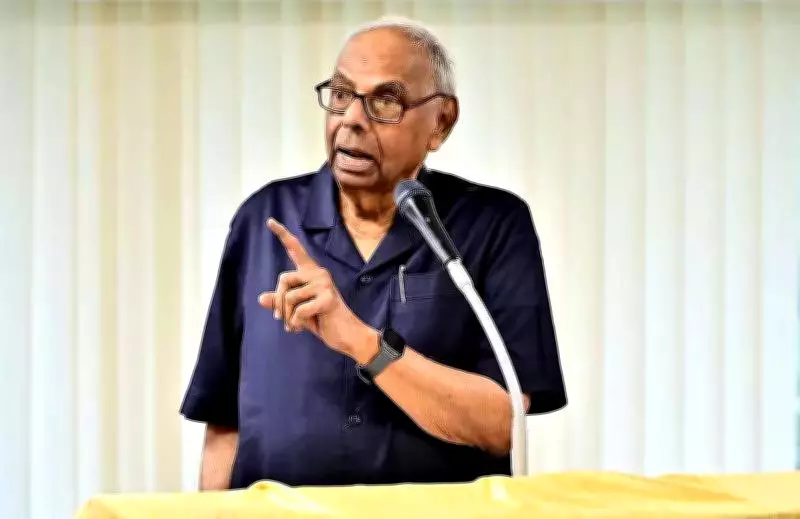
In a significant development, former Reserve Bank of India governor and eminent economist C Rangarajan has strongly criticized the 16th Finance Commission's recommendation for a "grand bargain" between the central government and states regarding the divisible tax pool. Speaking at a conference in Chennai on Tuesday, Rangarajan expressed his concerns about the appropriateness of such a proposal from the constitutional body.
The Controversial 'Grand Bargain' Proposal
The 16th Finance Commission report suggested that states might agree to a smaller share of the divisible tax pool, which would result in a larger overall pool with no revenue loss to either side. This arrangement would be contingent upon the Centre merging a larger portion of cesses and surcharges into regular taxes. Rangarajan found this approach surprising, emphasizing that "the finance commission was appointed to decide the shares of the Centre and states" rather than propose bargaining arrangements.
"This is surprising. The finance commission was appointed to decide the shares of the Centre and states," Rangarajan stated during his address at the conference jointly organized by the Madras Institute of Development Studies and Madras School of Economics.

Concerns About Shrinking Fiscal Space
Rangarajan highlighted that the finance commission repeatedly noted the shrinking fiscal space in its report. He pointed out that the central government has responded to this constraint by increasingly relying on cesses and surcharges rather than regular duties or taxes, since these two items are not part of the divisible pool that must be shared with states.
"The finance commission repeats in many places that the fiscal space is shrinking. The Central govt reacted to it in many ways, including levying cess and surcharges rather than duty or taxes, because these two items, cess and surcharges, are not part of the divisible pool," Rangarajan explained.
Stronger Position Needed on Centre's Measures
The former RBI governor argued that the finance commission should have taken a firmer stance against the Centre's approach. He expressed his view that the commission should have explicitly stated that it was inappropriate for the Centre to use cesses and surcharges as mechanisms to reduce states' share of revenue.
"In my view, the finance commission should have made a strong point that it is inappropriate for the Centre to resort to these measures to reduce the share of the states," Rangarajan asserted during his presentation.
Additional Criticisms and Broader Perspectives
Rangarajan also noted that the finance commission retained the provision that 41% of the divisible tax pool would go to states, while criticizing the removal of certain grants that previously benefited state governments. He expressed concern about how these changes might impact fiscal federalism in India.
During the same conference, S Narayanan, former economic adviser to the Prime Minister, offered a broader perspective on the issue. He cautioned against viewing the matter solely as a Centre versus State conflict, noting that such a narrow focus overlooks significant disparities within the country from social, economic, and anthropological perspectives.
"Simply looking at this as a Centre vs State issue misses a lot of disparities that are happening within the country from a social, economic and anthropological point of view," Narayanan remarked, suggesting that the discussion about fiscal arrangements should consider these broader dimensions of inequality and development.
Implications for Fiscal Federalism
The criticism from such a respected economist as Rangarajan raises important questions about the future of fiscal federalism in India. The debate centers on several key issues:

- The appropriate role of finance commissions in determining revenue sharing arrangements
- The impact of cesses and surcharges on states' financial autonomy
- The balance between central and state fiscal responsibilities
- The need for transparent and equitable revenue distribution mechanisms
As India continues to develop its fiscal architecture, discussions like these at academic conferences in Chennai and elsewhere will likely influence future policy decisions regarding intergovernmental financial relations and the constitutional framework governing revenue distribution between the Centre and states.