

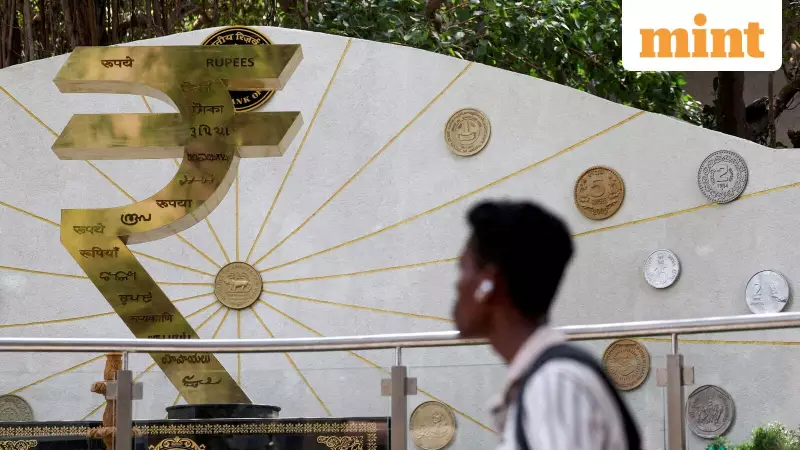
The Indian rupee crossed a critical psychological threshold on Wednesday, 3 December 2025, breaching the 90 mark against the US dollar to set a new record low. This milestone cements its position as the worst-performing major currency among both emerging and advanced economies for the year.
The Drivers Behind the Rupee's Steep Decline
As of 2 December, the rupee has depreciated by more than 5.5% against the US dollar in 2025. Analysts point to two primary, interconnected forces behind this sustained weakness. The first is the ongoing trade impasse with the United States, which escalated after the US imposed additional tariffs on India. This triggered a sharp 1.64% month-on-month depreciation in August alone.
The second major factor is the persistent outflow of foreign capital. Foreign Portfolio Investors (FPIs) have been pulling money out of Indian equity and debt markets for most of the year, reflecting concerns over India's growth outlook in a high-tariff global environment.

RBI's Shifting Stance and Economic Pressures
The Reserve Bank of India's (RBI) approach to managing the currency has evolved in response to these pressures. After actively defending the rupee at specific levels, the central bank has shifted to smoothing volatility rather than holding a rigid line. Dhiraj Nim, an economist and forex strategist at ANZ Bank, noted, "The RBI is smoothening moves but not defending levels. This shows they recognise the need for a more competitive rupee until the trade deal is resolved." He described the fall as a "natural economic adjustment."
This adjustment is happening against a backdrop of a widening trade deficit. While imports have remained robust, exports have suffered due to higher tariffs and global demand uncertainty, increasing the demand for US dollars to pay for imports.
Broader Weakness and Future Outlook
The rupee's depreciation is not isolated to the US dollar; it has also lost ground against the euro, British pound, and Japanese yen. This pattern signals a broader market reassessment of India's external resilience rather than a move driven solely by dollar strength.
Looking ahead, the currency's trajectory remains tightly linked to the resolution of trade tensions. ANZ's Nim expects the rupee to reach 91.5 by the end of the financial year 2027, but warns that "with the current momentum, that level can be realised very soon" without clarity on a US-India trade agreement.
This view is echoed by other institutions. Analysts at MUFG, in a report dated 2 December, stated that without a deal to lower tariffs, the bias would tilt towards further rupee weakness and potentially more RBI rate cuts, even as the domestic economy continues to support overall GDP growth.
The rupee's journey highlights the complex interplay of global trade dynamics, investor sentiment, and central bank policy in shaping the fate of a currency.






