

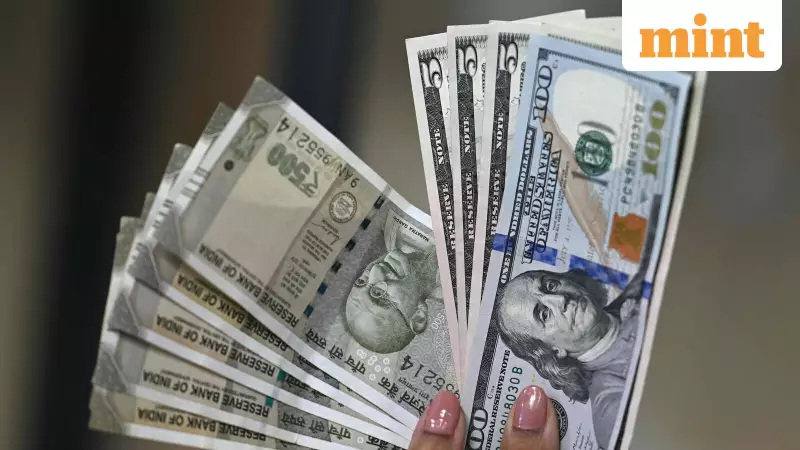
The Indian rupee extended its losing streak on Friday, slipping further against the US dollar. During early trading, the domestic currency depreciated by 10 paise to reach 90.44 per dollar. This marks the third consecutive session of decline for the rupee.
Rupee's Downward Movement Continues
Forex traders reported that the rupee opened at 90.37 in the interbank foreign exchange market. It quickly weakened to 90.44, down 10 paise from Thursday's closing level. On Wednesday, the currency had fallen by 11 paise to close at 90.34, following a 6-paise drop the previous day.
Two factors primarily drove the rupee's decline. A continuous outflow of foreign investments and a robust US dollar exerted significant pressure. However, the fall was somewhat cushioned by lower crude oil prices and a positive sentiment in domestic equity markets.

Five Key Factors Pressuring the Rupee
1. Strong US Dollar
The US dollar hit a six-week high, bolstered by surprisingly strong labor market data. Initial jobless claims in the US fell to 198,000 for the week ending January 10. This figure represents the second-lowest level in nearly two years and was much better than the expected rise to 215,000.
The data signaled resilience in the US economy. It strengthened market belief that the Federal Reserve will not cut interest rates soon. This expectation kept the dollar well-supported, putting pressure on emerging market currencies like the rupee.
2. Hawkish US Federal Reserve Comments
US Federal Reserve officials adopted a predominantly hawkish stance on Thursday. Their comments focused on inflation, with many indicating that potential rate cuts would depend on consistent progress toward the 2% inflation target. These stern remarks, combined with strong labor market indicators, further supported the dollar against the rupee.
3. India's Trade Deficit
India's merchandise trade deficit widened slightly in December. It increased to $25.04 billion from $24.53 billion in November, as imports rose. A larger trade gap means more dollars are leaving the economy than entering it. This creates a gradual but consistent strain on the rupee, especially when capital inflows are slow.
4. Delay in India-US Trade Deal
Commerce Secretary Rajesh Agrawal stated that India is close to finalizing significant trade deals with the US and the European Union. However, no specific timeline exists for the India-US agreement. While negotiations continue, the lack of a finalized deal delays potential positive impacts on market confidence and the rupee.
Dr. VK Vijayakumar, Chief Investment Strategist at Geojit Investments Ltd., noted, "Rupee movements will depend on many events like the outcome of the US-India trade agreement, foreign portfolio capital flows and India’s trade deficit. A favourable outcome from the US-India trade deal can strengthen the rupee since that can reverse FII outflows too."
Rahul Kalantri, VP Commodities at Mehta Equities Ltd., added that the rupee's outlook remains weak without progress on a US-India trade agreement. Persistent selling in domestic equities and rising crude oil prices due to geopolitical tensions are also capping any meaningful currency recovery.
5. Foreign Portfolio Investor (FPI) Outflows
Foreign investor sentiment poses a major challenge. Since the start of the year, Foreign Portfolio Investors have been net sellers. In January alone, they offloaded Indian equities worth ₹19,015 crore. As long as confidence remains low and foreign investment does not return, the rupee stays vulnerable. Every surge in the dollar feels more burdensome, and recovery attempts face obstacles.
Outlook for the Indian Rupee
Amit Pabari, MD of CR Forex Advisors, said that USD/INR is likely to face strong resistance in the 90.30–90.50 zone. A sustained break above this area could open the path toward 91.20–91.50. On the downside, 89.50 remains a key support level.
"For now, the rupee walks a narrow bridge — supported by the RBI below, tested by the dollar above, and guided by sentiment that is still waiting to turn," Pabari commented.

According to VK Vijayakumar, the rupee in the first half of 2026 is likely to hover around the 88-91 level. Rahul Kalantri expects the rupee to remain volatile this week amid fluctuations in the dollar index, domestic equity markets, and geopolitical tensions. He forecasts the currency pair could trade in the range of 89.20-91.40 in the near term.
Disclaimer: The views and recommendations mentioned are those of individual analysts or broking companies. They do not represent Mint. Investors should consult certified experts before making any investment decisions.





