

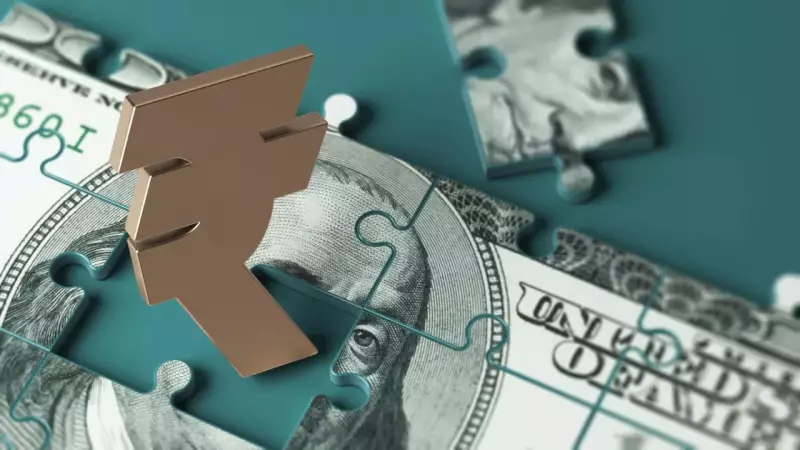
Analysts and official data point to a period of significant and sustained turbulence for the Indian rupee, extending through 2026. Persistent capital outflows, disruptions linked to global tariffs, and weakening foreign investment are overwhelming the nation's otherwise robust macroeconomic foundations, according to a PTI report.
Anatomy of a Decline: From Fundamentals to Outflows
Despite India's steady economic growth and controlled inflation, the currency has struggled to find a stable footing. Market experts warn that uncertainty surrounding international tariffs is a key hurdle, and even a potential trade agreement with the United States might not be enough, on its own, to steady the rupee.
The rupee has depreciated nearly 5% since breaching the 85-per-dollar mark in January, later falling past the historic low of 91 against the US dollar. Its performance against other major currencies has been stark: a drop of over 19% against the euro, about 14% versus the British pound, and more than 5% against the Japanese yen in the past year. This makes it the weakest performer among Asian currencies, even as the dollar index itself fell over 10%.

The slide intensified after reciprocal tariffs announced by US President Donald Trump in April triggered sustained foreign portfolio outflows. Global investors moved capital to other emerging markets promising better risk-adjusted returns.
The Investment Flow Reversal and RBI's Stance
The pressure is clearly visible in investment data. On a net basis, foreign direct investment (FDI) between January and October this year turned negative. Total investment inflows plummeted to minus $0.010 billion, a dramatic reversal from inflows of $23 billion in the same period last year. While net FDI was $6.567 billion, net portfolio investment stayed negative at minus $6.575 billion.
"FDI acts as the anchor flow for the balance of payments. When that anchor weakens, the currency becomes more dependent on portfolio flows; forex markets turn more sensitive to global risk sentiment; and central bank intervention requirements increase," explained Anindya Banerjee, head of currency and commodity research at Kotak Securities.
The rupee's fall accelerated in the year's final quarter. It dropped over 1% in a single session on November 21 to 89.66 per dollar, broke past the 90 level on December 2, and crossed the 91 mark on December 16.
The government has cited a widening trade deficit and delays in finalising a US trade pact, coupled with weak capital account support, for the depreciation. Minister of State for Finance Pankaj Chaudhary informed the Rajya Sabha on December 16 that the rupee's slide was influenced by the growing trade gap and developments around the India-US trade agreement.
RBI Governor Sanjay Malhotra has stated the central bank does not target a specific exchange rate. Analysts add that recent rate cuts aimed at boosting domestic growth have reduced the rupee's relative yield attractiveness.
Long-Term Anchor Amid Short-Term Storm
Dilip Parmar, a research analyst at HDFC Securities, described the situation as a capital account-driven crisis, where shrinking inflows are the primary driver, not just trade. The RBI has also moved towards a more flexible exchange rate regime, classified by the IMF as a "crawl-like" arrangement.
The drain on net foreign investment has amplified volatility. "A sharp decline in FDI has reduced long-term dollar inflows, making the rupee more dependent on volatile portfolio flows," said Jateen Trivedi, VP research analyst for commodity and currency at LKP Securities. He added that higher commodity prices and elevated risk around US trade deals diverted FDI away from India to competing destinations.
RBI data shows a depletion of $10.9 billion in foreign exchange reserves during July–September of FY26, compared to an accretion of $18.6 billion a year earlier. The record $17.5-billion exit by foreign institutional investors in 2025 has further increased dollar demand, pressuring the rupee.
Analysts anticipate the current account deficit widening to around 2% or more in 2026 as the full impact of US penalty tariffs affects exports, boosting structural demand for dollars. "A trade pact with the US would help, but it is not a silver bullet," cautioned Banerjee.

Despite the near-term stress, India's strong growth trajectory and stable inflation profile are seen as a long-term anchor for the currency. Banerjee expects the rupee to test the 92–93 levels amid global volatility over the next three to four months. A potential appreciation phase could begin from April as capital flows realign and dollar weakness becomes more pronounced, with levels of 83–84 possible by the end of FY27.





