

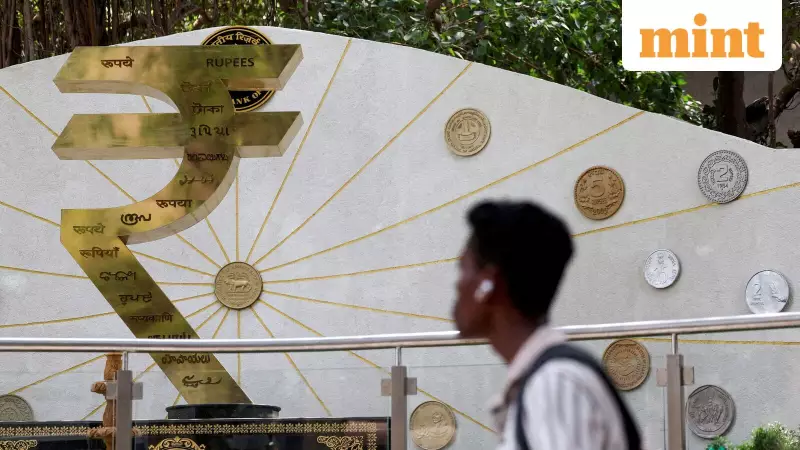
The Indian rupee touched a fresh record low against the US dollar on Wednesday, briefly crossing the 91 mark before the Reserve Bank of India (RBI) stepped in to curb the decline. The currency's slide, exceeding 6% this year, positions it among the weakest performers in emerging markets. However, economists emphasize this is not a crisis of external fundamentals but a pressure point from capital account dynamics.
Understanding the Pressure Points
Market experts are unanimous that India is not facing a current account crisis. The country's current account deficit remains manageable at around 1-1.3% of GDP, a level historically easy to finance. The real pressure is stemming from the capital account. Key factors include sustained portfolio outflows, profit repatriation by multinationals, and a noticeable slowdown in net foreign direct investment (FDI) inflows. This confluence, coupled with uncertainty from steep US tariffs, has driven the rupee's depreciation.
Five Potential Stabilizers for the Rupee
While the currency may remain volatile amid ongoing US-India trade talks, several developments could slow or even reverse its decline.

1. Revival in Foreign Direct Investment
Economists identify a pickup in net FDI as the most critical stabilizer. India previously funded larger deficits comfortably when annual FDI inflows were around $130 billion. Gaura Sengupta, chief economist at IDFC FIRST Bank, notes that while gross inflows are healthy, net FDI has slowed over the past two years due to increased repatriation. FDI represents long-term, sticky capital, unlike volatile portfolio flows. A revival hinges on improved expected returns on investment in India.
2. Higher Nominal GDP and Corporate Earnings Growth
Nominal GDP growth acts as a proxy for dollar-denominated returns for global investors. After slowing from about 12% in FY24 to an estimated 8% now, this compression makes Indian assets less attractive. A rebound, driven by faster real growth or stronger corporate pricing power, would directly enhance India's investment appeal. Sengupta suggests this requires reforms or a renewed long-term growth narrative that boosts profitability.
3. Better Performance of Indian Equity Markets
For many foreign investors, India is primarily an equity story. Over the past year, global markets from the US to China have outperformed Indian benchmarks. The perception of expensive valuations has reinforced outflows. A sustained turnaround in domestic equities, powered by companies beating earnings expectations and more reasonable valuations, could attract crucial portfolio and direct equity flows, easing pressure on the rupee.
4. Progress on a US-India Trade Agreement
Sentiment is a powerful driver. The rupee's weakness is increasingly linked to uncertainty around US trade policy. Although negotiations are underway with hopes of a deal by March 2026, the lack of clarity weighs on flows. As noted by Bank of Baroda's economic research team in a December 17 report, this is a sentiment-based factor. Any concrete progress would likely boost investor confidence, revive foreign portfolio investment (FPI) inflows, and reduce speculative pressure on the currency.
5. Strong Fundamentals and RBI's Calibrated Stance
India's underlying economic buffers remain robust. Neelkanth Mishra, chief economist at Axis Bank, highlighted on Tuesday that the balance of payments is comfortable. While higher gold prices add to import costs, this is offset by lower oil prices and strong double-digit growth in services exports and remittances. With foreign exchange reserves between $675-690 billion, the RBI is in a strong position. Mishra commended the central bank's approach of not rigidly defending a level, allowing the rupee to find its equilibrium, which encourages importers and exporters to hedge their exposures sustainably.

Outlook and Key Takeaways
The rupee's trajectory in the near term is closely tied to global capital flows and trade sentiment. While short-term volatility may persist due to external factors, India's strong forex reserves and the RBI's prudent management provide a significant cushion against any disorderly movement. A concerted improvement in FDI, corporate earnings, and equity market performance, alongside positive developments on the trade front, are the essential ingredients needed to build a firmer foundation for the Indian rupee.





