

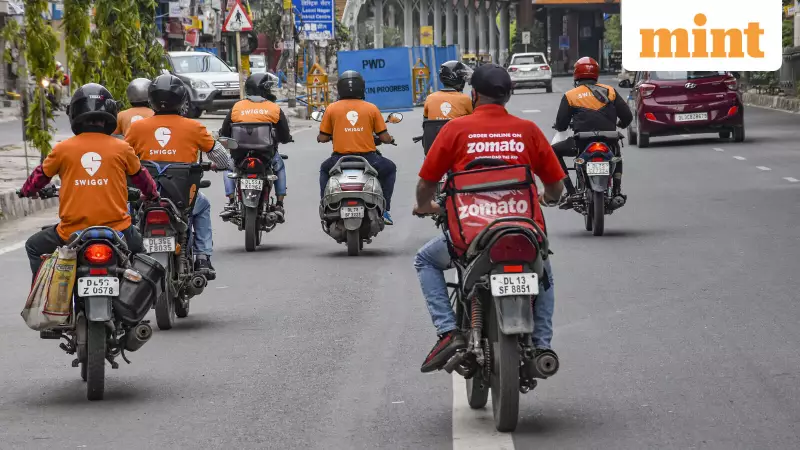
The recent New Year's Eve strike by gig workers in India, which ultimately fizzled out, has ignited a fierce debate about the true earnings of app-based delivery partners. While platforms like Zomato and Swiggy offered lucrative incentives to ensure service continuity, the incident has pulled back the curtain on a payment system defined by volatility, unpaid waiting hours, and a constant tug-of-war between supply and demand.
The Platform's Promise vs. Ground Reality
In the wake of the planned strike, Zomato CEO Deepinder Goyal took to social media platform X to present internal data. He stated that the average hourly earnings for Zomato delivery partners in 2025 stood at ₹102, calculated on all logged-in time, including waiting periods. Goyal projected that a partner working close to 10 hours a day for 26 days could earn a gross monthly income of roughly ₹26,500. After accounting for expenses like fuel and maintenance, estimated at 20%, the net take-home pay would be around ₹21,000.
However, worker unions and on-ground data paint a different picture. An examination of actual earnings dashboards reveals significant fluctuations. One Zomato partner earned ₹19,756.94 in December 2025 by completing 345 orders over nearly 125 hours of active delivery time, translating to ₹158 per active hour. Yet, weekly earnings varied wildly, from a high of ₹5,614 to a low of ₹1,870, showcasing the inherent instability.

The Hidden Cost of "Logged-In" Time
A critical flaw in the earnings calculation, as highlighted by a report titled Prisoners on Wheels from the labour rights collective Paigam, is the prevalence of unpaid waiting time. The report, funded by the University of Pennsylvania, found that 43% of delivery partners wait idle for at least an hour daily for orders, with another 34% waiting for two hours. In Delhi, over half spend at least two hours daily waiting unpaid.
This waiting period, often spent in poor conditions outside restaurants or in gated communities without access to basic amenities, is not compensated. A Swiggy partner's dashboard from 31 December 2025 illustrates this: he earned ₹844 for 22 trips while being online for almost 13 hours, resulting in an effective hourly rate of just ₹65 when including waiting time.
"The time shown as 'online' does not mean paid work. Earnings depend only on trips completed, not total availability," explained a union representative. This uncounted labour forms a significant part of a gig worker's day without contributing to their income.
Beyond Wages: The Broader Crisis of Gig Work
Balasubramanian Anantha Narayanan of TeamLease notes that earnings are a complex function of supply and demand, leading to a wide range of ₹20,000 to ₹40,000 in gross monthly income. After expenses, the take-home pay for the top bracket may settle at ₹20,000-₹25,000, but can easily fall below ₹20,000.
However, the debate extends beyond pay. The Paigam report underscores non-wage stressors, revealing that 41.5% of delivery workers have faced workplace violence, often without platform support. Furthermore, workers cite a lack of transparency in order allocation and unfair practices, such as static payouts despite increased delivery distance after order acceptance.
Narayanan argues the core issue is the absence of a growth path, safety nets, and social security. "Gig workers’ core demands include health insurance, life cover, accident cover and retirement benefits," he stated. This sentiment is echoed by service providers on platforms like Urban Company, where a beauty partner reported monthly earnings plummeting from ₹55,000-60,000 in 2018 to just ₹13,000 recently, citing reduced service prices and higher platform commissions.

As the debate rages, a policy shift is underway. Draft rules under the Code on Social Security aim to formally recognize gig workers and bring them under social protection, potentially making them eligible for insurance and welfare benefits. The enforcement of these provisions will crucially determine whether the gig economy evolves into a more sustainable framework or remains a model of precarious flexibility.





