

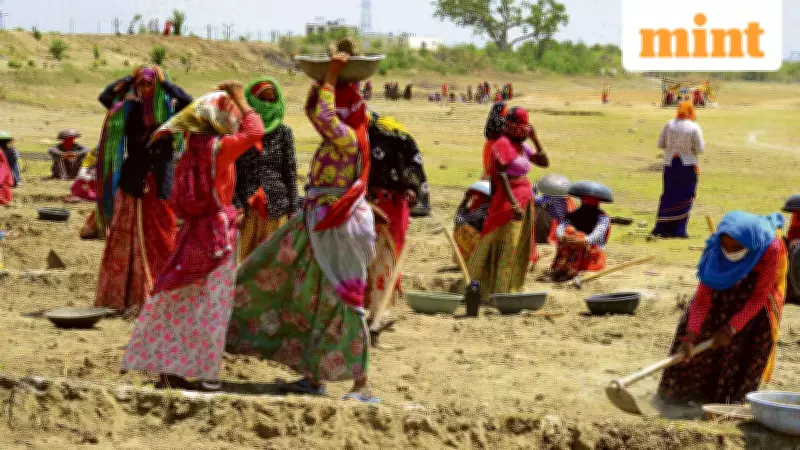
India's Rural Job Guarantee Overhaul: Why Field Trials Are Crucial Before Full Rollout
The recent Union Budget has signaled a significant transformation in India's approach to state-backed rural employment support. With a sharp reduction in funding for the Mahatma Gandhi National Rural Employment Guarantee Act (MGNREGA) scheme and substantial allocation to the new Viksit Bharat Guarantee for Rozgar and Ajeevika Mission-Gramin (VB-G RAM G) program, policymakers are steering toward a revised framework. However, given the profound changes embedded in the new scheme, experts emphasize the necessity for comprehensive field trials before nationwide implementation.
The Budgetary Shift: From MGNREGA to VB-G RAM G
The financial blueprint reveals a dramatic reallocation of resources. MGNREGA funding has been slashed to ₹30,000 crore from last year's expenditure of ₹88,000 crore, while the incoming VB-G RAM G scheme receives an allocation exceeding ₹95,000 crore. This transition marks a pivotal moment in India's rural employment policy, moving away from the unconditional guarantee that has characterized MGNREGA since its inception in 2006.
The original scheme emerged from the political landscape following the NDA government's defeat in the 2004 elections. Despite robust economic growth indicators, rural India faced persistent challenges, prompting the newly elected UPA government to introduce a universal, demand-driven employment guarantee. This entitled rural households to 100 days of work annually without preconditions, with provisions for unemployment allowances if work wasn't provided within 15 days of demand—though such allowances were rarely enforced in practice.

Current Employment Landscape and MGNREGA's Role
Recent data provides crucial context for evaluating the proposed transition. According to calculations based on Periodic Labour Force Survey statistics, approximately 2.2% of working-age women (15-59 years) and 0.13% of men in rural India reported engagement in 'casual wage employment in public works' during 2023-24—a reliable proxy for MGNREGA participation. This translates to roughly 8.5 million women and 500,000 men.
Administrative records further indicate that average household participation in MGNREGA hovers around 50 work days annually, significantly below the guaranteed 100 days. Meanwhile, rural unemployment rates stood at 2.5% for men and 1.2% for women in the same period. However, these figures obscure the substantial proportion of women (approximately 37%) who remain outside the labor force, often discouraged by limited suitable employment opportunities.
Wage Disparities and Behavioral Insights
Comparative wage analysis reveals important patterns in rural labor markets. While MGNREGA nominal wages increased from approximately ₹133 in 2013-14 to ₹253 in 2024-25, market wages for alternative rural occupations remained substantially higher. Official data shows that by 2024-25, all-India average daily wages reached about ₹398 for male agricultural laborers (₹316 for women) and ₹441 for male construction workers (₹343 for women).
Research indicates that when farm wages exceeded MGNREGA wages by ₹150-200 on average, many workers opted against agricultural employment, possibly due to its more strenuous physical demands. This behavioral insight appears to inform VB-G RAM G's design, particularly its provision for suspension during peak harvest seasons—presumably to channel labor toward agricultural work when wages are higher.
Unanswered Questions and Implementation Concerns
Several critical policy questions remain unresolved in the transition to VB-G RAM G. First, there's insufficient publicly available data regarding the extent of households' continuous reliance on MGNREGA versus its use as a temporary buffer during economic shocks. Understanding whether the program fosters state dependency among certain households or serves primarily as a safety net is essential for effective redesign.

Second, the reform process has raised procedural concerns. The absence of documented consultations with state governments, coupled with a revised funding structure that shifts 40% of costs to states, potentially reduces central fiscal responsibility while challenging states' implementation capacities. This financial restructuring could have significant implications for scheme delivery across diverse regional contexts.
The Case for Phased Implementation and Pilot Trials
Given these complexities, experts advocate for a cautious, evidence-based approach to implementing VB-G RAM G. The absence of pilot trials in at least one major Indian state leaves the transition resting on uncertain empirical foundations. A phased rollout schedule would allow for systematic assessment of the scheme's impact across various parameters:
- Labor market responses during harvest-season suspensions
- State governments' administrative and financial capacities under the new cost-sharing model
- Effects on vulnerable groups, particularly women and households with limited mobility
- Comparative outcomes between MGNREGA and VB-G RAM G participants
Such field testing could generate valuable insights to refine the scheme before nationwide expansion, potentially preventing unintended consequences that might exacerbate rural economic stress.
Beyond Scheme Design: The Broader Employment Challenge
Ultimately, the debate transcends mere program replacement. India's rural employment landscape must align with evolving labor market realities, particularly as rural youth attain higher education levels. The durable solution lies in expanding quality non-farm employment opportunities, especially for women who often face mobility constraints that limit urban migration.
The transition from MGNREGA to VB-G RAM G represents more than administrative restructuring—it reflects an ongoing negotiation between social protection objectives and market realities. As India navigates this complex terrain, evidence-based policymaking through systematic field trials could ensure that reforms genuinely enhance rural livelihoods rather than merely altering program architecture.
The authors are, respectively, Union Bank Chair professor of economics at Great Lakes Institute of Management, and assistant professor at Institute of Management Technology.





