

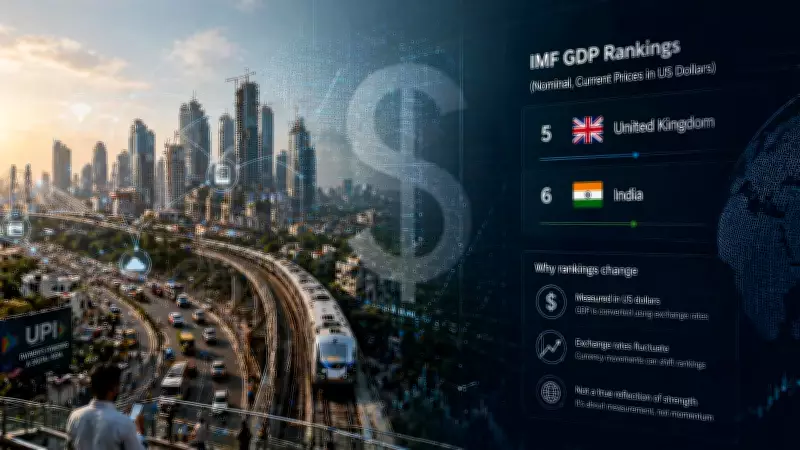
India's return to sixth place in the latest IMF global GDP rankings may seem contradictory. How can a country projected to be the fastest-growing major economy lose ground? The answer lies in how rankings are calculated. They are based on the total size of the economy in current US dollars, not growth rates. In the IMF's April 2026 World Economic Outlook, India's nominal GDP for 2026 is estimated at about $4.15 trillion, behind the UK's $4.26 trillion, despite India's real GDP growth of 6.5%.
Nominal GDP vs. Real Growth
Nominal GDP reflects the current market value of goods and services, influenced by exchange rates and inflation. India's rupee depreciation against the dollar reduced its nominal GDP in dollar terms, offsetting its high real growth. Meanwhile, the UK's stronger currency and moderate growth helped it maintain a higher nominal GDP.
Exchange Rate Impact
The Indian rupee weakened by about 5% against the US dollar in the past year, shrinking the dollar value of India's output. This factor, combined with global economic conditions, caused India to slip despite robust domestic expansion.

Outlook for India
India remains the fastest-growing major economy, with the IMF projecting 6.5% growth in 2026. However, to climb the rankings, India needs sustained high growth and a stable currency. The gap with the UK is narrow, and India could regain fifth place if growth outperforms and the rupee stabilizes.






