

World Bank Announces Major $8-10 Billion Annual Funding for India's Job Creation Drive
The World Bank Group has unveiled a significant new partnership with the Government of India, committing substantial financial support aimed at boosting employment opportunities across the nation. This strategic collaboration represents a major step forward in India's development journey.
Enhanced Financial Commitment for Employment Generation
The World Bank revealed on Thursday that it has established a fresh partnership framework with India, designed to support job creation initiatives in both urban and rural regions. The financial institution has pledged annual financing of $8-10 billion over the coming five-year period, marking a substantial increase from previous arrangements.
This new initiative, which took effect from the beginning of 2026, replaces the earlier plan that was originally scheduled for FY18-22 but extended to December 2025 due to pandemic-related disruptions. The previous framework had an annual outlay of $6-7 billion, making the current commitment significantly larger in scope and ambition.

Strategic Focus on High-Impact Sectors
The partnership will concentrate on sectors with substantial job creation potential, specifically targeting areas that can generate local employment at scale. According to World Bank officials, the primary focus will be on:
- Infrastructure and energy development projects
- Agribusiness and agricultural transformation
- Healthcare system improvements
- Tourism industry expansion
- Value-added manufacturing initiatives
A World Bank spokesperson emphasized that the program will continue for approximately five years, with immediate deployment of funds through existing government schemes.
Government's Vision and Implementation Strategy
Finance Minister Nirmala Sitharaman welcomed the new country partnership framework, stating that it aligns perfectly with India's Viksit Bharat vision. In her remarks, she highlighted several key aspects of the collaboration:
- Leveraging public funds with private capital to maximize impact
- Creating employment opportunities across both rural and urban India
- Incorporating the World Bank Group's global knowledge and expertise
- Achieving sustainable impact at both speed and scale
The minister noted that this support would have a "sustainable impact" on job creation in India, supporting the government's ambitious goal of transforming the country into a developed nation by 2047.
Immediate Deployment Through Existing Programs
The World Bank funds will be channeled through ongoing government schemes to ensure rapid implementation and maximum effectiveness. Key programs that will receive support include:
- Pradhan Mantri Skilling and Employability Transformation through Upgraded ITIs
- The Maharashtra Project on Resilient Agriculture
- The Kerala Health Systems Improvement Program
- Expansion of electric mobility infrastructure across the country
This approach ensures that the funding complements existing initiatives rather than creating parallel structures, thereby enhancing efficiency and impact.
World Bank Leadership's Perspective
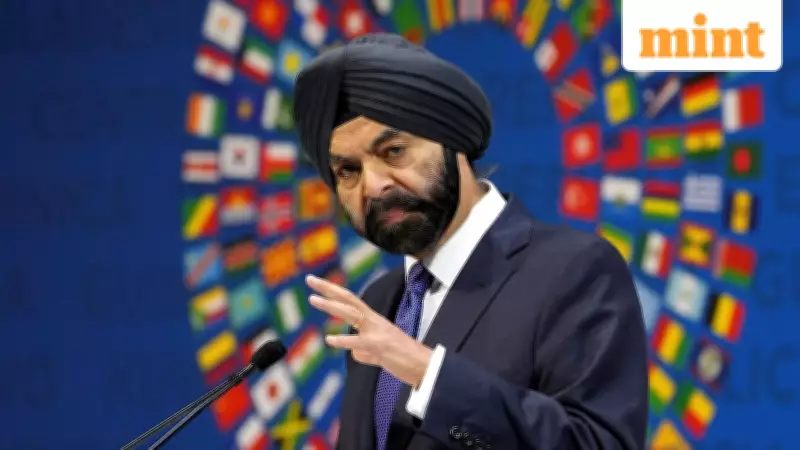
World Bank Group President Ajay Banga, who was in India for the announcement, emphasized the strategic importance of this partnership. He described India as "one of the key engines of global growth today" and stated that the collaboration aims to accelerate India's progress toward its development goals.
"Creating more jobs is at the core of our work," Banga declared. "This partnership brings together financing, reforms, and private sector investment to turn growth into opportunity for millions of Indians."
India's Position as World Bank's Largest Client
The World Bank's statement on Friday confirmed that India remains the institution's largest client, with substantial existing commitments across multiple agencies:

- International Bank for Reconstruction and Development (IBRD) commitments: $20 billion across 79 projects
- International Finance Corporation (IFC) commitments: $16.72 billion across 174 projects
- Multilateral Investment Guarantee Agency (MIGA) guarantees: $618 million
The new partnership will further shift IBRD resources toward leveraging private-sector capital while drawing more extensively on the World Bank Group's private-sector expertise and financial instruments.
Broader Development Funding Landscape
While the World Bank represents India's largest partner among multilateral development banks, the country maintains relationships with several other international financial institutions, including:
- The Asian Development Bank (ADB)
- The Asian Infrastructure Investment Bank (AIIB)
- The BRICS-led New Development Bank (NDB)
As of December 31, 2025, the World Bank's India portfolio comprised 710 projects with total commitments of $139.07 billion. These initiatives span numerous sectors critical to national development, including agriculture, education, energy, environment, finance, governance, health, infrastructure, macroeconomics, social programs, transport, urban development, water resources, and digital transformation.
The partnership announcement comes amid broader changes in the World Bank's South Asia administrative structure, with Pakistan and Afghanistan having been removed from the region in July 2025. The South Asia group now consists of six countries: India, Bangladesh, Bhutan, the Maldives, Nepal, and Sri Lanka.





