

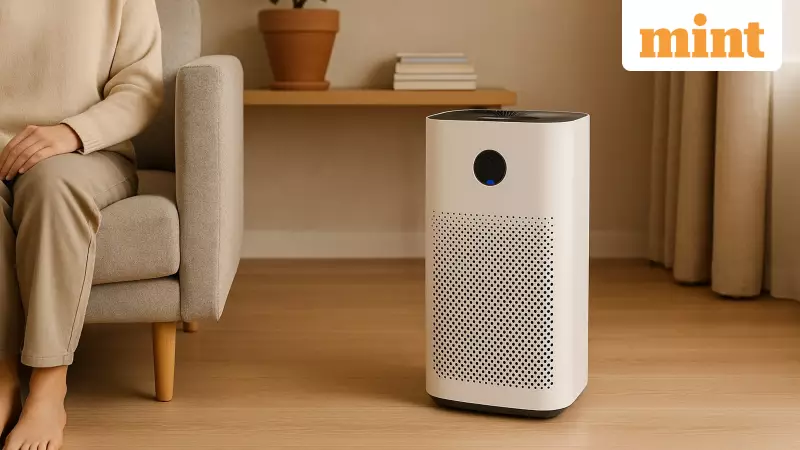
The Delhi High Court issued a sharp directive on Wednesday, criticising authorities for failing to provide tax relief on air purifiers. The court emphasised that these devices have transformed from luxury items into essential tools for survival, given the capital's dangerously polluted air.
Court's Stern Directive to GST Council
A bench comprising Chief Justice Devendra Kumar Upadhyaya and Justice Tushar Rao Gedela ordered the Goods and Services Tax (GST) Council to convene at the earliest. The court's directive is clear: consider removing or significantly lowering the GST levied on air purifiers.
The bench acknowledged that organising a meeting of the pan-India GST Council takes time. However, it stressed the immediacy of the public health crisis, stating, "considering the air quality situation in Delhi and nearby areas, we find it appropriate for the GST council to meet at the earliest." This instruction was formally recorded in a court notice issued on Wednesday.

Why Air Purifiers Are Taxed as Luxury Items
Currently, air purifiers attract an 18% GST, placing them in the same category as electronic luxury goods like air conditioners and televisions. The core issue, as highlighted in a Public Interest Litigation (PIL), is that they are not classified as medical devices, which are taxed at a much lower rate of 5%.
The petition argued that this high tax rate makes a crucial health intervention financially inaccessible for a large portion of Delhi's population. It stated that air purifiers serve a medically recognised role by preventing respiratory complications, especially during prolonged periods of toxic air quality.
High Court's Rebuke to Authorities
During the hearing, the judges expressed strong disapproval of the government's inaction. The bench pointedly remarked that providing citizens with clean air is a fundamental right, and reducing the tax burden on purifiers is the "minimum" that can be done in the current emergency.
"Every citizen requires fresh air. If you can't do it, minimum you can do is reduce GST. Give an exemption for 15 days on a temporary basis. Treat this situation as an emergency," the High Court told the authorities.
The judges underscored the severity of the health hazard by citing a stark fact: "How many times do you breath in a day? 21,000 times. Just calculate the harm you are doing to yourself." For weeks, Delhi's Air Quality Index (AQI) has consistently remained in the 'Poor', 'Very Poor', and 'Severe' categories, with readings frequently crossing 400 at multiple monitoring stations.
Key Implications and Public Demand
The PIL sought a judicial direction to the central government to reclassify air purifiers as "medical devices" and slash the GST to 5%. It contended that the current 18% tax inflicts an "arbitrary, unreasonable, and constitutionally impermissible burden" on people.
This legal push comes at a time when sales of air purifiers have surged in the National Capital Region. Residents, desperate for clean indoor air, are facing high costs exacerbated by the significant tax component. The court's intervention highlights the growing chasm between public health needs and fiscal policy, urging a swift realignment to address what it deems a clear emergency.






