The Goa revenue department has introduced a new land valuation methodology, replacing the earlier uniform rate system with a category-based approach. This change assigns different minimum land rates to areas within a village based on location and available amenities, with Taleigao serving as the pilot project.
New Methodology Details
Under the previous system, the revenue department fixed a single minimum land rate for an entire village. The new methodology allows the department to determine the value of individual plots based on their proximity to amenities and services. The department stated that dividing villages into smaller categories with different land valuation rates is a more “practical, rational and effective” method for fixing minimum land rates.
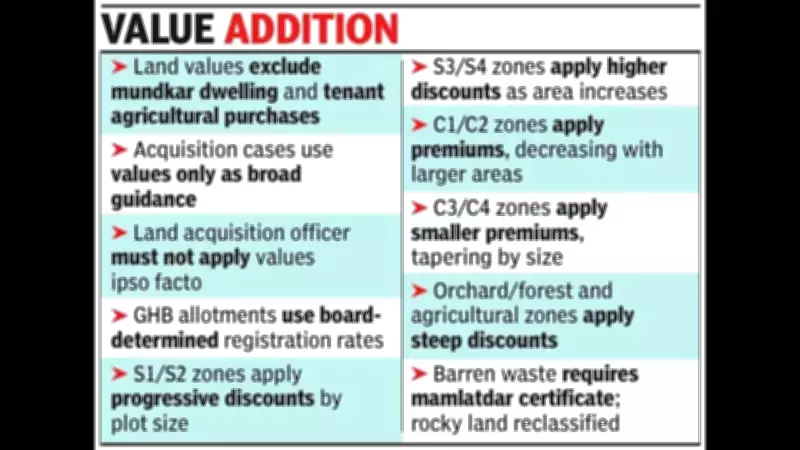
Notified by revenue under secretary Vrushika Kauthankar, Taleigao has been divided into five categories — A, B, C, D and E — each with separate minimum land rates for 2026-27. The revised rates will serve as the basis for stamp duty calculations and will vary depending on the zone and plot size, Kauthankar said.

Category-Wise Rates
Plots in category A will carry the highest base rate of Rs 30,000 per sqm, with rates decreasing across the lower categories. Survey numbers falling under category B will be valued at Rs 25,000 per sqm. Category D plots have been assigned a base rate of Rs 7,000 per sqm. Land classified under category E will be valued at 20% of the lowest minimum rate specified for categories A to D.
Departure from Previous Practice
The decision marks a significant departure from the earlier practice of fixing a single rate for entire villages, a system the government acknowledged led to widespread valuation inconsistencies and revenue loss. Officials noted that uniform rates failed to account for differences in proximity to the coast, sea views, urban centres, road connectivity, civic amenities and commercial activity within villages.
“Fixation of uniform rate results in overvaluation or undervaluation of some areas, thereby creating inconsistencies in valuation, reducing transparency and increasing grievances and objections,” the notification stated.
Application and Modifications
The base rate applies to S1 zone properties measuring up to 1,000 sqm, with variations across zones and plot sizes detailed in an appendix to the order. Under the new framework, properties up to 500 sqm in zones S1 to S4 will receive a 30% reduction from the base rate, except those in category E. The revision partially modifies an earlier order dated Oct 30, 2024, which notified revised minimum land rates for Tiswadi, Salcete and Mormugao talukas.