Deputy Chief Minister of Maharashtra, Ajit Pawar, disclosed on Monday that the state's exchequer faced a significant revenue shortfall of up to Rs 12,000 crore as a consequence of Prime Minister Narendra Modi's 'GST Bachat Utsav' campaign. Despite this financial impact, Pawar affirmed the state government's commitment to supporting key institutions, including the revival of the Nashik District Central Cooperative Bank.
GST Reductions and State's Revenue Sacrifice
Addressing a campaign rally in Mhaswad, located in the Satara district, Pawar elaborated on the timeline of tax reforms. He noted the abolition of octroi, followed by the introduction and subsequent scrapping of the local body tax, and finally the rollout of the Goods and Services Tax (GST).
The Prime Minister's initiative to reduce GST slabs led to substantial cuts: the highest slab of 28% was brought down to 12%, the 18% slab was reduced to 5%, and the 5% slab was eliminated entirely. Pawar, who also holds the finance portfolio, stated that these reductions directly resulted in revenue losses for all states.

"Maharashtra alone faced losses ranging from Rs 10,000 crore to Rs 12,000 crore," Pawar said. However, he emphasized that the state supported the central government's decision as it was fundamentally aimed at providing relief to the poor and needy sections of society.
Campaign Trail and Financial Allocations
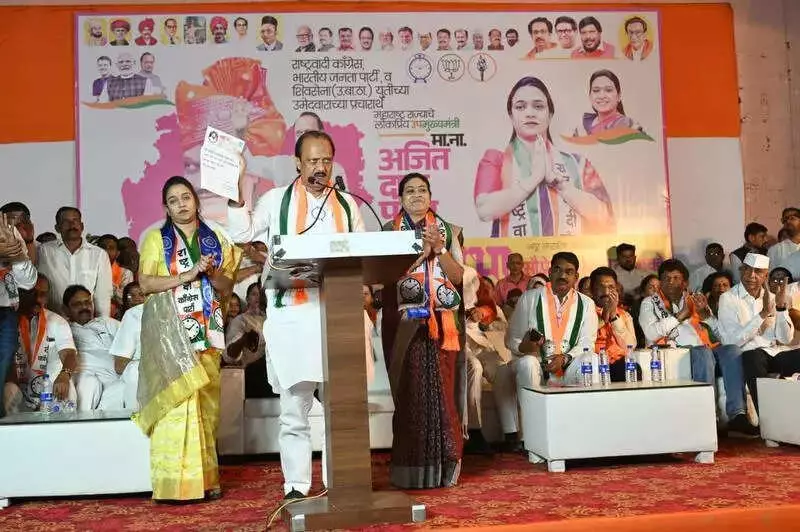
Pawar was in Mhaswad to campaign for candidates of the Nationalist Congress Party (NCP) and the NCP (Sharadchandra Pawar) in the upcoming council elections, where a local alliance has been formed to take on the Bharatiya Janata Party (BJP).
Highlighting Maharashtra's outsized contribution to the national GST kitty, Pawar pointed out that the state generates 16-17% of the total GST collected by the Centre. He explained the fund flow mechanism, where the Union government releases funds to states, which are then allocated in the state budget for local bodies. He stressed that the pace of development work is often tied to the timely release of these central funds.
Illustrating the financial constraints at the local level, Pawar mentioned that the Mhaswad Municipal Council generates only about Rs 10 crore from its own revenue sources. To bridge funding gaps, he reiterated his strong connections with the Centre and corporate entities, suggesting that Corporate Social Responsibility (CSR) initiatives could be a viable solution.
"We have successfully attracted corporate funds through CSR in Baramati, and we can replicate a similar model on a smaller scale for the development of Mhaswad," Pawar assured the gathering.
Policy Announcements and Political Critiques
Earlier in the day, at a public rally in Bhagur, the Deputy Chief Minister made a significant policy announcement. He declared plans to bar individuals responsible for financial mismanagement and distress in cooperative banks during their tenure from contesting elections to these institutions in the future.
He also launched a political attack on the Shiv Sena, criticizing the party for failing to bring substantial development to Bhagur despite being in power for 25 years.
For the council polls, the NCP, BJP, and Shiv Sena (UBT) have formed an alliance and have nominated NCP office-bearer Prerna Balkawade as their consensus candidate for the council president's post. Pawar urged voters to support the alliance panel, promising that their victory would ensure comprehensive development and transform Bhagur into a clean and well-developed city.
Focus on Welfare Schemes and Farmer Aid
Emphasizing the government's focus on women's empowerment, Pawar highlighted various initiatives run through self-help groups and schemes under the women and child development department. He directly countered opposition claims that the popular 'Ladki Bahin' scheme would be discontinued, firmly clarifying that the scheme would continue to benefit women across the state.

On the agrarian front, Pawar outlined relief measures for farmers affected by unseasonal rains. The state government has provided assistance worth Rs 44,000 crore to farmers who lost their crops due to heavy rains between May and mid-October, he announced. In a significant move, the government has also increased the land eligibility limit for compensation from two hectares to three hectares, extending support to a larger number of cultivators.