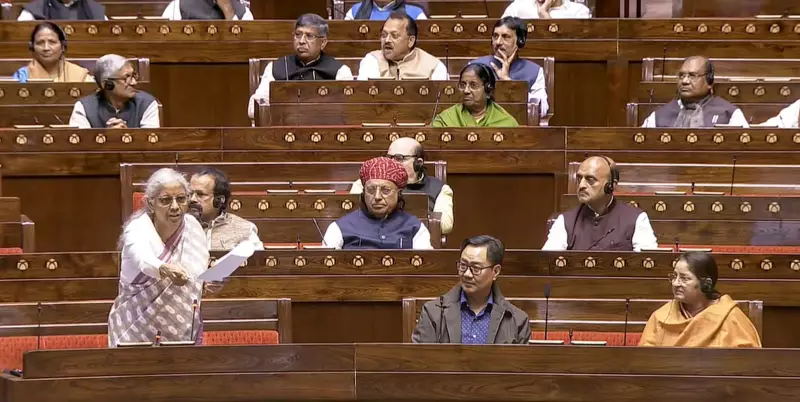
Union Finance Minister Nirmala Sitharaman provided crucial clarifications in the Rajya Sabha on Thursday regarding the proposed Health and National Security Cess Bill, 2025. She firmly stated that the new levy would exclusively target demerit goods, such as pan masala, and would not be applied to essential commodities. The revenue generated is intended to create a dedicated funding stream for national health initiatives and security needs, with a portion being shared with state governments.
Purpose and Mechanism of the New Cess
While introducing the Bill, Sitharaman emphasized its objective to establish a "dedicated and predictable resource stream" for two critical national priorities: public health and security. She explained that the cess is designed as a deterrent on products associated with significant health risks. "This is a cess, and it is placed not on any essential commodity. The purpose of this Bill is to levy a cess on demerit goods... We wish to impose such a cost, so that it is a deterrent, so people tend not to use it," the Finance Minister said during the discussion.
She detailed that the cess on pan masala would be levied on a capacity-based system, linked to manufacturing machinery, rather than on actual production or consumption. This, she argued, would not interfere with the existing Goods and Services Tax (GST) framework. "It is imposed not on consumption but on machine-linked and capacity-based... It will not impact the GST system at all," Sitharaman clarified. Currently, pan masala attracts a 28% GST plus a variable compensation cess.

Opposition Voices Concerns: Inspector Raj and MSME Impact
The proposed legislation faced criticism from several opposition members, who raised alarms about potential negative consequences. DMK member Sumathi accused the government of excessive reliance on cesses, calling it a "cessification of governance". She argued that the Bill, despite good intentions, was a flawed instrument and warned that Micro, Small, and Medium Enterprises (MSMEs) would be "hit the hardest" by its provisions.
Congress MP Varun Chaudhary expressed fears that the capacity-based levy would lead to increased bureaucratic interference, effectively reviving an "inspector raj". He questioned the fate of small factories under this system and urged the government to refer the Bill to a Select Committee for deeper scrutiny. RJD's Sudhakar Singh questioned the cess's effectiveness as a deterrent and instead demanded a complete ban on the production and sale of pan masala, similar to the policy in Bihar.
Defence and Conditional Support from Other Quarters
Defending the Bill, BJP MP Jagdambika Pal highlighted its transparency, stating it was perhaps the first legislation committing to show where every paisa collected from a demerit good would be spent. "The mool bhawna (core intent) of the Bill is health and national security... I believe it is in national interest," he said.
While Samajwadi Party's Virendra Singh offered support based on the Finance Minister's assurance that funds would not be diverted, others like TMC's Saugata Roy criticized the government for depending on "sin taxes" to fund security. NCP's Supriya Sule questioned why pan masala was not being banned outright and sought clarity on cess utilization, indicating her party's support would be contingent on such assurances.
The Bill, introduced on December 1, aims to augment resources for expenditure on national security and public health by levying a cess on the manufacturing capacity for specified goods.