

Ahmedabad Grapples with Severe Commercial LPG Shortage, Disrupting Daily Operations
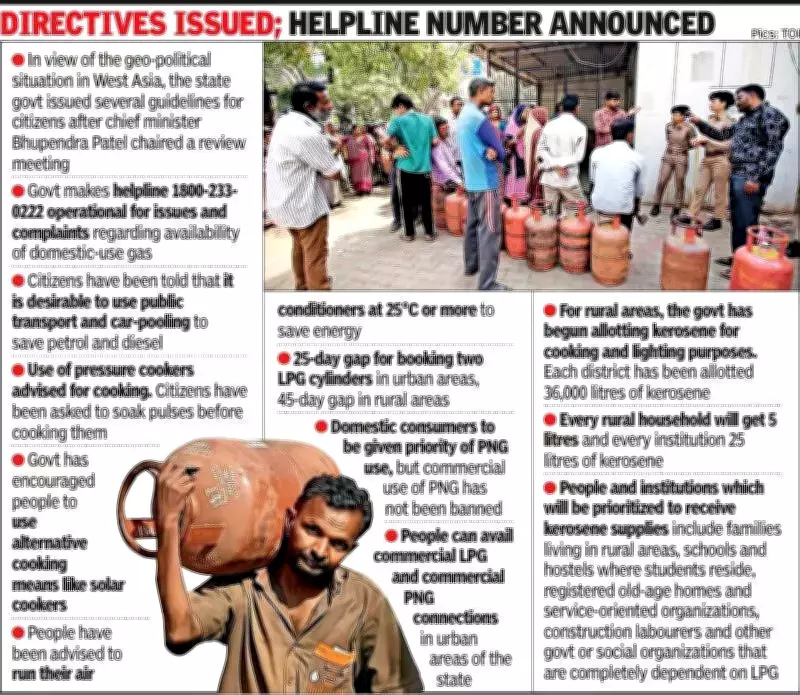
A deepening shortage of commercial LPG cylinders is crippling operations across Ahmedabad, forcing educational institutions, restaurants, and community kitchens to take drastic measures. Many are suspending services, slashing menus, or reverting to traditional wood-fired cooking to cope with the crisis.
Educational Institutions Forced to Adapt or Halt Services
Student mess services at GMERS Medical College, attached to Sola Civil Hospital, were temporarily suspended on Friday, affecting nearly 300 students. While canteens on campus continue to function, meals for patients remain unaffected for now. Dr. Jignasha Bhalodia, the in-charge dean, was unavailable for comment.
The boys' hostel mess at Gujarat University has also been temporarily closed due to the fuel scarcity. Some community hostels are scrambling to modify menus or switch fuel sources to continue serving students. At a free hostel run by Bharwad Yuva Sangathan near Sarkhej, where around 100 students preparing for government job exams rely on donated meals, the organization had to overhaul its daily menu to conserve fuel.

President Dilip Bharwad explained, "We usually require 40 commercial cylinders a month, but that is becoming difficult now. On Friday, instead of 700 rotis, we could make only 300 oversized ones. The hostel plans to begin cooking over a wood fire from Saturday onwards, as students still have two months of exam preparation ahead."
At BJ Medical College, senior authorities stated that meal services have not been discontinued, but student committees have instructed cooks to minimize gas wastage and explore alternatives like induction stoves. A senior official from a premier educational institute in Gandhinagar noted, "The state government has assured us of fuel supply, and we do not see any reason for panic as of now. A review will take place next week if needed."
Restaurants and Eateries Face Widespread Disruption
Restaurants across Ahmedabad are reporting severe disruptions, with some shutting temporarily and others switching to dishes that require less fuel. Rajsinh Rathod, who operates a restaurant on a temple premises in Maninagar, had no choice but to shut it down. "We roughly serve 300 people and charge Rs 80 per thali. However, due to the commercial LPG shortage, we had to stop operations from Thursday," he said.
Newly opened businesses are also caught in the squeeze. Hiren Bhimani, who recently inaugurated a 120-seat restaurant on Rajpath Rangoli Road, said he has been unable to launch commercial operations. "I just opened a 120-seater restaurant serving Gujarati dishes. I planned to start operations this week, but am rationing the limited LPG stock for staff use only," Bhimani explained.
Dilip Thakkar, co-chapter head of the National Restaurants Association of India, highlighted that all of the city's estimated 10,000 food joints have been impacted. "The shortage of commercial LPG has badly affected 10,000 restaurants. Some are shutting down, and others are exploring alternatives or reworking their menus."
Smaller eateries are resorting to traditional methods to keep their kitchens running. Nikhil Thakur, who runs a cafe on an open plot along the SP Ring Road, has set up a traditional chulha in the parking area for low-flame cooking. "Our menu does not require much gas, so it is easier for us to manage," he said.
Larger establishments are also adapting. Gulmohar Club, which sees around 300 visitors daily, has slashed its menu and shifted to electricity-based cooking where possible. Alpesh Parikh, director of the club, stated, "We typically use 60 commercial cylinders a month. But from Friday, we have trimmed the restaurant menu and shifted to electricity-based cooking. We are in the process of installing an industrial-grade wood-fire setup."
Impact on Vulnerable Populations and Community Services
The crisis is hitting some of Ahmedabad's most vulnerable populations, particularly students relying on community kitchens and hostels for sustenance. With limited alternatives, many are forced to adjust their dietary plans or face interruptions in meal services, potentially affecting their academic and exam preparations.

As the shortage persists, institutions and businesses continue to seek innovative solutions, from induction stoves to wood-fired setups, to mitigate the impact on daily operations and service delivery.





