

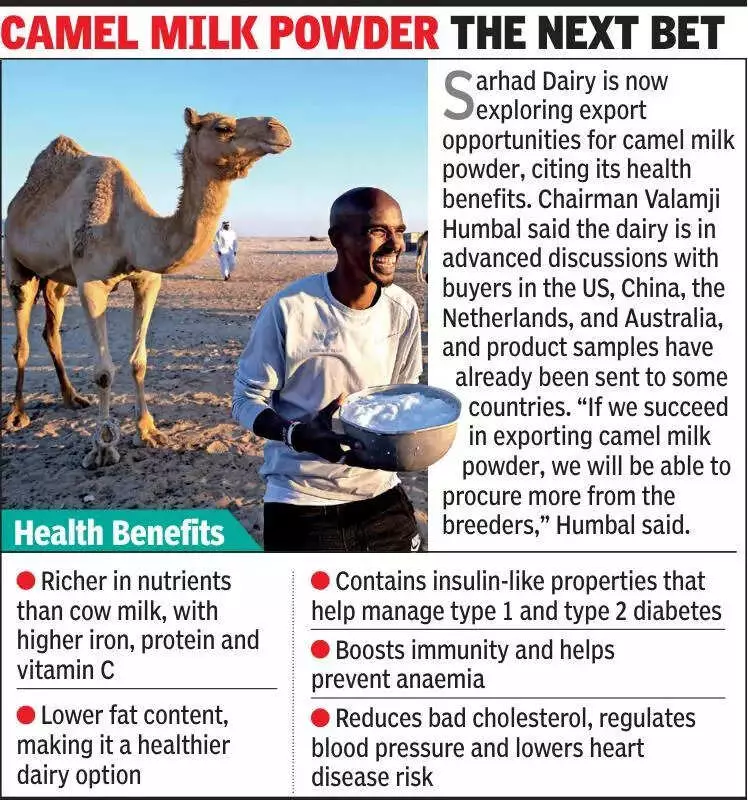
The launch of India's first branded camel milk by dairy giant Amul several years ago was heralded as a revolutionary step. It promised a dual benefit: offering a nutrient-rich superfood to urban consumers while creating a sustainable livelihood for camel herders in the arid landscapes of Kutch. Today, that promise rings hollow for the very community it aimed to uplift.
A Promise of Prosperity Turns Sour
Procured and processed by the Kutch-based Sarhad Dairy and marketed under the famed Amul brand, the initiative began in 2019 with grand plans. The vision was to source milk not just from Kutch but also expand to North Gujarat and Rajasthan. However, these expansion plans never took off. Even within Kutch, the dairy's procurement has hit a wall, remaining largely stagnant and failing to absorb the total milk available from local breeders.
Initially promoted heavily for its health benefits, the product range saw an expansion to include value-added items like tetra-pack milk, flavoured variants, ice cream, and chocolates. Despite this, consumer demand has plateaued, failing to match the initial projections.

The Stark Numbers: A Stagnant Business
The data reveals a clear picture of stagnation. In the financial year 2019-20, Sarhad Dairy's daily procurement stood at approximately 4,200 litres. Years later, this figure has seen only a marginal rise to between 5,000 and 5,500 litres per day, sourced from around 350 breeders.
Valamji Humbal, the chairman of Sarhad Dairy, candidly admitted the venture is financially unviable. "It is a loss-making business for us," he said. "We are paying Rs 51 per litre to camel breeders, which is very high. Since demand has not increased as expected, we are unable to procure an additional 25% to 30% milk. We even have to turn away breeders who want to sell milk to us."
Breeders Bear the Brunt of Failed Marketing
On the ground, the fallout is direct and painful for the pastoral community. Nurmamad Mohadi, a breeder from Abdasa taluka in Kutch who owns 20 milk-producing camels, finds himself with no reliable buyer. "I am not able to sell the milk to Sarhad Dairy because there are no procurement centres nearby. Since the dairy does not need more milk, we are left without buyers," he explained.
This sentiment is echoed beyond Kutch. Lakha Rabari from Devbhumi Dwarka district revealed that about 25 camel breeders in his area are stuck with unsold milk due to the absence of procurement. "We hoped that after Kutch, procurement would expand to our region. Selling camel milk at a good price could have provided us with a stable income," he lamented.
Kavita Mehta, executive director of Sahjeevan—a voluntary organisation that played a pivotal role in connecting breeders with the dairy—pinpoints the core issue. "Sarhad Dairy has created the necessary infrastructure, but we feel there have not been sufficient efforts in marketing," she stated. "The quantity of 5,000 litres per day is very small for a dairy giant, and promoting such a niche product may not be a priority."
The story of Amul's camel milk is thus a classic case of a well-intentioned project that stumbled due to inadequate market creation and outreach. While the infrastructure was built, the crucial link of generating sustained consumer demand appears to have been neglected, leaving camel breeders in a precarious position, their hopes for a stable income yet again deferred.






