

Safety Neglect Plagues Andhra Pradesh's Granite Mining Heartland
The granite-rich Prakasam district of Andhra Pradesh, a major contributor to the state's stone industry, is grappling with a deepening crisis in worker safety. Despite a sharp increase in fatal accidents last year, authorities have consistently failed to implement established accident-prevention measures, leaving thousands of laborers exposed to life-threatening hazards in quarries.
Administrative Inaction Despite Rising Death Toll
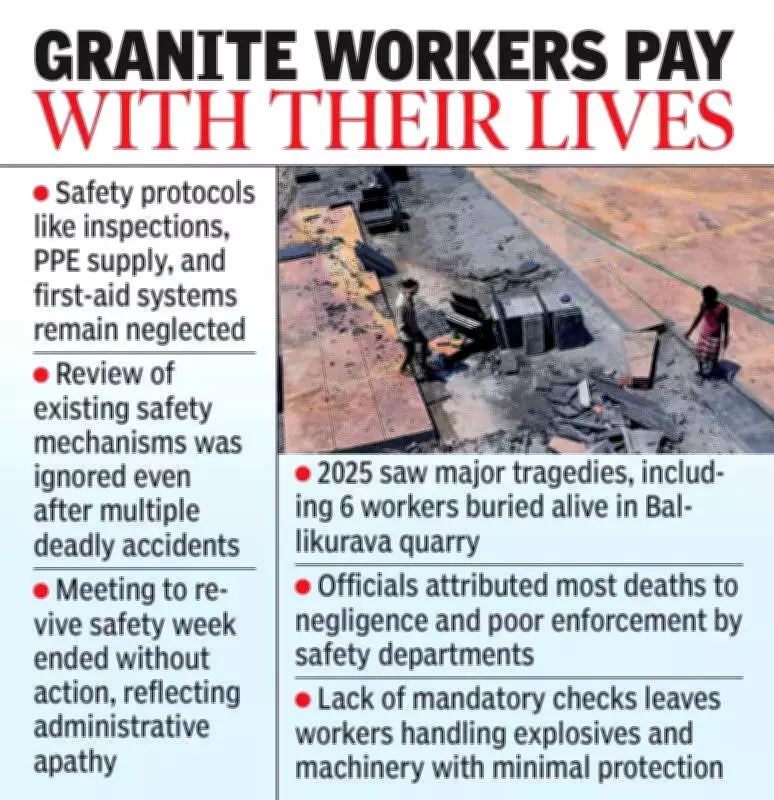
Official meetings and internal discussions have produced little tangible action, with critical safety interventions remaining confined to paperwork. Basic protections such as strengthened quarry security, distribution of personal protective equipment (PPE), expert inspections, improved first-aid preparedness, and recognition of safety-compliant operators have not been implemented. This administrative paralysis persists despite multiple fatal accidents that have exposed glaring enforcement failures.
Senior officials convened a meeting last month at the granite vocational training centre in Ramatirtham to revive the long-discontinued safety week program—a structured initiative previously designed to reduce accidents in the granite sector. The meeting was prompted by the rising death toll, and action plans were reportedly discussed. However, no concrete follow-up steps materialized, and the initiative quickly faded from priority, reflecting a recurring pattern of neglect.

Deadly Year for Quarry Workers
The year 2025 proved particularly deadly for quarry workers in the combined Prakasam district. In one of the most tragic incidents, six workers were buried alive under heavy boulders at a quarry in the Ballikurava area. In another series of accidents at the Galaxy Granite Mines near Cheemakurthy, up to six workers lost their lives in separate mishaps.
Senior officers investigating these incidents attributed many deaths to negligence by safety department officials responsible for routine quarry inspections, noting that several accidents were preventable. The absence of mandatory periodical safety checks means workers now operate heavy machinery, handle explosives, and work near unstable rock faces with minimal protection and limited safety reinforcement.
Collapse of Structured Safety Oversight
Previously, the safety week program provided a comprehensive framework for accident prevention. It began with trade tests for workers at the Ramateertham centre, followed by week-long inspections across quarries led by senior officials from the Director General of Mines Safety (DGMS) and the deputy director from the mines and geology department.
Inspection teams would examine operational hazards, ensure distribution of safety gear, reinforce first-aid protocols, identify high-risk practices, and issue site-specific recommendations. The program concluded with events promoting best practices and acknowledging operators adhering to safety norms.
With this structured oversight now absent, laborers in granite hubs such as Cheemakurthy and Martur continue to face hazardous conditions daily. The continued lack of safety oversight raises serious concerns within the mining sector, where economic activity in granite extraction appears to overshadow enforcement of safety standards.
Officials from the Director General of Mines Safety (DGMS) bear primary responsibility for establishing proper safety mechanisms. However, their visits to major factory sites as part of routine inspections reportedly lack sufficient focus on safety standards, further exacerbating the crisis.






