

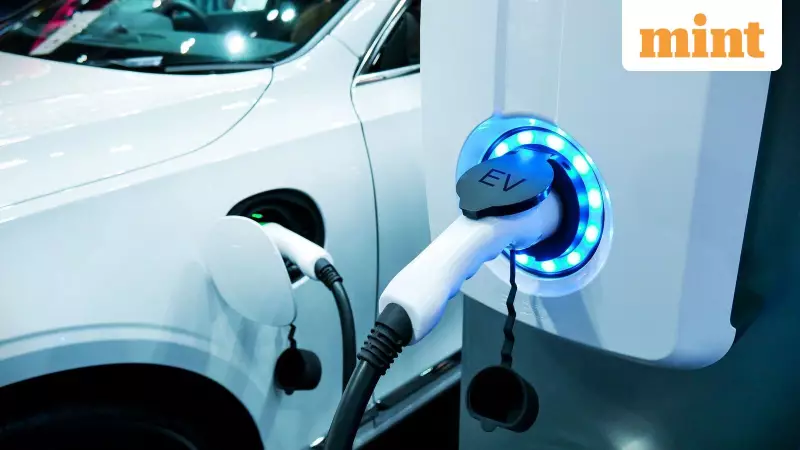
In a major push for its flagship manufacturing initiative, the Indian government is considering a substantial increase in budgetary allocation for the Production Linked Incentive (PLI) scheme dedicated to automobiles and auto components. According to sources familiar with the matter, the upcoming Union Budget is likely to propose nearly doubling the outlay to approximately ₹5,500 crore for the fiscal year 2026-27 (FY27), up from the ₹2,800 crore earmarked for the current fiscal year.
Boosting Disbursals and Ensuring Policy Continuity
This proposed hike, currently under discussion between the Ministry of Heavy Industries and the Ministry of Finance, is seen as a move to accelerate disbursements under the scheme and underscore policy continuity for India's electric vehicle (EV)-led transition. The PLI-Auto scheme, notified in 2021, has a total five-year outlay of ₹25,938 crore for the period FY25 to FY29.
The scheme aims to position India as a global hub for advanced automotive technology and electric vehicles. So far, it has attracted investments worth ₹35,000 crore, leading to the establishment of 278 manufacturing units and the creation of nearly 49,000 jobs. From over 80 shortlisted companies, eight vehicle manufacturers and ten component makers have products qualified for the incentives.

However, disbursals have lagged behind targets. In its first year (FY25), the government disbursed ₹322 crore to four companies—Tata Motors, Mahindra & Mahindra, Ola Electric, and Toyota Kirloskar Auto Parts—against an earmarked ₹604 crore. For FY26, disbursements until November 2025 stood at about ₹1,000 crore, significantly lower than the ₹3,150 crore allocated for the full year.
New-Age EV Makers' Plea Rejected
In a related but separate development, the government is unlikely to reopen the application window for the PLI-Auto scheme, despite requests from several new-age electric vehicle manufacturers. Companies including Ather Energy, Euler Motors, and River Mobility had written to Heavy Industries Minister H.D. Kumaraswamy in December, seeking inclusion.
These firms argued that they were ineligible when the scheme launched in 2021 due to stringent criteria but have since developed indigenous products and scaled up operations. They highlighted that the current framework, which requires new non-automotive companies to have a minimum global net worth of ₹1,000 crore, creates an "unintended structural imbalance." The companies stated that being excluded from PLI benefits puts them at a 13-16% cost disadvantage, hindering their ability to make EVs more affordable.
A senior government official confirmed that while the proposal was received, amending the scheme now is a long process requiring Union Cabinet approval, and thus the window will not be reopened.
Job Creation and the Future of Auto Manufacturing
Experts view the proposed fund increase as a positive signal for the industry's long-term growth. Poonam Upadhyay, Director at Crisil Ratings, stated that the move confirms the government's commitment to sustaining momentum in advanced automotive technologies and EVs, providing manufacturers with crucial investment visibility.
The focus on cleaner technology is also reshaping the job landscape. Auto industry veteran I.V. Rao and Crisil's Upadhyay both emphasized that the energy transition will require significant upskilling of the workforce. Job creation will increasingly depend on high-skill profiles, sustained production volumes, and a robust domestic manufacturing ecosystem, rather than incentives alone.
The push comes as EV adoption grows in India. Government data shows electric vehicle sales reached 2 million units in 2025, accounting for about 8% of the total 27.4 million new vehicles sold. The EV market, currently valued at around $55 billion, is projected to nearly double by 2029, highlighting the sector's critical role in India's industrial future.






