

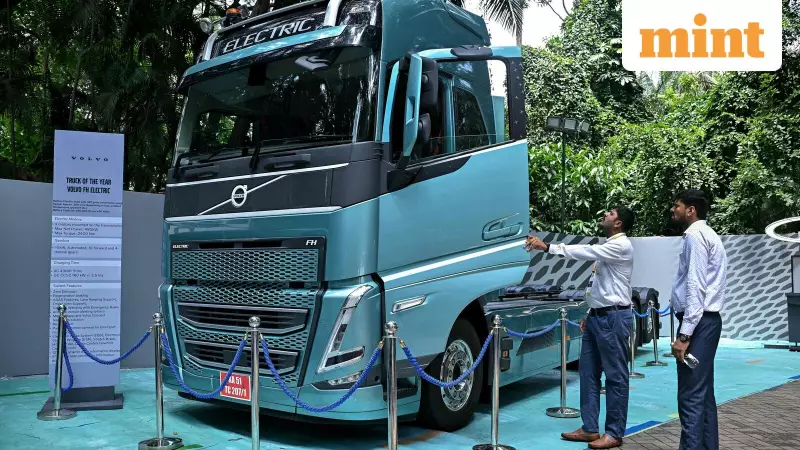
India's ambitious drive to green its massive logistics sector is gaining powerful momentum with a game-changing technology: battery swapping for heavy-duty electric trucks. This innovation, moving beyond two and three-wheelers, promises to slash upfront costs and eliminate lengthy charging stops, potentially making zero-emission freight commercially viable for the first time.
The Economics of Swapping: Cutting Cost and Charging Time
The core appeal of battery swapping lies in its dual attack on the biggest barriers to electric truck adoption: high price and operational downtime. In a standard model, the truck is sold without a battery, which can account for nearly half the total vehicle cost. This dramatically reduces the initial purchase price. Heavy electric trucks above 12 tonnes typically cost between ₹1 to 1.5 crore, compared to ₹25-50 lakh for diesel versions. The battery becomes a service provided by network operators.
"The more you sweat the asset, the more you lower the TCO (total cost of ownership). That's a very clear game," explained PV Satyanarayana, Chief Business Officer of Montra Electric, part of the Murugappa Group. He emphasized that reducing charging time directly increases vehicle utilization and improves TCO. Swapping a depleted battery for a fully charged one takes just 5-10 minutes, rivaling diesel refueling speeds.

The industry is witnessing rapid growth. Valued at around $10.2 million in 2022, India's EV battery-swapping market is projected to reach $61.57 million by 2030, growing at a compound annual growth rate (CAGR) of 25.2%.
Commercial Rollouts and Decarbonization Drive
Major players are now entering commercial deployment. Companies like Pune-based Blue Energy Motors and Montra Electric are rolling out 55-tonne e-trucks designed for swappable batteries. Meanwhile, battery-swapping company Energy in Motion (EIM), in collaboration with China's Foton, has begun operations, setting up stations at Mumbai’s JNPT and in Sonepat in October 2025.
Narendra Murkumbi, MD & CEO of EIM, highlighted the environmental imperative, noting that while trucks constitute only about 3% of India's vehicles, they contribute roughly 40% of the transport sector's emissions. "Compared to two-wheelers and even cars, converting heavy trucks in India to electric will have the largest environmental impact," he stated.
The adoption is still in early stages. Government data shows about 11,000 light, medium, and heavy e-trucks were sold in India in 2025, with medium- and heavy-duty models making up only around 550 units.
Policy Push, Infrastructure, and Challenges Ahead
The government's PM E-Drive scheme is providing crucial support, incentivizing both e-trucks and battery swapping stations with allocations of ₹500 crore and ₹2,000 crore respectively. The policy covers 80% of the upstream cost for setting up public battery swapping stations.
"In India, policy is emerging as a critical first driver of the electric truck transition," said Deepali Thakur, Senior Technical Manager at Smart Freight Centre India. She noted that government incentives are being complemented by state-level policies offering subsidies and tax exemptions.
However, challenges remain. Battery swapping is best suited for short, fixed, high-utilization routes, such as port logistics or dedicated industrial corridors, while fast-charging will still be needed for long-haul trips. The capital expenditure for setting up high-tech swapping stations and maintaining a battery inventory is significant, though declining battery prices (down 75% since 2015) and faster charging tech are improving economics.
As of early 2025, India had about 3,500 battery swapping stations handling roughly 350,000 batteries. Companies like Blue Energy Motors plan to set up stations along key corridors like Mumbai-Pune, treating energy as a service. This foundational shift, treating energy as a flexible service rather than a fixed asset, could be the silver bullet that transforms Indian logistics from a top polluter into a leader in green mobility.






