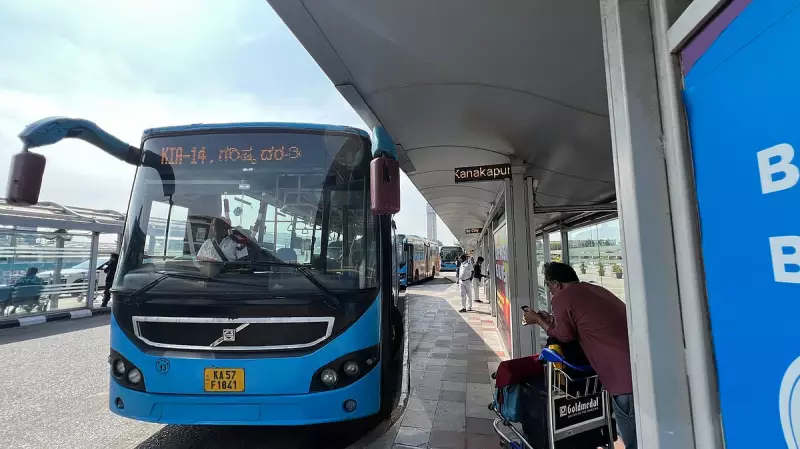
Kempegowda International Airport (KIA) in Bengaluru is facing significant criticism from daily commuters and travelers following a major reduction in facilities for public transport buses. The airport authority has drastically cut the number of dedicated bus bays for BMTC's Vayu Vajra services at Terminal 1, leading to increased waiting times and passenger inconvenience.
What Changed at Terminal 1?
Previously, the Bengaluru Metropolitan Transport Corporation (BMTC) operated its popular Vayu Vajra airport shuttle services from 14 dedicated bus bays at Terminal 1. This arrangement allowed for smoother operations, with buses having adequate space to queue and board passengers. The average waiting time for travelers during this period was reported to be around 30 minutes.
However, in a recent and controversial move, the airport management has reduced this infrastructure to just six operational bus bays. Furthermore, the new policy restricts buses to a halt time of barely 10 minutes at these bays. This decision, which came into effect recently, has severely impacted the efficiency of the bus service, a vital and affordable connectivity link for the city.

Impact on Commuters and Backlash
The reduction has immediate and tangible consequences for thousands of passengers who rely on the Vayu Vajra service every day. The primary issue is the sharp increase in waiting time. With fewer bays and strict time limits, buses are unable to maintain their previous frequency, causing longer queues and crowded waiting areas.
Commuters have expressed their frustration on social media and to ground staff, highlighting how this move undermines the push for sustainable public transport. The Vayu Vajra service is often hailed as a cost-effective and reliable alternative to expensive cabs or private cars for airport transit. This scaling back of facilities is seen as a step backward, potentially forcing more people towards private vehicle usage, thereby adding to the airport's congestion and carbon footprint.
Looking for Solutions
The reported change, highlighted by Asra Mavad and noted in updates on 08 January 2026, has sparked a call for review from citizen groups and urban mobility advocates. The core demand is for the airport operator, Bangalore International Airport Limited (BIAL), to reconsider the decision and restore adequate infrastructure for public transport.
Stakeholders argue that for a city grappling with traffic woes, robust airport bus connectivity is not a luxury but a necessity. They emphasize that the airport, as a major gateway, should prioritize and incentivize public transport use rather than creating hurdles. The coming days will show if the backlash leads to a restoration of facilities or if commuters must adapt to a new, more challenging normal for their airport journeys.