

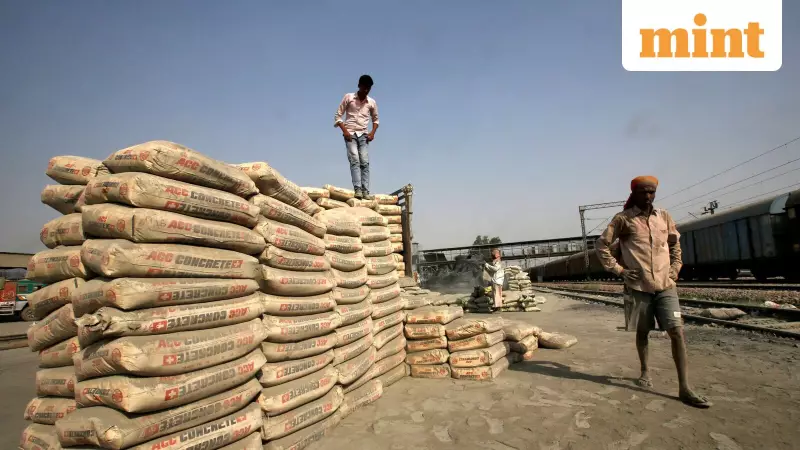
The Indian cement industry is witnessing a significant strategic shift as companies prioritize volume growth over price increases in response to persistent market challenges. With cement prices remaining range-bound and competitive pressures intensifying, manufacturers are focusing on protecting market share through aggressive volume push rather than attempting price hikes.
Market Dynamics and Price Trends
Cement prices across India have remained largely flat throughout November, maintaining an average of ₹375 per 50kg bag according to dealer channel checks conducted by Yes Securities. This price stagnation comes despite the recent reduction in Goods and Services Tax (GST) on cement from 28% to 18% in late September, with the entire benefit being passed on to consumers.
The market witnessed brief attempts at price increases during November, with some regions trying to implement hikes of ₹5-10 per bag. However, these efforts proved unsuccessful, being rolled back within just two to three days due to weak market acceptance and competitive pressure from larger players. Consequently, average prices for October-November have settled approximately ₹6 per bag lower than the exit levels of Q2FY26.

Regional Demand Challenges and Seasonal Patterns
Demand conditions have varied across different markets during the third quarter of FY26. Several factors have contributed to this patchy performance, including elections in Bihar and the Vidarbha region, labor shortages in certain areas, and construction slowdowns in Delhi due to pollution concerns. These regional challenges have further complicated the pricing environment for cement manufacturers.
Traditionally, the second half of the financial year represents a strong period for cement demand as construction activity peaks. Companies typically push volumes during this period to meet annual sales targets. However, the current scenario is marked by persistent pricing pressure that continues to keep realization growth muted.
Competitive Landscape and Capacity Expansion
The competitive intensity in the cement sector has intensified significantly following recent capacity expansion announcements by major players. UltraTech Cement Ltd's phase IV expansion plan of approximately 23 million tonnes and Ambuja Cements' planned capacity addition of around 15 million tonnes through debottlenecking have raised concerns about increasing market competition.
These capacity additions are expected to boost overall supply in the sector, potentially capping improvements in utilization levels and preventing substantial price increases. The increased supply comes at a time when cement makers are already grappling with limited pricing power and margin pressures.
Financial Performance and Outlook
The lack of pricing power has translated into earnings downgrades for the sector, with stock performance reflecting this challenging environment. So far in calendar year 2025, shares of major cement manufacturers including UltraTech, Shree Cement Ltd, and Ambuja Cements Ltd have delivered modest returns of only 2-4%.
Industry analysts from Centrum Broking anticipate demand recovery beginning in December and remaining healthy through the fourth quarter of FY26 as construction activity reaches its seasonal peak. However, they caution that any material near-term price recovery appears unlikely in December, as most cement companies are expected to continue prioritizing volume over price hikes.
With prices expected to remain range-bound, cement manufacturers are increasingly turning to various cost-saving initiatives and higher green energy usage to control operating expenses. These measures are crucial for maintaining profitability in an environment where meaningful price increases remain elusive.
The industry's margins are likely to remain range-bound in Q3FY26, with the benefit of sequential uptick in volume being partly offset by subdued pricing. This balancing act between volume growth and price realization continues to define the current strategy of cement companies across India as they navigate through one of the most competitive phases in recent memory.






