

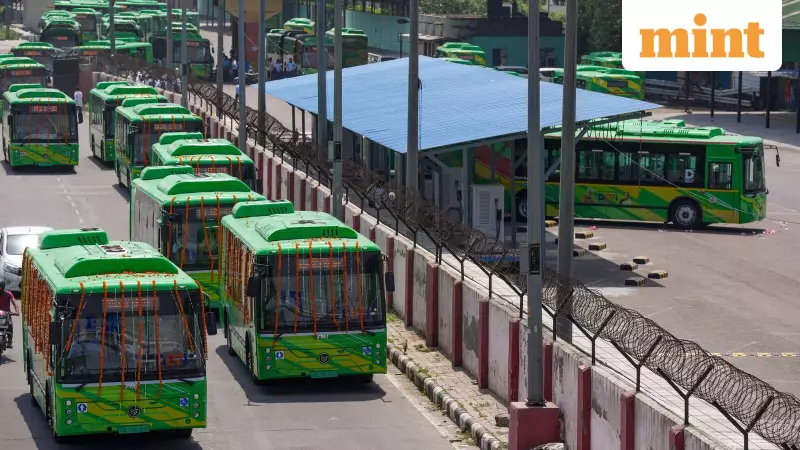
In a significant boost to India's electric mobility ambitions, the Union government's demand aggregator, Convergence Energy Services Ltd (CESL), has announced the discovery of attractive, lower-than-expected prices in its massive tender for 10,900 electric buses. The tender, a key component of the PM E-Drive scheme, covers five major Indian cities and concluded its financial bid opening on Wednesday.
Winning Bidders and Contract Details
Out of 16 bids received, 14 bidders were found to be technically qualified and their financial bids were opened. PMI Electro Mobility has emerged as the largest winner, securing a contract to supply and operate 5,210 e-buses. Following closely, EKA Mobility won orders for 3,485 buses, while Olectra Greentech will supply 1,785 units. The remaining 420 buses were allocated to a consortium led by Anthony Travels.
The contracts are structured as long-term agreements where the winning companies will not only supply the electric buses but also operate them. They will be compensated on a per-kilometre basis, a model designed to ensure service quality and operational efficiency.

Attractive Pricing and City-Wise Allocation
While CESL did not publicly disclose the exact discovered rates, stating they would be shared directly with the participating city transport undertakings, a government official familiar with the process revealed that the prices varied for each city. Crucially, the discovered rates were found to be about 5% to 15% lower than earlier estimates.
The tender will see a major augmentation of public transport fleets. Bengaluru is slated to receive around 4,500 buses, Delhi about 2,800, Hyderabad approximately 2,000, while Ahmedabad and Surat together will induct around 1,600 new electric buses.
Scheme Context and Industry Capacity
This tender forms a critical part of the PM E-Drive scheme, which has allocated ₹4,391 crore—nearly 40% of its total ₹10,900-crore outlay—to deploy 14,028 zero-emission buses across nine major cities. The scheme provides a subsidy of at least ₹25 lakh per e-bus.
The winning manufacturers are scaling up capacity to meet demand. PMI Electro is expanding its Haryana plant and setting up a new facility in Neemrana to ramp up annual capacity to over 15,000 buses. EKA Mobility aims to reach a production rate of 500 e-buses per month by the end of this fiscal year, while Olectra targets an annual capacity of 10,000 units by next year.
Challenges and the Road Ahead
The tender process moves forward despite an unresolved legal dispute raised by Ashok Leyland's subsidiary, OHM Global Mobility, regarding its inability to bid. Officials confirmed the tender would proceed without OHM.
However, a significant challenge looms beyond manufacturing. Industry experts point to a severe shortage of trained drivers for electric buses. T Surya Kiran, former executive director of the Association of State Road Transport Undertakings (ASRTU), highlighted the lack of a standardized training curriculum and upskilling facilities as a serious concern that could hamper smooth operations.
The successful conclusion of this tender, one of the largest of its kind in India, marks a pivotal step in the country's transition to sustainable public transportation, even as it navigates operational hurdles like driver training and legal complexities.






