Chandigarh Administration Proposes Major Industrial Reforms to Boost Growth
In a significant move aimed at reviving industrial growth and addressing long-standing demands from the business community, the Chandigarh administration is developing a comprehensive set of reforms designed to enhance ease of doing business, unlock underutilized land, and strengthen the city's industrial ecosystem.
Potential Shift in Land Ownership Policy
A key proposal under active consideration is the possible conversion of leasehold industrial plots into freehold ownership—an issue that has remained contentious for years. In a recent submission to the Central Government, the UT administration indicated that an expert committee would examine the feasibility of permitting such conversions.
This move signals a potential policy shift, as over the past year, both the Chandigarh Administration and the Ministry of Home Affairs (MHA) maintained there were no plans to allow leasehold-to-freehold conversions in industrial areas.

According to a senior UT official, the renewed momentum follows directions from the Centre, which asked the Administration to unlock vacant and underutilized land within existing industrial clusters. The Central Government also suggested liberalizing the industrial plot allotment policy, including allowing greater flexibility in land parcels and exploring the option of converting leasehold plots to freehold to provide industries with greater ownership security and operational flexibility.
Regulatory Relaxations Under Consideration
The Chandigarh administration is considering a series of regulatory relaxations in industrial areas as part of its proposed reforms to boost industrial activity. These include:
- Greater land parcel flexibility: Examining relaxations for subdivision and amalgamation of industrial plots, allowing pooling or splitting of land parcels, along with mortgage facilities for plot holders.
- Common parking provisions: Introducing shared parking facilities to optimize space utilization.
- Removal of height restrictions: Eliminating caps on industrial building heights to allow for vertical expansion.
The Administration also plans to introduce greater flexibility in development controls for industrial zones. Proposed measures include higher floor area ratio (FAR), reduced setback requirements, increased ground coverage, and relaxation for smaller plots.
Single-Window Approval System
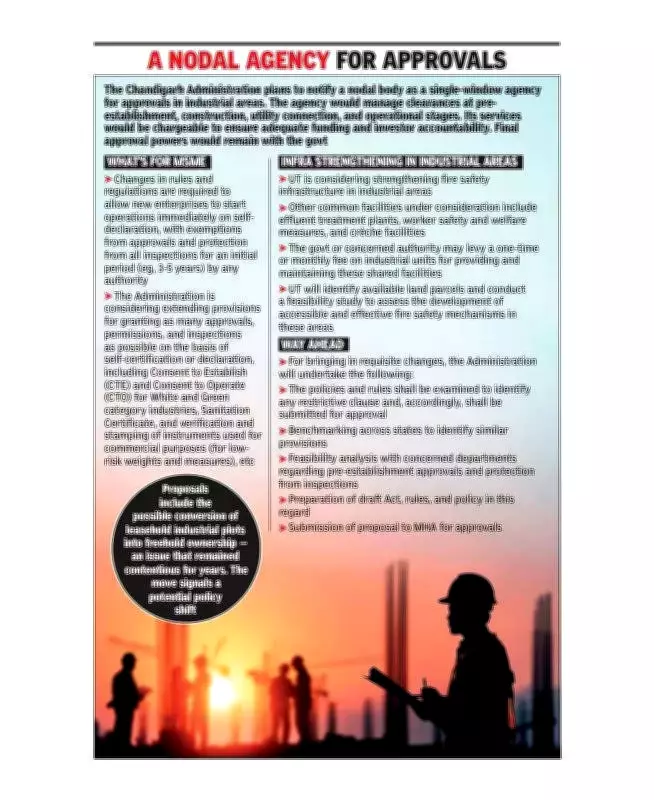
The Chandigarh Administration plans to notify a nodal body as a single-window agency for approvals in industrial areas. This agency would manage clearances at pre-establishment, construction, utility connection, and operational stages. Its services would be chargeable to ensure adequate funding and investor accountability, though final approval powers would remain with the government.
Support for MSMEs
Significant changes are being considered to support Micro, Small, and Medium Enterprises (MSMEs). The Administration is examining provisions that would allow new enterprises to start operations immediately on self-declaration, with exemptions from approvals and protection from all inspections for an initial period of 3-5 years by any authority.
The reforms would extend provisions for granting approvals, permissions, and inspections based on self-certification or declaration. This would include Consent to Establish (CTE) and Consent to Operate (CTO) for White and Green category industries, Sanitation Certificate, and verification and stamping of instruments used for commercial purposes for low-risk weights and measures.
Infrastructure Strengthening Initiatives
The UT administration is considering strengthening fire safety infrastructure in industrial areas. Other common facilities under consideration include effluent treatment plants, worker safety and welfare measures, and crèche facilities.
The government or concerned authority may levy a one-time or monthly fee on industrial units for providing and maintaining these shared facilities. UT will identify available land parcels and conduct a feasibility study to assess the development of accessible and effective fire safety mechanisms in these areas.

Implementation Roadmap
To bring about these requisite changes, the Administration will undertake the following steps:
- Examine existing policies and rules to identify restrictive clauses and submit them for approval.
- Benchmark across states to identify similar provisions implemented elsewhere.
- Conduct feasibility analysis with concerned departments regarding pre-establishment approvals and protection from inspections.
- Prepare draft Act, rules, and policy documents.
- Submit the complete proposal to the Ministry of Home Affairs for final approvals.
These comprehensive reforms represent a significant effort by the Chandigarh administration to create a more business-friendly environment, attract investment, and stimulate industrial growth in the region.