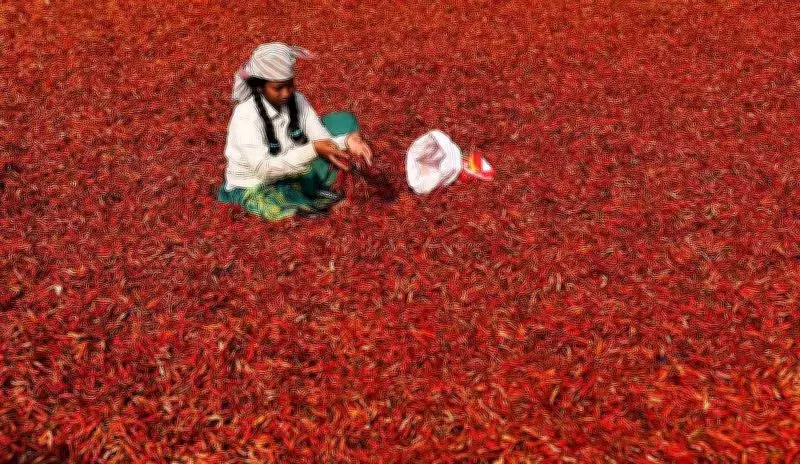
Telangana Chilli Farmers Celebrate Price Surge After Years of Struggle
In a dramatic turnaround for agriculture in Telangana, chilli farmers are experiencing a wave of relief and optimism as prices for the prized Wonder Hot variety have surged dramatically. After a prolonged period of over two years marked by financial distress, the current market has seen prices leap from a range of Rs 15,000–17,000 to an impressive Rs 38,000 per quintal. This significant increase comes as a welcome change for growers who have endured heavy losses in recent seasons.
From Despair to Hope: Farmers' Financial Recovery
The agricultural landscape had grown bleak for many chilli cultivators, with prices plummeting below Rs 8,000 per quintal last year, leading numerous farmers to abandon the crop altogether. However, a sharp decline in output this season has created a supply shortage, propelling prices upward. Farmers are now hopeful that this trend could continue, with some anticipating prices might even reach Rs 50,000 per quintal in the near future.
T Bhaskar, a farmer from Jayashankar Bhupalpally, shared his success story: "I managed to recover Rs 2 lakh of the Rs 2.5 lakh I invested by selling Wonder Hot chillies at Rs 38,000 per quintal." He achieved this by selling his produce at the Enumamula agricultural market in Warangal, where he sold 14 bags of chillies, including six of the high-value Wonder Hot variety. Bhaskar's experience highlights a broader narrative of recovery, as he had cultivated chilli on two acres this year after suffering substantial losses in previous seasons.

Challenges and Reduced Yields
Farmers have faced mounting difficulties over the past few years, with many unable to recoup even their basic investment costs. The situation was exacerbated by poor market prices and severe pest attacks, particularly from Nalla Tamara Purugu (black thrips), which have drastically reduced yields. From a robust 25–30 quintals per acre four years ago, production has fallen to a mere 10–15 quintals per acre today.
Karaivadha Sudhakar Reddy, a chilli farmer cultivating on three acres, noted: "The overall produce reaching markets this year will be at least 50% lower." He expressed optimism that prices could exceed Rs 50,000 per quintal, contrasting sharply with last year's sales at just Rs 12,000 per quintal. Reddy added, "This year, due to the shortage, things look different. I hope prices remain at least in this range so we can pay off some debts."
Market Dynamics and Future Projections
R Mallesham, secretary of the Enumamula agricultural market, confirmed the sharp drop in arrivals. On a recent Thursday, the market received around 600 bags of Wonder Hot chillies, compared to 500 the previous day. Typically, by this time of year, arrivals would range between 1,000 and 2,000 bags, indicating a significant reduction in supply.
Mallesham explained that more produce might reach the market in the coming days, as farmers had been occupied with the Medaram Jatara festival until recently. "In the next 10–15 days, arrivals may increase," he stated, noting that Wonder Hot mirchi sold at Rs 37,100 per quintal on a Wednesday. The highest price for this variety in the last five years was Rs 39,000 per quintal, recorded in 2022, suggesting the current surge is approaching historic highs.
Broader Impact on Regional Agriculture
The price increase is not limited to Telangana alone. Guntur chilli, which is exported in large quantities from Asia's largest chilli hub in Andhra Pradesh, has also seen a sharp rise, recently reaching around Rs 24,500 per quintal. This regional uptick underscores a broader trend of recovery in the chilli farming sector, offering a glimmer of hope to growers across South India.
As farmers navigate this newfound prosperity, the focus remains on sustaining these prices to alleviate long-standing debts and reinvest in their livelihoods. The current season serves as a critical reminder of the volatile nature of agricultural markets and the resilience of those who depend on them.