

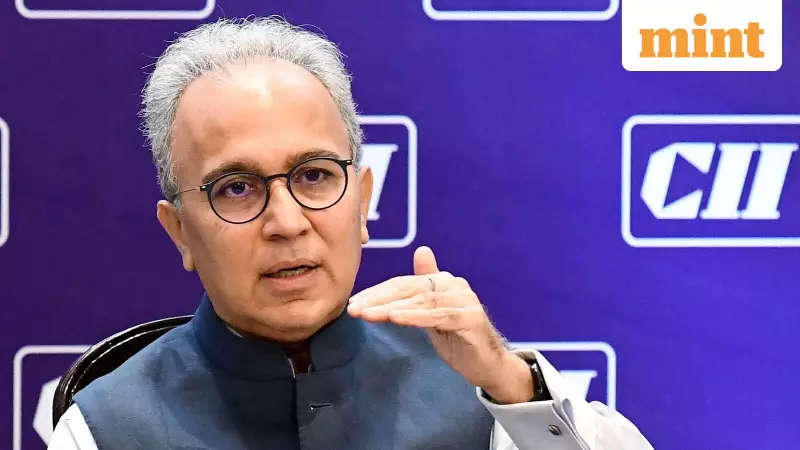
In a significant push to revitalize India's manufacturing sector and generate employment, Rajiv Memani, President of the Confederation of Indian Industry (CII) and Chairman of EY India, has proposed a tailored strategy focused on the country's 50 most imported products. This plan, based on an internal CII study, aims to scale up domestic production, reduce import dependence, and integrate India deeper into global supply chains.
The Core Strategy: Targeting Key Imports
Memani, in an interview, detailed that the proposed manufacturing strategy would involve a mix of incentives, research support, and targeted investments. The identified 50 intermediate products span critical sectors like electronics, various components, energy transition equipment, and semiconductors. A CII analysis found these imports are concentrated within eight to ten HSN codes, the global system for classifying goods.
"The goal is to scale up domestic value creation and facilitate integration into global supply chains," Memani stated. He emphasized the need for a clear, product-led strategy for goods currently imported or insufficiently produced at home. This requires actively promoting labor-intensive industries through partnerships between the Centre and states, and through targeted schemes like the Production Linked Incentive (PLI) program.

Funding the Vision: The Disinvestment Imperative
Memani identified funding as key to the plan's success and pointed to accelerated disinvestment as a viable option. He suggested that if the Union government scales up its disinvestment program to ₹2-3 trillion over the next two years, it could fund crucial infrastructure projects like high-speed rail, which would sharpen India's competitive edge.
This call comes against the backdrop of the government's disinvestment efforts falling short of targets. In FY25, the Centre raised ₹33,000 crore against a target of ₹50,000 crore. For the current financial year, the target is ₹47,000 crore, but only ₹8,768 crore has been mobilized so far. With tax revenues potentially affected, disinvestment gains significance as an alternative revenue stream.
Addressing Jobs and Competitiveness
To tackle India's jobs challenge, Memani stressed scaling up economic activity, especially in labor-intensive sectors like manufacturing and tourism. "It's also vital to address the skilling gap, implementing initiatives to make the workforce job-ready beyond just academic qualifications," he added.
While applauding the government's efforts on decriminalizing laws, new labour codes, and reforms in permits, he noted that streamlining approvals and environmental clearances remains an ongoing process. To enhance competitiveness, reforms in power distribution, logistics (ports, airports, railways), and mining are critical. "Logistics costs can be lowered by increasing capacity at ports and airports, and expanding railway networks," Memani said.
He also proposed forming an inter-ministerial group to oversee the targeted strategy for the 50 products, which often involve high technology and face challenges from global excess capacity.
Context and Expectations for the Future
These suggestions come as India's economy expanded at 8.2% in Q2 and is expected to grow at 7% or more this year. However, the share of manufacturing in the GDP has stagnated around 14%, far from the long-held 25% goal. The PLI scheme, with mixed success overall, has shown promise in electronics. In FY25, Apple assembled $22 billion worth of iPhones in India, capturing 20% of global production, aided by the PLI push.
For the Union Budget for FY27, Memani advocated for fiscal prudence coupled with vigorous growth drivers. He expects the government to maintain high capital expenditure of about ₹13-14 trillion, directed towards logistics infrastructure, multimodal parks, and coastal economic zones. Increased public-private partnerships (PPP) and leveraging the National Monetization Pipeline are also crucial, he concluded.






