The Desperate Dig: Panna's Diamond Hunters and Their Crushing Debt Cycle
In the heart of India's impoverished Bundelkhand region lies Panna district, a place where ancient temples and tiger reserves share space with a modern-day tragedy of human desperation. Here, thousands of men and women spend years digging shallow pits with rudimentary tools, driven by the faint hope of discovering a diamond that might erase their overwhelming debts. This is the stark reality of India's only remaining diamond mining location, where financial ruin meets elusive fortune.
A Magnet for Troubled Souls
"This place is a magnet for troubled souls," confessed Ram Kumar Gupta, speaking from Krishna Kalyanpur village in Panna district. "You wouldn't be here if life was smooth." Gupta, who requested anonymity to protect his family's reputation, represents the countless individuals who have turned to artisanal diamond mining as a last resort against financial catastrophe.
Just ninety minutes from the UNESCO World Heritage Site of Khajuraho temples, Panna presents a jarring contrast between historical grandeur and contemporary poverty. Despite containing valuable mineral deposits including diamonds and limestone, this district remains among India's poorest, trapped in a cycle of distress migration and economic hardship that characterizes the broader Bundelkhand region spanning Madhya Pradesh and Uttar Pradesh.

The Mechanics of Desperation
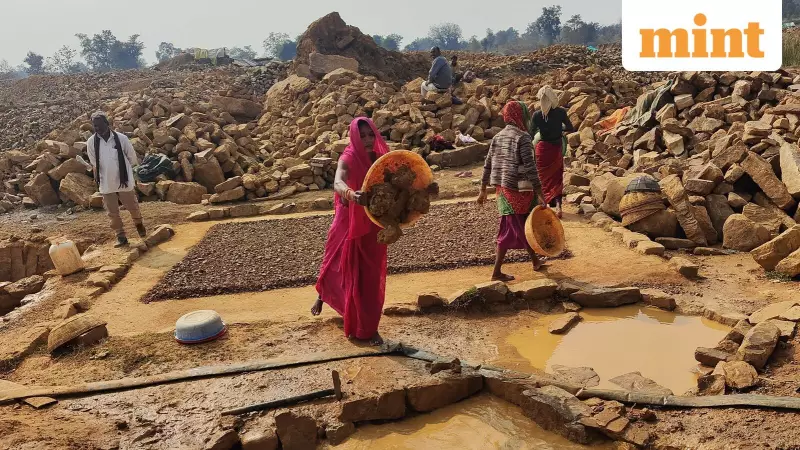
For a nominal fee of ₹200 annually, any Indian citizen can lease an 8x8 meter plot—smaller than half a volleyball court—from the district diamond office. What follows is grueling physical labor: removing topsoil, digging pits 8-10 feet deep, breaking sandstone with hammers, sieving gravel, and meticulously scanning for sparkling stones. Most invest ₹1-1.5 lakh within a year for basic accommodation, food, and sometimes hired labor, often living in flimsy tents vulnerable to the elements.
Gupta's story typifies this desperation. Once operating a six-truck transport business across states, a series of accidents bankrupted him, leaving over ₹40 lakh in debt. "There was only one way out," he explained. "If I could find a diamond, my financial troubles would vanish overnight."
Occasional Success, Persistent Struggle
Rare success stories fuel the collective hope. In 2025, farmer Swamidin Pal discovered a 32-carat diamond in his field that auctioned for ₹2.21 crore. Similarly, Puran Pal found a 7-carat diamond in 2024 that fetched ₹16 lakh. Yet even these windfalls often prove illusory—after sharing proceeds with partners and covering labor costs, many find themselves with little net gain.
The mining community represents a cross-section of desperation: former carpenters with damaged fingers and massive debt, elderly couples funding temple construction, local sanitation workers like 48-year-old Santosh Harijan who has searched unsuccessfully for decades. "I haven't found one in more than 20 years," Harijan admitted, "but today is a new day. Anything can happen." His uneducated children work day wages while his daughter awaits marriage, all dependent on his diamond dream.
Geological Reality and Economic Irony
Panna's diamonds originate from secondary deposits in riverbeds and floodplains, weathered from ancient kimberlite pipes that brought them to the surface through volcanic activity millions of years ago. These secondary sources offer significantly lower yields than primary kimberlite deposits, making the search "bilkul andha kaam"—completely blind work akin to finding a needle in a haystack while blindfolded.
The district mining office, headed by Ravi Patel, issues approximately 500 artisanal mining leases annually, collecting 11.5% royalty plus 1% TDS on auction proceeds. Yet the entire operation yields only 300-500 carats yearly, generating less than ₹1.5 crore in government royalties. Patel acknowledges the economic irrationality but warns that banning legal leases would drive activity underground, creating black markets and potential violence.

Broader Context and Historical Legacy
India's diamond history stretches back to the 4th century BC, with the legendary Koh-i-Noor diamond originating from Golconda mines. Today, however, India processes over 90% of the world's rough diamonds while contributing minimally to global production. Panna's "sweat diamonds"—mined through human desperation rather than conflict—contrast sharply with the "blood diamonds" that fueled African civil wars in the 1990s.
The current diamond market presents additional challenges: rough diamond prices crashed 40% by 2025 from 2021-22 peaks due to lab-grown competition and inventory gluts. Yet this reality hasn't reached Panna's riverbeds, where workers like 27-year-old Shankar Adivasi—who lost his farm to the Runj dam construction—continue their Sisyphean labor. Each morning, he empties water from his pit with a plastic bucket before beginning another day of digging, his four young children living nearby in a fragile tent.
Systemic Contradictions and Human Resilience
Panna embodies multiple contradictions: mechanized mining at the government-operated NMDC mine in Majhgawan has never been commercially viable, sustained only by subsidies from profitable iron ore operations elsewhere. Meanwhile, artisanal miners using basic hand tools pursue an economically irrational venture, their persistence fueled by debt and desperation.
When asked how long he'll continue his search, Shankar Adivasi offered a response echoing throughout Panna's mining communities: "There's a divine debt all of us owe. When mine is repaid with hard labour, I will find one." This spiritual framing of economic hardship captures the complex intersection of faith, poverty, and perseverance that defines India's last diamond frontier.